
Margin is engineered before the restaurant opens, because every cost that decides it — the occupancy, the footprint, the seat count, the kitchen, the menu — is set by decisions made before the first Guest walks in.
The operator who understands this does the math first. He builds the model of the business before he picks a site. He calculates his per-person average, his average check and his break-even before the first hour of operation. He doesn’t sign a lease if the occupancy costs don’t fit the model. The cast and the vendors inherit that margin. They can only lose margin the design left room for. None of them can create margin the operator never designed. That’s [Summers Principle] applied to margin: every outcome traces to design or default, and margin is no exception.
The lease is the most important profit document in the business, and it can’t be the first decision. A lease can only be judged against something, and that something is the model. Margin is engineered by making ten decisions in order, each one judged against the ones before it.
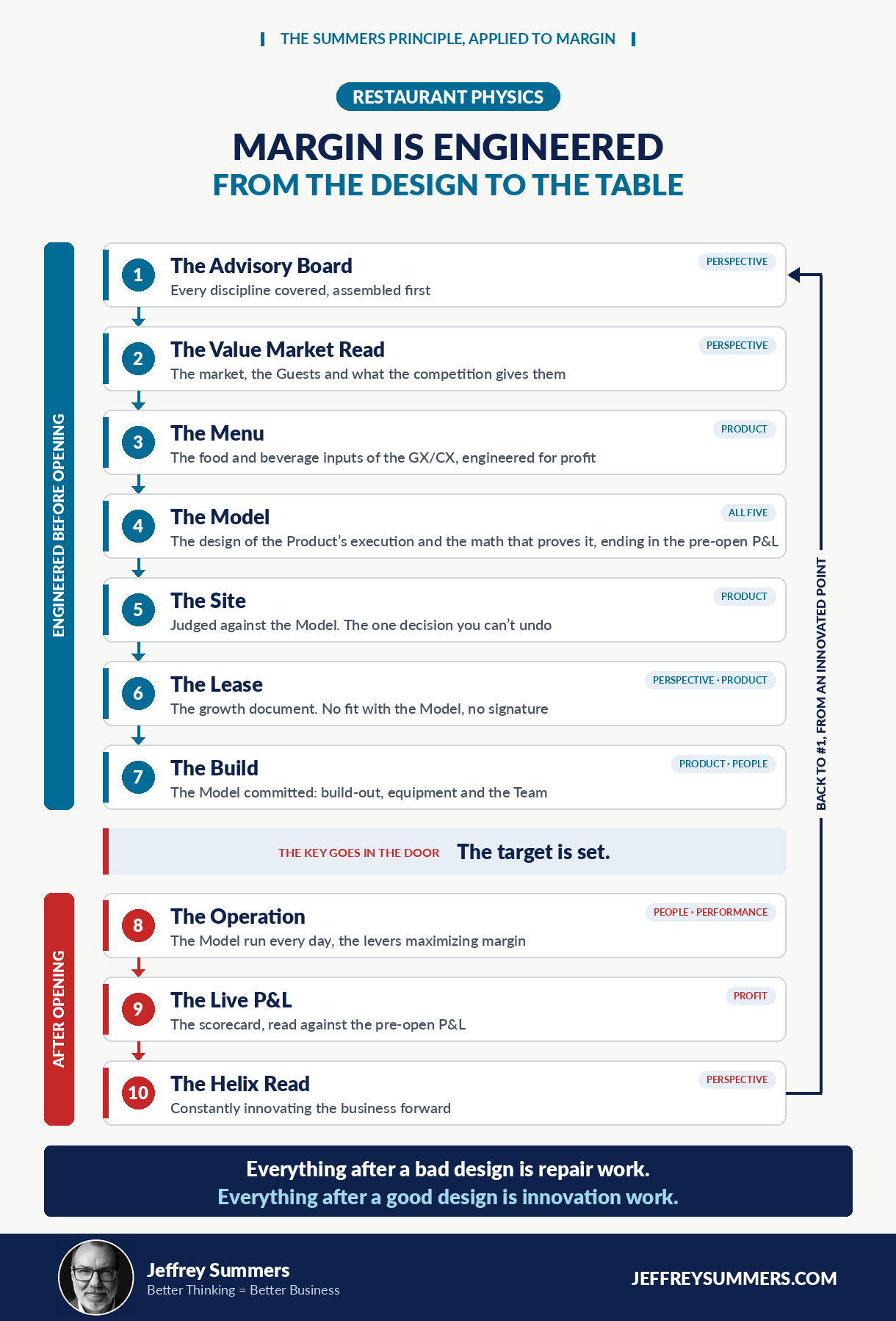
Step 1: The Advisory Board
Fundamental: Perspective
Before anything is decided, the operator assembles the read he can’t produce himself. Every discipline the open will touch gets a seat:
- the consultant
- the GM
- legal: entity, lease legality, employment, liquor and permit licensing
- accounting and tax, including payroll
- finance
- insurance
- brand and marketing
- technology
- construction, through an owner’s rep
- equipment, for production and FF&E
- a tenant-rep broker who works for you, not the landlord
- an architect, an MEP engineer, an interior designer and a general contractor
One consultant with successful openings behind him can cover most of that board. Legal and finance need their own professionals.
The board costs money, and that’s the usual objection. It can be paid for, traded for or bartered for. What it can’t be is skipped, because every decision after this one is only as good as the read behind it.
Step 2: The Value Market Read
Fundamental: Perspective
Next, the operator learns who he’s building for: who the Guests are, what they value, what they’ll pay relative to what they get, and what the competition already gives them. The read runs on socioeconomic and psychographic data, traffic patterns, existing and future commercial development, housing, and the competitive set.
Everything after this step is built for a specific Guest in a specific market. The menu, the building, the price and the cast all get judged against what this read found.
Step 3: The Menu
Fundamental: Product
The menu is the food and beverage input of the GX, engineered for profit. It’s the second most important profit document in the business, because it has to hold costs and engineer profit at the same time. It’s priced with [X Factor]: the full burden of the business as modeled, not just plate cost. That’s the price the business actually needs to charge, and the price the Guest the market read found has to be willing to pay.
The menu comes before the building because the menu decides the building. You can’t know what kind of kitchen, equipment, square footage, seat count or table mix you need until you know what you’re selling.
Step 4: The Model
Fundamental: all five
The Model is the design of the Product’s execution and the math that proves it.
The design covers every aspect the business needs to succeed:
- the GX
- the building
- the equipment
- the brand
- the cast
- the service
- the production, with food and supplies inside it
- every channel the business will sell through
The Model needs roles, not people. It defines what each position produces and what it costs before anyone is hired.
The math covers occupancy, per-person average, average check, cost of goods, labor, capital, break-even, and profit from Guest one. All of it lands in the pre-open P&L, with every cost included. The pre-open P&L is built forward from the design and real costs. When the numbers don’t clear the profit the business needs, the design changes or the operator walks. The assumptions never move to make it pass.
The Model also builds in [Uncertainty Capacity]: the operation’s capacity to absorb a wrong determination without structural damage. Every decision in an open is a bet placed before the market settles it, so the Model holds room to be wrong — cash reserve, bench depth, operator time — rather than assuming every bet lands.
Step 5: The Site
Fundamental: Product
The site is judged against the Model, never the other way around. Does the traffic carry the sales the Model needs? Is there delivery parking and pickup access for the channels the Model includes? Does the space hold enough tables, at the right mix of two-tops and four-tops, to hit the targeted sales and profit? A dining room built for parties of four that fills with couples runs at half capacity when every seat is taken.
The site is the one decision you can’t undo. The menu can be re-engineered. The schedule can be rebuilt. The building stays where it is.
Step 6: The Lease
Fundamental: Perspective and Product
The lease is the growth document. It decides what the business will be able to do for the length of the term. The lawyer makes sure it’s legal. The consultant makes sure it’s the growth plan. It’s negotiated by your broker or your consultant, and every tool the Model needs gets written in:
- the use clause
- exclusivity
- signage
- parking and pickup
- the patio
- utilities and exhaust
- the tenant-improvement allowance
- renewal
- assignment
If the lease doesn’t fit the Model, there’s no signature.
There is no version of this step without a plan. Signing a lease is a forecast whether the operator writes one down or not. Every lease assumes the business will produce enough to pay it. The only choice is whether that assumption was modeled.
Step 7: The Build
Fundamental: Product and People
The build is the Model committed: the build-out, the equipment and the Team. The building and equipment are built to the Model’s design, through the owner’s rep and the contractor the board brought in.
The Team is unit leadership: the GM, already on the board, plus the AGM, the Culinary Lead(s) and the front-of-house lead(s). The Team is assembled first, and the Team hires and trains the cast. They’re hired into the roles the Model already defined, before the doors open, so they can build the cast and the production into the design rather than around it.
Then the key goes in the door, and the target is set. The target is what the business needs to produce if the plan works as planned. It isn’t a ceiling. If the operation exceeds it, that’s the point. It’s the bar the design was built to clear.
Step 8: The Operation
Fundamental: People and Performance
The operation is the Model run every day, with the levers maximizing margin. Scheduling, purchasing, portioning, the daily cost checks — they’re how the operation reaches the margin the design made room for. They maximize margin potential. They can’t raise the ceiling the design set.
The menu keeps moving inside the operation. It’s re-engineered seasonally, and prices get adjusted on the fly as costs and the market move.
An outside event — a commodity spike, a wage change — is survivable because of the design. It hits one or two levers, and the Model tells the operator which ones and by how much. He recalibrates against a plan instead of guessing against nothing.
Step 9: The Live P&L
Fundamental: Profit
The live P&L is the scorecard. Profit holds no decisions. It keeps score on the decisions already made in Perspective, Product, People and Performance.
In an engineered restaurant, the live P&L is read against the pre-open P&L, line by line. The pre-open P&L said what each line should be if the plan worked as planned. Every gap between the two points back to the Fundamental that produced it. The scorecard decides nothing. It tells the operator where to read next.
Step 10: The Helix Read
Fundamental: Perspective
The Helix Read is the constant innovation of the business forward. It reads all five Fundamentals, against the market as it is now, not as it was at opening. It runs on no fixed timeline. The market the design was built for keeps moving, so the read never stops.
What the read finds sends the operator back to the first step, from an innovated point. The board, the market read, the menu, the Model — each one is run again against what the business has become. That’s the [Operating Helix]: the chain doesn’t end at the scorecard, it climbs.
Everything after a bad design is [Repair Work]. Everything after a good design is [Innovation Work].
What You Do Monday Morning
Pull your current P&L and the pre-open P&L or pro forma you opened on. Put them side by side, line by line. Every line where they don’t match is a decision, and each one points back to the Fundamental that made it. If you haven’t signed yet, build the pre-open P&L forward from real costs first, and don’t sign until it clears.
To understand what not to do, as it exists in the wild, go to Hacksterism: Margin Is Defaulted.
Digging Deeper
Positions on the record
- Margin Is Built, Not Found — https://physics.jeffreysummers.com/margin-is-built-not-found/
- Every Input That Moves Your Margin Has An Owner — https://physics.jeffreysummers.com/every-input-that-moves-your-margin-has-an-owner/
- QFO How Long After Opening Will A Restaurant Begin Turning A Profit — https://physics.jeffreysummers.com/qfo-how-long-after-opening-will-a-restaurant-begin-turning-a-profit-2/
- QFO What Is The First Step That I Should Take Before I Build My Own Restaurant — https://physics.jeffreysummers.com/qfo-what-is-the-first-step-that-i-should-take-before-i-build-my-own-restaurant-2/
- I Get Two Kinds Of Calls — https://physics.jeffreysummers.com/i-get-two-kinds-of-calls-2/
- The Restaurant Helix — https://physics.jeffreysummers.com/the-restaurant-helix-why-90-of-operators-quietly-fail-2/
- Your Current Business Design Will Eventually Fail — https://physics.jeffreysummers.com/your-current-business-design-will-eventually-fail-that-is-not-a-prediction-it-is-a-guarantee/
- Your Lease Is A Profit Decision — https://kb.jeffreysummers.com/docs/5-x-your-lease-is-a-profit-decision/
- Profitable By Design — https://kb.jeffreysummers.com/docs/5-x-profitable-by-design/
- The Site Decision — https://kb.jeffreysummers.com/docs/2070-the-site-decision/
- Build Your Team Before You Build Your Restaurant — https://kb.jeffreysummers.com/docs/5-x-build-your-team-before-you-build-your-restaurant/
- Margin Is Defaulted — https://hacksterism.jeffreysummers.com/margin-is-defaulted/
Discover more from Restaurant Physics
Subscribe to get the latest posts sent to your email.
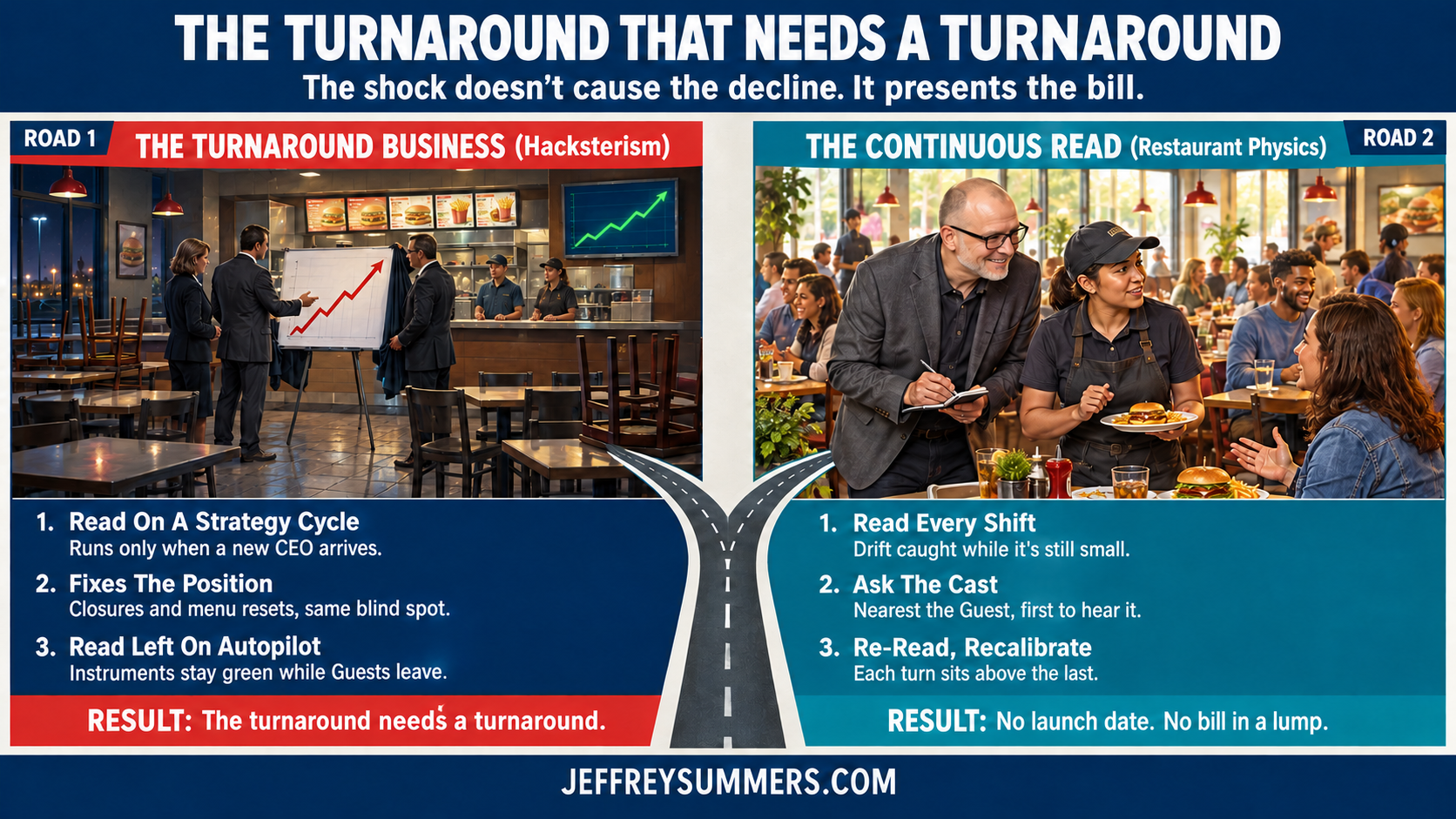

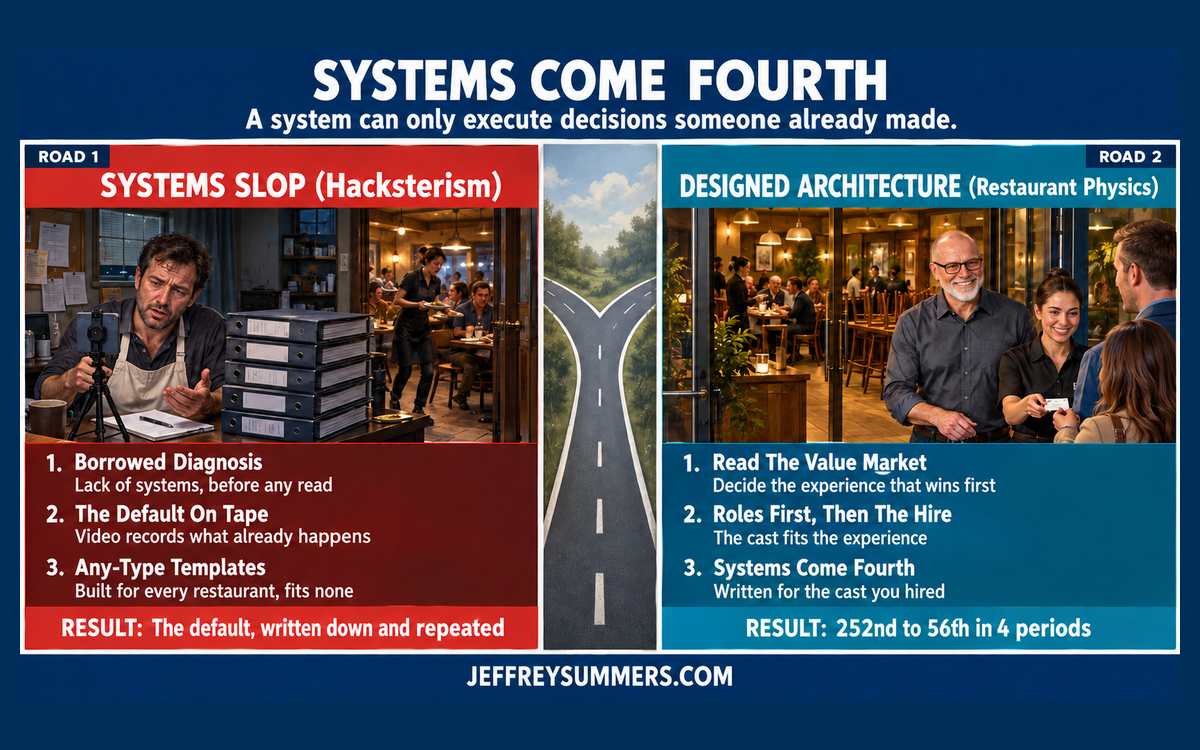

[…] To understand the ideal state, go to Restaurant Physics: Margin Is Engineered. […]
[…] Margin Is Engineered — https://physics.jeffreysummers.com/margin-is-engineered/ […]