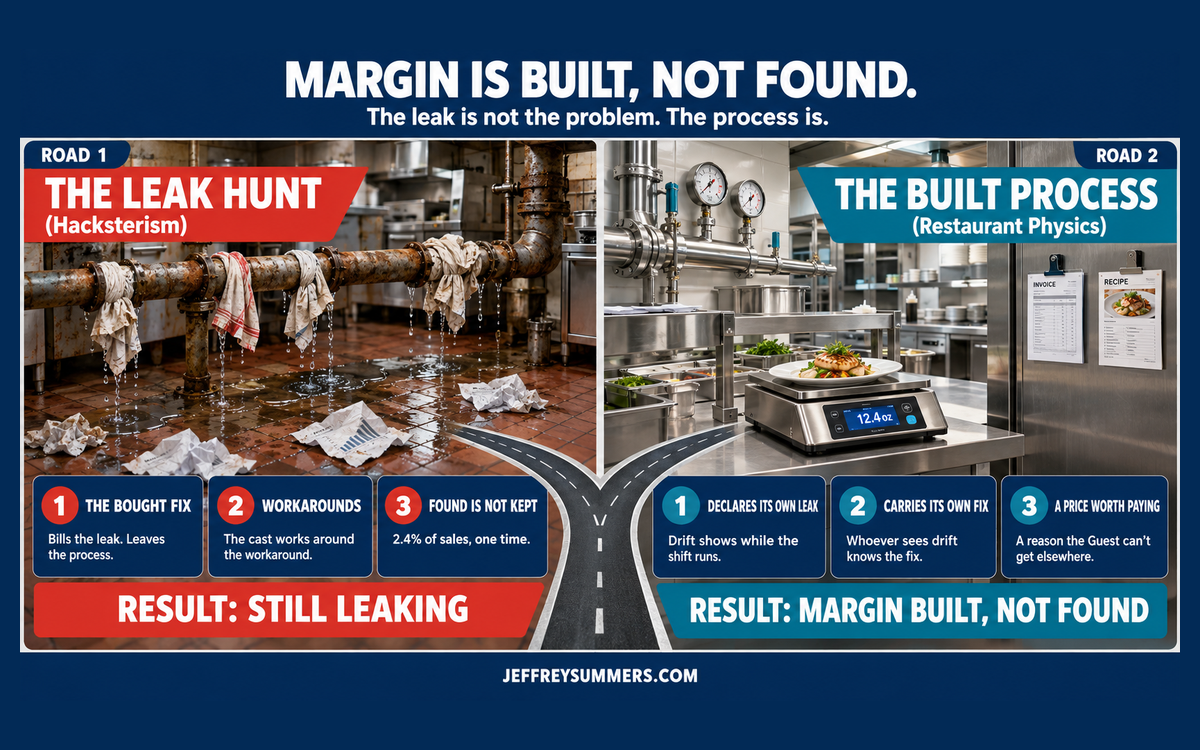
Margin is built, not found, because it comes from two things no leak hunt touches: processes that declare their own leaks where they happen and carry their own fix, and a price the Guest has a reason to pay that he cannot get anywhere else.
A leak is the gap between what a process is supposed to produce and what it actually produces, measured in money. Every restaurant has them, and in most restaurants they are discovered after the fact, at period close, by the numbers, an audit, or a vendor’s software. That is two design failures, not one: the process leaks, and the process cannot see its own leak. The operation built on Road 2 designs out both. Its processes report their own drift on the stage while the shift is running, and they are redesigned when they stop fitting the operation instead of patched. Its price is set from the Guest down, not from the walk-in up, and it is protected by the one gap a competitor cannot buy. What is at stake is whether the operator spends the next ten years paying someone to find his money or building an operation that never loses track of it.
The Test For Every Process
If a process cannot declare a leak on its own and does not carry a fix for it, it is a bad process.
That is the whole standard, and it is harder than anything a leak seller offers, because it runs without him. A good process does two things the leak seller is paid to do. It finds its own leak, where the leak happens, while the shift is still running. And it carries its own correction, so the person who sees the drift knows what to do about it before the money is gone. A process that needs someone from outside to find its leaks is telling you it cannot see itself.
Take one $18 plate, costed at $5.40, a 30 percent food cost on paper, and run the five most common leaks in the building through that standard.
Yield. The bad process costs protein at purchase price, so the card says $5.40 and the plate is really $6.60. The good process builds yield into the card. Protein is costed at usable weight, at about 75 percent after trim and cooking, and the card is right on the day it is written.
Portions. The bad process says six ounces and trusts that somebody checks. On a busy Saturday it goes out at eight and the plate becomes $8.20. The good process reads weight where the plate is built. The cook knows the portion is heavy while he is plating it, not three weeks later when the period closes wrong.
Supplier prices. The bad process checks the count on the case and never the price against the card, so the January card is wrong by July. The good process connects the invoice to the card at the back door. The receiver catches the price move the day it arrives, and the card moves with it.
Comps and discounts. The bad process lets the comp come off the check without a conversation, and the $18 plate becomes a $14.40 check that disappears into the variance. The good process gives every cast member holding a check the argument for the price. The operator who built the menu can defend the $18 in thirty seconds. The cast member at the table should be able to do the same.
Delivery. The bad process sells the dining-room price on a platform that takes 30 percent before food cost, so the operator receives $12.60 on a $6.60 plate. The good process prices each channel for what that channel costs, or decides the plate does not belong on that channel at all.
Not one of those takes a vendor. Every one of them takes a process that was designed to read itself.
Why It Sprang In The First Place
Once you find a leak, there are two questions, and the leak seller asks neither. He asks where the leak is and how much it is worth. The questions that matter go under it.
Why didn’t the existing process fix it? Because it was never built to read itself. It was designed once, or defaulted into, and left alone. A process with no read on its own output cannot catch its own drift, so every correction gets handed to a patch.
Why did it spring in the first place? Because it no longer fits the operation. Either it was a default that never fit, or it was designed for conditions that have since changed: the menu, the volume, the cast, the price. The leak is the process telling you it is out of date.
That is [No Static Achievement] applied to a single process. A process that stops being refined does not hold still. It decays. The recipe card priced correctly at launch can be underwater twelve months later with nobody noticing, which is why the review has to run every period and has to ask a different question than the card asks.
And it is why the answer is redesign, not repair. [Relational Innovation] refuses to treat the broken part as the unit of analysis. It asks whether the part belongs in the system at all, then redesigns through it so the failure cannot recur. That is the move that takes the leak out of the process instead of tying one more handkerchief around the pipe. [Repair Work] returns the operation to the state it was in before the leak. Redesign returns it to a state where that leak has nowhere to happen.
The Gap Is The Margin
Fix every process in the building and you still have not built the margin. You have stopped losing the margin you had. The margin itself comes from somewhere else.
My book says it this way: “The competitive value gap — the distance between what the operation delivers and what the Guest can get elsewhere — is not a brand metric. It is a financial metric. The wider the gap, the more latitude the operation has on price, the more resilient the Guest base is to competitive entry, and the more durable the [Relational Compounding] becomes.”
That is the difference between a leak and a gap. A leak is defensive. It is found once, it is fixed once, and at its best it ends exactly where it started. The gap is built continuously, because a competitor is always closing it. The operator who plugged every leak and never widened the gap has a restaurant that loses nothing and earns nothing it was not already earning.
The [Competitive Value Read] is how the operator knows which one he has. It is the ongoing confirmation that the differentiation the operation was built to produce is still wide enough to justify the price. The operation that never runs it ends in [Values Of Sameness]: values every competitor in the category could state without changing a word, and no gap to protect. That margin can look healthy right up until the next competitor opens at a lower price.
Price From The Other Direction
The leak hunt starts with cost and works toward price. The right sequence runs the other way.
Start with what this Guest will pay for this plate, in this restaurant. Then decide what the plate has to cost to fit that price and still carry its share of the rent, the power, and the cast. Then ask whether the cost can be engineered to fit. If it cannot, that is not a costing problem. It is a menu problem, and the plate does not belong on the menu.
Run it with round numbers. An independent carries $50,000 a month in rent, power, cast, and everything else, across 4,000 plates. Every plate owes $12.50 before food. With food at $5.40, break-even is $17.90. Add a 10 percent margin so the operation can grow and the plate has to sell for $19.89. No leak in any kitchen closes the distance between a plate priced at $14 and a plate that has to sell at $19.89. Only the gap does, because the only thing that holds $19.89 when a chain sells a comparable plate for $14 is something the chain cannot copy.
What The Built Operation Looks Like
Perspective. The operator stops using the word leak. He calls a leak what it is, a process that no longer fits or cannot see itself, and the word stops choosing the fix for him.
Product. The dish is protected, not trimmed. When the numbers miss, the first move is never a portion trim, a cheaper substitute, or a smaller plate, because the Guest reads every one of them and each one is a withdrawal on the relationship. The first move is the two questions.
People. The cast is handed processes that fit the shift, so nobody has to build a workaround to get through it. And every cast member holding a check has been given the argument for the price.
Performance. Every process reports its own drift on the stage, where it happens. The portion is read at the pass. The price is read at the back door. The comp is read at the table. Nothing waits for period close to be discovered.
Profit. The operator runs the [Competitive Value Read] every period and prices from the Guest down. The margin is protected by a gap he keeps widening, not by a spreadsheet of money somebody found.
The Diagnostic
Test One — The Declaration Test. List the five processes that touch your top seller: costing, portioning, receiving, the check at the table, and each channel it sells on. For each one, name who knows the process has drifted, and when. If the answer is somebody at period close, the process cannot see itself.
Test Two — The Fit Test. For each of those five, write the date it was last redesigned and what has changed since: the menu, the volume, the cast, the price. Every process older than the last change is a leak waiting to be found.
Test Three — The Workaround Test. Ask the cast working the shift how each of those processes actually runs. Every place where the answer differs from the card is a workaround, and every workaround is a process that does not fit.
Test Four — The Gap Test. Look at your price on that plate against your nearest competitor’s. Name what the Guest gets from you that he cannot get there. If the list is short or vague, the premium may be borrowed.
Pass all four and the operation is building margin. Fail the first two and it is waiting to be found. Fail the last one and there was never a margin to protect.
The Closer
The operation that builds margin never needs anyone to find its money, because its processes declare their own leaks where they happen and its price is held by a gap its competitors cannot buy. Every process in it is judged by one standard: if it cannot declare a leak on its own and does not carry a fix for it, it gets redesigned. And every price in it starts with the Guest. Margin is built, not found.
What You Do Monday Morning
Take your top seller and rebuild its card from scratch this week. Cost the protein at usable weight, not purchase weight. Price every ingredient from this week’s invoice, not the last time somebody updated it. Put a portion read at the pass for that plate on Friday and Saturday night. Then put the finished card next to the menu price and ask whether the plate earns its place. If it does not, you have a menu decision, not a leak.
To understand what not to do, as it exists in the wild, go to Hacksterism.
Digging Deeper
Positions on the record:
-
5 Money Leaks I Found Opening A Jar Of Peanut Butter — https://hacksterism.jeffreysummers.com/5-money-leaks-i-found-opening-a-jar-of-peanut-butter/
-
What I Have To Undo Before I Can Fix Anything — https://jeffreysummers.com/what-i-have-to-undo-before-i-can-fix-anything/
-
Every Input That Moves Your Margin Has An Owner — https://physics.jeffreysummers.com/every-input-that-moves-your-margin-has-an-owner/
-
The Pricing Architecture That Refuses The Discount Reflex — https://physics.jeffreysummers.com/the-pricing-architecture-that-refuses-the-discount-reflex/
-
Your Cast Is Not The Problem. Your System Is. — https://physics.jeffreysummers.com/your-cast-is-not-the-problem-your-system-is/
-
Every Read You Own Has A Date On It — https://physics.jeffreysummers.com/every-read-you-own-has-a-date-on-it/
Terms used in this piece: Two Roads, No Static Achievement, Relational Innovation, Repair Work, Relational Compounding, Competitive Value Read, Values Of Sameness. Definitions in the Knowledge Base (https://kb.jeffreysummers.com/).


1 comment