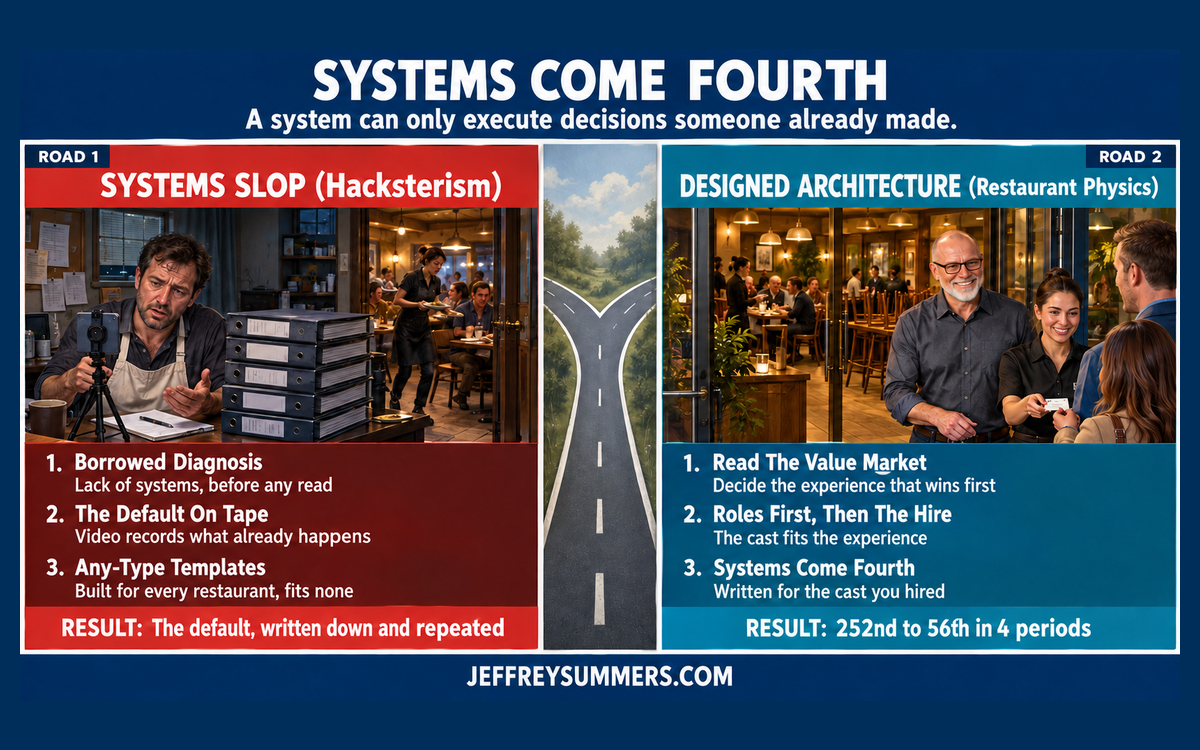

Systems come fourth in a restaurant, because a system executes decisions, and the three decisions it executes have to exist before there is anything to write down: the read of the value market, the experience and the concept that delivers it, and the roles and the cast who deliver it.
The Systems Club talks about systems first. The coaches and the template libraries tell the operator his biggest problem is that he doesn’t have systems, and they sell him procedures, pars, labor schedules and training manuals for an operation nobody designed. In my framework the order is causal. [The Five Fundamentals] runs Perspective, Product, People, Performance, Profit, and each one produces the next. Systems live in Performance, which is where [Systems Architecture] sits. Written in that order, a system executes what the operator decided, and the operation has [Designed Architecture]. Written first, it can only execute whatever the restaurant already does, or what somebody else’s restaurant decided. I proved the order on a TGI Fridays ranked 252nd of 252 units in its region in Guest satisfaction. Same corporate concept, same labor budget. I rebuilt the cast and calibrated the shift to how I wanted the concept executed, and in 4 periods the unit was 56th. The service research says the same order, and it found that installing operating systems without a clear concept made performance worse.
252nd To 56th On The Same Labor Budget
When I took over that Fridays, the unit was dead last in Guest satisfaction in a region of 252 units. In 4 periods it was 56th. Labor stayed at the same budgeted amount the whole time. Nothing about the concept changed. The menu, the format and the brand were corporate’s. What changed was how the concept was delivered, and the order I changed it in.
The experience came first. I decided the experience that unit would deliver, and I decided how the concept would operate at the volumes that unit actually ran, including the nights I didn’t have enough people. My rule was simple. If I lose Guests anywhere, it should only be the door. A Guest seated into a section the cast can’t cover can cost you the relationship, and the cast pays for that shift too. A Guest turned away at the door costs you one visit and leaves the relationship and the cast intact.
The roles came next, then the cast. I designed the roles for that experience, and then I replaced almost all of the FOH cast and about half of the BOH to fit them.
The procedures came last, written for the cast I hired. When I was short-staffed, I closed sections. Nothing changed except total access. The experience in the sections that stayed open was the one I had decided on. That is the shift calibrated to the volume rule. I counted anyone who walked in the door, not just the Guests who were seated, so the Guests I lost at the door were on my report instead of invisible. For the Guests who didn’t want to wait, I had cards printed. The front read “I’m not sorry but…” The back read: “I’m not sorry we were too busy for your visit. I guess that’s what being good is all about. But I do want you to return and experience for yourself, why we had to turn people away that we truly wanted to serve.” It carried my name and my number, and no discount. I wasn’t going to discount the experience, and an apology would have set the table for more negative thoughts about us. The hosts were coached to hand it out back side up first, so the Guest read the explanation before the front.
The card is the order on one piece of paper. The experience said we would rather turn a Guest away at the door than seat him into a section we couldn’t cover, and it said we would not discount it. The cast was hired to deliver that. The procedure, card side up or back side up, came last and was written for the hosts actually working that door.
Form Ever Follows Function
In 1896 the architect Louis Sullivan wrote that “form ever follows function, and this is the law.” He was writing about tall office buildings. The law holds in a restaurant. The procedures, pars and schedules are the form. The function is the experience the operation was built to deliver. The form can’t be drawn before the function is decided, because there is nothing for it to follow.
So the words have to be exact.
Design is deciding in causal order: the read of the value market, then the experience, the concept and its volume design, then the roles and the cast, then the systems that organize how they execute it.
Concept is the specific form that delivers the experience: the menu, the format, the service style, the space and the price point.
Systems are the procedures, standards, pars, prep lists, labor schedules and checklists that organize how the cast executes the experience. That is Performance.
A tool works the same in any kitchen, because it is math. Recipe and plate costing is a tool. A tool isn’t a system.
A best practice is a common practice in restaurants that has to be calibrated to the concept it is applied in. Applied as-is, it fails three ways. It delivers someone else’s experience. It breaks at volumes it was never built for. And when it doesn’t work, the cast gets blamed for not following it.
The Research Says The Same Order
In 1987 James Heskett of Harvard laid out what he called the strategic service vision. It identifies a target market segment, develops a service concept for that market, codifies an operating strategy to support the concept, and then designs a service delivery system to support that strategy. The market comes first, then the concept, and the delivery system comes last. Heskett’s operating strategy, which covers the organization and its policies, comes before the delivery system too.
In 2002 Goldstein and his co-authors put it in one line in the Journal of Operations Management: the service concept “defines the how and the what of service design.”
The strongest evidence on what happens without that order comes from a 2023 study of lean programs in service organizations by van Assen and Lameijer. Lean is exactly the kind of operating system the Systems Club sells. On its own, lean had no significant relationship to operational performance. Where the service concept was unclear or absent, lean made performance worse, with a significant negative effect (β −.42). It only helped where the concept was clear and widely known. The authors: “lean implementation in service environments without clear service concept diffusion does not seem to result in enhanced operational performance.” The limits matter. It is a survey of 153 respondents rating their own organizations, it isn’t restaurant-specific, and the performance measures are self-reported. It still points the same direction as the Fridays. Installing systems before the concept is not neutral.
One difference in vocabulary. When the research says delivery system, it means facilities, equipment and information systems. When I say systems, I mean the procedures, pars, prep lists, labor schedules and checklists. The order holds either way. Both come after the market and the concept.
Perspective: Read The Value Market
Perspective is the read of the value market: who this restaurant is for, what they value, and what experience will win with them. Everything after it is caused by it. An operator who skips the read doesn’t skip the decision. He gets someone else’s, usually the diagnosis the Systems Club hands him.
The read is not a labor percentage, a pain point or the binder he is told he is missing. Those are things the operator sees in his own building. The read is outside it, in the market, and it answers one question before any other: what experience will this market choose us for, and keep choosing us for?
Product: The Experience, The Concept And The Volume Design
Product is the experience, the concept that delivers it, and the volume design. The volume design is how the concept operates at differing volumes: at 40 covers and at 400, with six servers and with three. It is decided, not discovered on a Friday.
An operator can run a concept he didn’t write. Every franchisee does. At the Fridays the concept was corporate’s. The experience and the volume design were mine, and they were decided before anyone wrote a procedure. The door rule is a volume design. It says what happens to the experience when the volume exceeds what the cast can deliver. The answer was that the experience doesn’t change. Access does.
People: Design The Roles, Then Hire
If you are building an experience, people matter more than procedures, because only a certain type of person can give a Guest the experiential feeling that experience depends on. That is why People comes before Performance.
In People, the operator designs the experiential roles for the experience he decided on, then hires the best person to fill each one. The order inside People matters as much as the order of the Fundamentals. Roles first, then the hire. At the Fridays, the roles changed, so the cast changed. Procedures written before the hire assume interchangeable people. Procedures written after it can be written for the specific people who will execute them.
Performance: Systems, Tools And Shift Calibration
Performance is where systems live, and it is the first place in the order where the word belongs. The procedures, standards, pars, prep lists, labor schedules and checklists organize how the cast executes the experience the first three Fundamentals decided. Tools live here too. Recipe and plate costing works in any kitchen, because it is math. The pars, the prep list and the labor schedule only work in the kitchen they were built for, because they execute that kitchen’s decisions.
Performance also holds shift calibration. You don’t really design a shift. It gets calibrated, every shift, to how you want the concept executed at the volume in front of you. Closing sections when I was short was calibration. The volume rule was already decided. The shift was set to it that night.
Every system in [Systems Architecture] has to pass one question: what decision does it execute, and which Fundamental made it? A labor schedule executes a volume decision. A training manual executes a role. An opening checklist executes a standard set for the experience. If nobody can name the decision, the system is executing a decision nobody made.
The Score Of The Design
Profit holds no decisions. It is the scorecard for what Perspective, Product, People and Performance already decided, and whatever isn’t good enough there sends the operator back to re-read the Fundamental that produced it. At the Fridays the scorecard read the design: 252nd to 56th in Guest satisfaction in 4 periods, on the same labor budget, with the same corporate concept. What that unit was missing was never a binder. It was the decisions. The hard work isn’t building systems. It’s the read, the concept design and the cast. Systems are what make that work pay off every shift. The first rule of Systems Club is you don’t talk about systems first. When you finally do, you write them for the experience you decided, the volumes you designed for and the cast you hired, and then they work.
What You Do Monday Morning
Take next Friday’s labor schedule. Above it, write the volume rule for that shift in one sentence: when the volume is more than the cast can deliver, where do you lose Guests? Mine was the door. Then write the experience the schedule is supposed to protect, and the roles it is staffing. Now read the schedule against those three lines. If it was built from last Friday’s labor percentage or from a template, it can’t answer any of them. Make the three decisions first, rewrite the schedule to execute them, and count everyone who walks in the door that night, not just the Guests you seat.
To understand what not to do, as it exists in the wild, go to Hacksterism.
Digging Deeper
Positions on the record:
- A System! A System! My Kingdom For A System! — https://hacksterism.jeffreysummers.com/a-system-a-system-my-kingdom-for-a-system/
- Best Practices Usually Aren’t — https://physics.jeffreysummers.com/best-practices-usually-arent/
- The 411 On Who Runs Your Operation — https://physics.jeffreysummers.com/the-411-on-who-runs-your-operation/
- Forms, Templates & Other Nonsense — https://jeffreysummers.com/forms-templates-other-nonsense/
- The Five Fundamentals — https://kb.jeffreysummers.com/
- Systems Architecture — https://kb.jeffreysummers.com/
- Designed Architecture — https://kb.jeffreysummers.com/
Terms used in this piece: The Five Fundamentals, Systems Architecture, Designed Architecture. Definitions in the Knowledge Base.
Discover more from Restaurant Physics
Subscribe to get the latest posts sent to your email.


[…] To understand the ideal state, go to Restaurant Physics. […]