
Three questions to ask before you add a unit, a daypart, a system or a hire, and why the capability has to be yours.
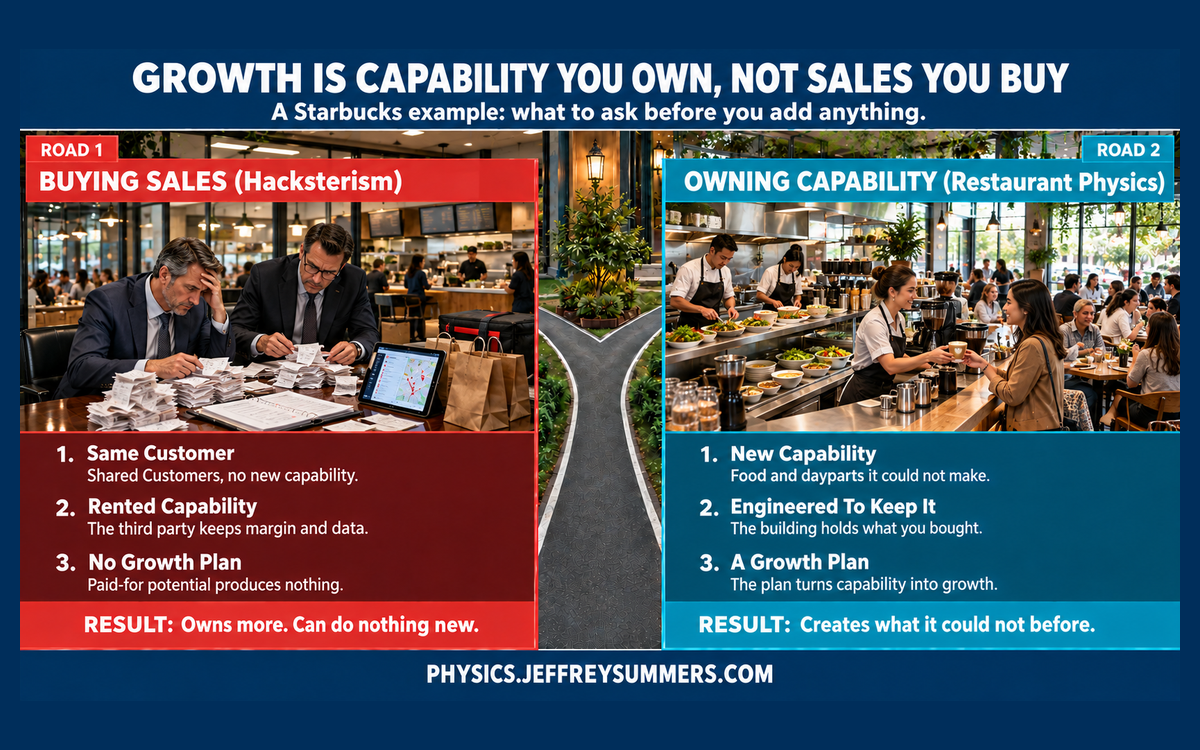
Starbucks shouldn’t buy Chipotle, because buying another company’s sales is accumulation, and an operation only grows when it owns a capability it didn’t have and has a growth plan to put it to work. On October 8 the Financial Times reported that Starbucks had worked with advisers to explore buying Chipotle. Starbucks answered that it is focused on its turnaround. Chipotle would hand Starbucks more stores, more sales and more of a Customer it already shares, at a price analysts put near $50 billion, and it would leave Starbucks able to make nothing it can’t make today. Panera is the opposite case: a kitchen, a menu and the lunch and dinner dayparts Starbucks has never been able to build inside its own stores. The deal is the specimen. The lesson is for every operator about to add a unit, a daypart, a concept, a system or a hire: are you buying sales or capability, was your operation engineered to keep it, and where is the growth plan. And whatever you obtain, own it. Capability rented through a third party stays the third party’s.Chipotle Is A Purchase Of Sales
Start with who the two companies share. Qaisar Hasan’s firm, Maiden Century, ran a cross-shopper analysis of US card transactions across 22 of the largest restaurant chains, using data from Facteus. To Starbucks, Chipotle is a top-three match: shared Customers run 18% above chance, beaten only by Panera and Dunkin’. To Chipotle, Starbucks ranks sixth. Hasan’s own read of what that means for the deal: “it’s a deepen-the-wallet deal, not a widen-the-funnel deal. Starbucks wouldn’t be buying many new customers.” That is the definition of buying sales. The Customer is already in both buildings. The deal moves the receipts from two companies onto one ledger and calls the total growth. The price says the same thing. Chipotle’s market value sat around $40.5 billion when the report broke, and analysts have suggested a premium could take a deal near $50 billion. William Blair has reportedly estimated about $300 million a year in corporate and technology savings. Brittain Ladd did the arithmetic in his own piece on the deal: 0.6% a year against the purchase price, before financing and integration. I have written on the record that accumulation is the increase of what the operation possesses, and growth is the increase of what the operation is capable of creating. Accumulation is additive. It needs a rising dose to hold the ground it already has, and when you stop feeding it, it gives the ground back. Fifty billion dollars of Chipotle is fifty billion dollars of possession. Starbucks would own more. It would not be able to do anything new.Panera Is A Purchase Of Capability
Now look at what Starbucks can’t do. Food was $1.86 billion of Starbucks’ $9.32 billion in revenue last quarter, about 20%. Its food attach hit a third-quarter record, with the strongest gains in the afternoon. The demand for food past the morning is there, and Starbucks can read it. What it can’t do is produce it, because a Starbucks store was engineered to make drinks and warm food. The building sets the ceiling. Starbucks has tried to buy its way past that ceiling once. It bought La Boulange in 2012 to fix its food, and closed all 23 La Boulange cafes in 2015. It bought a bakery and tried to run it through a coffeehouse. That is the [Engineering Question] answered wrong: the area was never engineered to operate that way, so every fix after that point was [Repair Work]. Panera is the capability La Boulange never was, because it comes with the building, the kitchen and the team that already produce it. Panera owns lunch and dinner. Starbucks owns the morning. Panera’s food pairs with coffee in a way a burrito bowl never will, and breakfast has always been a small part of Panera’s business, 10 to 15% of it in 2020. Each company has the daypart the other can’t build. Under [Daypart-Cohort Physics], every service window pulls its own cohort with its own ranking of what it wants. The morning cohort that ranks coffee first is not the dinner cohort that ranks the food first, and one operation that can serve both owns the whole day in one building. That changes what the Customer gets, which is the only test that matters. Chipotle gives the shared Customer the same two meals from the same two counters. Panera gives a Customer something neither company could give him alone.Capability Only Counts If You Can Keep It
Owning a capability on paper and keeping it inside the operation are two different things, and La Boulange is the proof. So the direction of the combination matters. Panera’s food does not go into Starbucks stores. A Starbucks counter goes into Panera. The Starbucks footprint is small and nearly portable. A Panera bakery-cafe already has the kitchen, the room and the seats, and only about a quarter of Panera’s business is eaten in the cafe, so the room has space to carry more. Starbucks has spent the last year paying to close buildings that couldn’t carry the coffeehouse it is rebuilding. A Panera room can carry more [Customer Experience] than many of the buildings it closed. Both companies run [Customer Architecture]. Both are Road 1, transactional by definition, and the combined company stays Road 1. The question is how much [Customer Experience] the combined operation can be designed to carry. It is easier to add that to a Road 1 business than to take the transaction out of a Road 2 one, but only up to what the building can hold. That is why the counter goes where the room is. Keeping the capability also means keeping the people who produce it. Panera’s team runs Panera. Starbucks owns the design and the standard. Panera’s franchisees already run to a franchisor’s standard, and Starbucks already runs thousands of licensed stores staffed by someone else’s people, so a franchisee’s cast can run a Starbucks counter to Starbucks’ standard. The combined company owns the counter, so the party that sets the standard carries the result. And both companies slim down at the same time. Panera’s CEO has said out loud that the company shrank portions, and that he regrets cost cuts he approved as CFO. Panera is now spending to undo them. Starbucks is mid-turnaround. Cut each to its core separately and you cut against two designs. Cut them together and the combined design decides what each one drops, and it shows you synergies neither company could see alone.Without A Growth Plan, Capability Is Potential
A rollout is not a growth plan. Company-owned cafes first, franchisees converting on results, the Starbucks name earning lunch and dinner one building at a time: that sequence says how the capability gets used. It doesn’t say what the combined operation will create, or how anyone will know it grew. I can’t write that plan for Starbucks, and neither can anyone outside it. Panera is private, and every Panera number in public is an estimate. That is the point. The math lives inside the operation, and the growth plan has to be built where the math is. I made the same argument in Where’s The Plan?: a forecast built off last year is a plan to hold last year, and a plan that hits its number and leaves the GM no more capable than he was when he built it has only done half its job. Capability bought without a growth plan behind it is potential you paid for, and it produces nothing until somebody builds the plan.Own The Capability, Don’t Rent The Business
The obvious shortcut for Panera is a license: put Starbucks coffee on its counters and skip the deal. Starbucks would say that works. It runs about 90% of its international stores through licenses and says there should be no real difference between a licensed store and one it owns. I argued against that split in The Irrationality of Asset-Light Thinking: whoever carries the result should hold the lever that changes it. A license gives Starbucks the standard and gives Panera the cost and the result. It also fixes only Panera’s problem. Starbucks still has no lunch and no dinner. The same holds for every capability an operator rents from a third party. Delivery, ordering, booking, loyalty, the data on who your Guest or Customer is: rent it, and the platform keeps the margin, the intelligence and the handoff. That is [3P Arbitrage], and it fails the second question by design, because you can’t keep what someone else owns. Ladd makes the same warning in his own piece about Starbucks’ supply chain: the company should keep ownership of its network design, its commercial policies, its inventory information and its Customer relationships. Even owning has a condition here. Under the 2018 Global Coffee Alliance, Nestlé holds perpetual rights to market Starbucks consumer and foodservice products outside Starbucks coffee shops. A Starbucks counter inside a Panera has to qualify as a Starbucks coffee shop, or Nestlé holds the rights. That is a question for Starbucks’ lawyers, and it is the kind of question you ask before you buy, not after.Coffee And Donuts Is The Same Mistake
Ladd’s own test is the right one. He argued for Starbucks buying 7-Eleven’s North American business, and in the comments he wrote, “I like acquisitions that close gaps and increase capabilities.” He called Dutch Bros, Black Rifle and 7 Brew meaningless, and he’s right: more coffee is more of what Starbucks already has. Then he floated Krispy Kreme and Shipley. Coffee and donuts sell into the same morning Starbucks already owns. That buys more of the daypart it is strongest in and closes no gap. The test only works if you run it on every candidate, including the ones that sound good together.The Three Questions
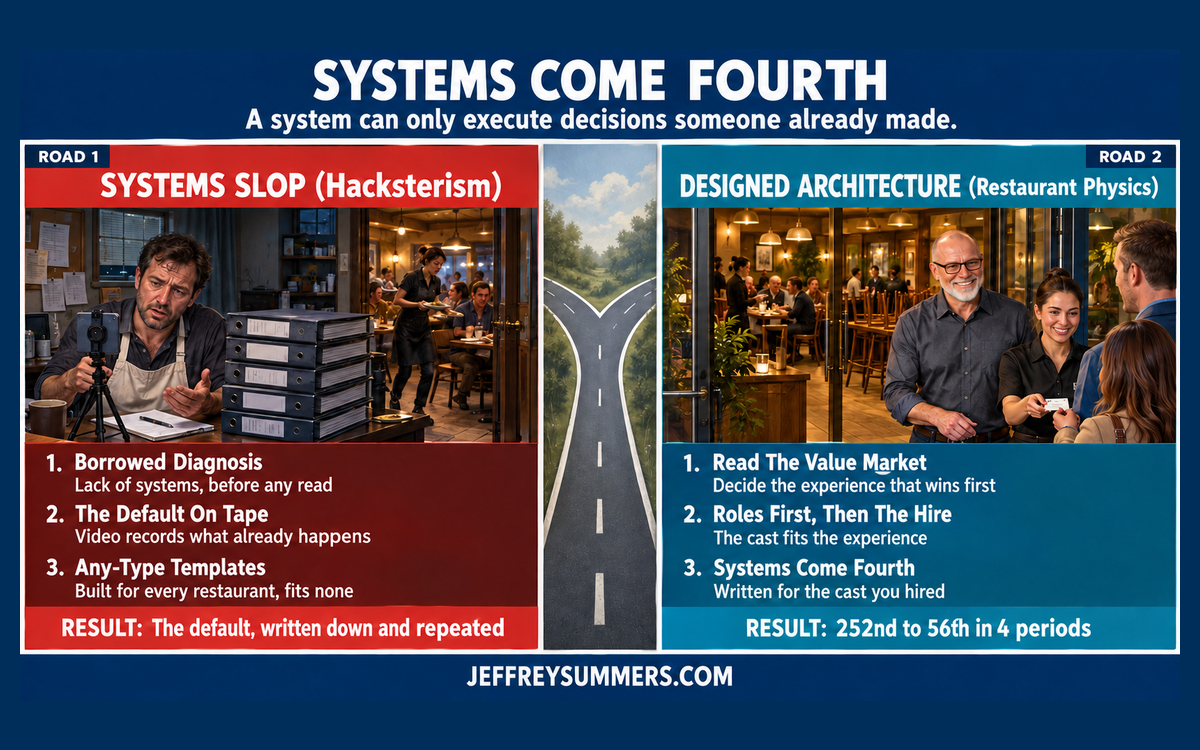
Every operator obtains capability. Almost none of them buy a chain. They open a second unit, add breakfast, buy a system, sign a platform, hire a kitchen manager, put in a new oven. The physics is the same at every size. Question one: am I buying sales or capability? A second unit that copies the first is sales. A daypart added because the numbers suggest an opportunity is sales. If the answer is sales, the operation will own more and be able to do nothing new. Question two: was my operation engineered to keep it? A capability the operation can’t hold is La Boulange. Breakfast in a building engineered for dinner is [Repair Work] before it opens. Tech that supports the experience is good. Tech that supplants it is bad, and tech amplifies whatever already exists. A system the operation was never built to run amplifies the gap. Question three: where is the growth plan? A capability with no plan behind it is potential you paid for. And under all three: own it. Capability rented through a third party is somebody else’s business running inside yours.The Closer
Starbucks doesn’t need more sales. It needs to be able to make something it can’t make today, inside a building that can hold it, with a plan to grow it. Chipotle is fifty billion dollars of possession. Panera is a capability Starbucks has tried and failed to build on its own. Every operator faces the same choice at his own scale, and it comes down to one line: own the capability, don’t rent the business.What You Do Monday Morning
Take the next thing you are about to add, whether it’s a unit, a daypart, a piece of tech, a platform or a hire, and write the answer to the three questions on one page before you sign anything. If question one says sales, stop. If question two says no, you are about to buy [Repair Work]. If question three is blank, you are about to pay for potential. If any of it runs through a third party, write down who owns the Customer, the data and the margin when it does.Digging Deeper
Positions on the record:- They Never Learned What Real Growth Is — https://www.linkedin.com/pulse/never-learned-what-real-growth-jeffrey-summers-cmdlc
- It’s The Restaurant That Gets The Obituary — https://jeffreysummers.com/its-the-restaurant-that-gets-the-obituary/
- Where’s The Plan? Part 1 — https://physics.jeffreysummers.com/wheres-the-plan-part-1/
- The Irrationality of Asset-Light Thinking — https://www.linkedin.com/pulse/irrationality-asset-light-thinking-jeffrey-summers-crlvc/
- The Chipotle Of X Is Framework Arbitrage — https://hacksterism.jeffreysummers.com/the-chipotle-of-x-is-framework-arbitrage/
- The Occasion Is The Unit — https://physics.jeffreysummers.com/the-occasion-is-the-unit/
Sources Cited In This Piece
- Reuters, 10.08.2026 — FT report that Starbucks explored a takeover of Chipotle — https://www.reuters.com/business/starbucks-explored-chipotle-takeover-ft-reports-2026-10-08/
- NBC News, 10.2026 — Starbucks response that it is focused on its turnaround — https://www.nbcnews.com/business/consumer/starbucks-responds-chipotle-merger-report-rcna602388
- Qaisar Hasan, Maiden Century, LinkedIn post, 10.2026 — cross-shopper analysis of 22 chains with Facteus data; Chipotle shared Customers 18% above chance for Starbucks, behind Panera and Dunkin’; Starbucks sixth for Chipotle; “deepen-the-wallet deal, not a widen-the-funnel deal” — pasted content, no URL, provided by Jeffrey; author profile https://www.linkedin.com/in/qaisar-hasan-2b434950/
- Brittain Ladd, LinkedIn article, 10.10.2026 — Chipotle market value about $40 billion, a possible deal near $50 billion, William Blair’s reported $300 million savings estimate, the 0.6% calculation, his warning to keep ownership of network design, commercial policies, inventory information and customer relationships, and the Nestlé Global Coffee Alliance point — https://www.linkedin.com/pulse/starbucks-should-buy-7-eleven-chipotle-brittain-ladd-v0onc/
- Brittain Ladd, comment on his article, 10.10.2026 — “I like acquisitions that close gaps and increase capabilities”; Dutch Bros, Black Rifle, 7 Brew as meaningless; Krispy Kreme and Shipley — pasted content, provided by Jeffrey
- Starbucks, fiscal third quarter 2026 results and earnings call, quarter ended 06.28.2026 — food revenue $1,863.3 million of $9,322.7 million total; food attach record with the strongest gains in the afternoon; about 90% of the international portfolio licensed; “no real difference” between licensed and company-owned stores — https://investor.starbucks.com/
- Financial data, 10.2026 — Chipotle market capitalization about $40.5 billion — finance data feed, Chipotle Mexican Grill (CMG) quote
- Los Angeles Times, 06.17.2015 — Starbucks closing all 23 La Boulange cafes; La Boulange acquired in 2012 — https://www.latimes.com/business/la-fi-starbucks-la-boulange-20150617-story.html
- Boston Globe, 02.27.2020 — breakfast 10 to 15% of Panera’s business — https://www.bostonglobe.com/2020/02/27/business/netflix-coffee-panera-offers-an-899-month-coffee-subscription/
- Business Insider, 2026 — about a quarter of Panera’s business eaten in the cafes; CEO regrets cost cuts approved as CFO — https://africa.businessinsider.com/careers/paneras-ceo-regrets-a-cost-cutting-move-he-approved-as-cfo/nnhy7zd
- Chicago Tribune, 03.31.2026 — Panera CEO Paul Carbone: “we shrunk portions” — https://www.chicagotribune.com/2026/03/31/panera-remake/
- Nestlé, 05.07.2018 — perpetual rights to market Starbucks consumer and foodservice products globally, outside Starbucks coffee shops — https://www.nestle.com/media/pressreleases/allpressreleases/nestle-press-release-may-2018
Discover more from Restaurant Physics
Subscribe to get the latest posts sent to your email.