
How a continuous read catches drift in every contract a restaurant runs, shift by shift, before a shock turns it into a turnaround.
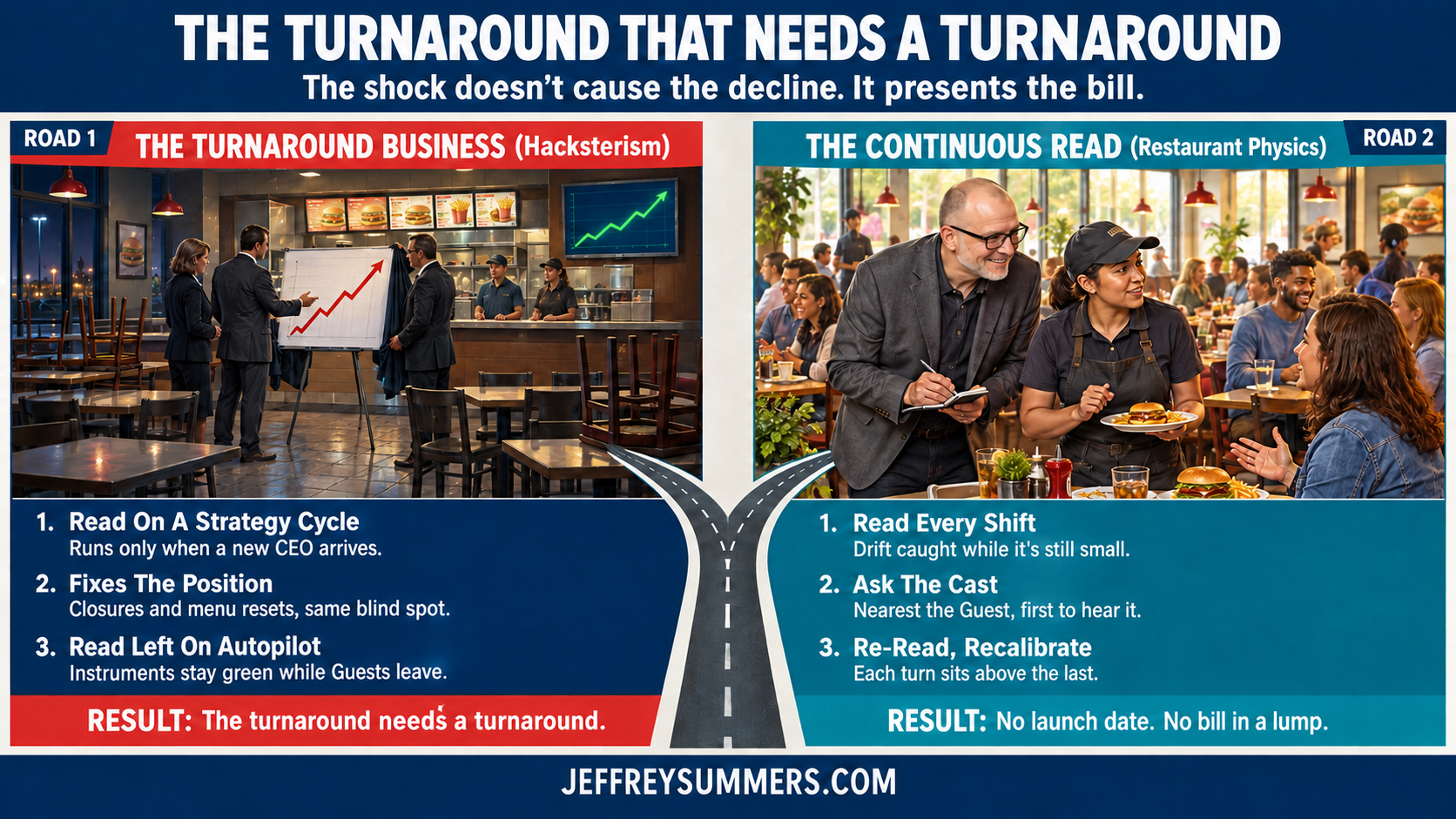
A continuous read never needs a launch date, because it reads every relationship the restaurant runs, every shift, and catches drift while it is still small enough to correct on the shift, so a shock arriving later finds no unread drift to send a bill for.
That is the architecture under every chain now in a turnaround, and under every independent who never needs one. Every restaurant runs on four contracts: with its Guests, its cast, its vendors and its market. All four drift, all the time, and no operator prevents it. What decides the outcome is whether someone reads the drift while it moves. A continuous read is not a program and it has no launch date. It is the operator, the lead and the cast nearest the Guest reading the stage every shift, re-reading after it, and recalibrating before the next one. It costs attention, paid shift by shift. What it saves is the lump. Wendy’s is on its second turnaround plan in a year, KFC brought back Colonel Sanders twice in a decade, and Del Taco’s new owner had to bring back the old burrito. Each of those is a bill for a read that stopped running. The operator who runs the read pays as he goes.
The Read Was Already In The Building
The strongest evidence for a continuous read comes from the two chains that show what it knows and what happens when it stops.
Start with Del Taco. Under Jack in the Box, the menu changed over two years, and Guests complained about the changes. When Yadav Enterprises bought the chain and launched Project Sunrise, the first move was to return the Classic Burrito line to its original preparation and its original names, and the reason given was those Guest complaints. Look at where the information came from. It was never missing. It came from the people eating the burrito, the whole time the menu was drifting. The read existed. Nobody running the chain was taking it in time.
That is the first thing to understand about a continuous read. You do not have to commission it. The Guest is reporting the state of the contract every shift, in what they order, what they leave on the plate, what they say to the server, and whether they come back. A continuous read is the discipline of collecting what the stage is already telling you.
Then KFC. In 2015, after what Business Insider called decades of stagnant sales, KFC put Colonel Sanders back at the center of its brand and posted thirteen consecutive quarters of growth. That is what a read does when it is run: the brand knew what its Guests came for, and the numbers followed. Later the chain posted seven consecutive quarters of negative same-store sales, and in 2025 it brought the Colonel back again. That is what happens when a read stops being run. Nothing about the first read was wrong. It expired, and nobody took the next one.
Those two specimens carry the whole architecture. The read is always available, and it only works while someone is taking it.
The Read Is A Discipline, Not An Event
The load-bearing distinction is between a read that happens and a read that runs.
A read that happens is an event. A new owner arrives, a new chief executive runs a 100-day plan, a consultant does an assessment, a bad quarter forces a look. The read is real, the conclusions are often right, and then the operation executes them for years against a market that keeps moving. In my framework, [Constant Expiry] is the reason that fails. What the operator knows about his Guests comes into existence when they decide, and it starts expiring the moment it exists, because the conditions it was read against never stop moving. A read taken once is accurate for a shift and stale within a period.
A read that runs is a discipline. It has a cadence, an owner and a place in the shift, the same as the line check or the pre-shift. It does not wait for a reason to happen.
That cadence is [Operating Helix]: read, design, execute, re-read, recalibrate, then read again from a higher position than the last turn left you in. The shape matters. A circle comes back to where it started. That is what a turnaround is, the brand restored to a position it held before. A helix comes back to the same position on a higher plane. Each turn sits above the last because the re-read feeds the next read, so the operation learns instead of resetting.
One parent company already uses this language. Restaurant Brands International credits Burger King’s second quarter, U.S. same-store sales up 8.5%, to the “compounding return on four years of continuous improvements.” That is the company describing itself, and Burger King is itself in a turnaround, so it proves nothing about what Burger King reads. But the word it reaches for is the right one. The return it credits does not come from a launch. It comes from compounding, and compounding only happens on a helix.
Read The Guest Before The Report
The Perspective read is who this restaurant is for, what they value and what experience wins with them. Run continuously, it has two rules.
The first is [Primary Read]: the live read of the operation comes before the report. Same-store sales, check average and food cost are reports. They are late by definition, because by the time they print, the shifts that produced them are over. They are still essential. They decide next period’s plan. But a report can stay green while Guests leave. Wendy’s second quarter shows how. Average check rose 5.6% while traffic fell 12.5%. Sales held up better than the Guest count did, and anyone reading only the sales line would have seen a smaller problem than the stage was showing. The primary read is the Guest. The report confirms what the read found or surfaces what it missed.
The second rule is that the market is inside the read. A competitor repositions on value, a cohort changes what it buys, a daypart thins, fuel goes up, January is cold. None of that arrives from outside the operation. It shows up first on the stage, in who comes in and what they order, and it shows up in small amounts before it shows up in large ones. The same quarter that sank some chains lifted others, under identical conditions. I laid out that sort in There Is No Signal In The Noise. There Is A Sort. A shock does not decide who falls. It reveals who was reading before it arrived.
Read The Contract Against The Plate
The Product read is the experience, the concept that delivers it, and how it runs at every volume. Run continuously, it reads one gap: the distance between the Guest contract and what is actually being served.
My framework calls that gap [Contract Drift]: the condition in which the terms actually running in a relationship have moved away from the terms that were agreed to. Almost none of the Guest contract is written down. It is the understanding the Guest carries about what this restaurant delivers, at what standard, for what price. The portion shrinks a little to hold food cost. The prep gets simplified to save labor. A favorite comes off the menu because it is slow. Each change is defensible on its own. Each one moves the running terms away from the agreed terms, and the Guest notices before the report does.
The continuous read catches the drift at the size of one plate. A cast member hears that the burrito isn’t what it was. The lead checks the build. The kitchen manager confirms the spec changed. The operator decides, that week, whether the change stays and gets explained or reverses. That is a correction made on the shift, at the cost of one conversation.
Then there is the decision about what kind of correction to make. [Repair Work] returns the operation to the state it was already in. Sometimes that is right, and Del Taco’s burrito may be exactly that case. But a continuous read gives the operator time to ask the better question. [Innovation Work] asks whether the thing being repaired belongs at all, and builds something new instead of restoring something old. An operator reading drift when it is small can afford to do innovation work. An operator reading it when it is large can only afford repair.
Give The Read An Owner
The People read is the roles the experience depends on and the people who fill them. A continuous read is a People design before it is anything else, because somebody has to take it every shift.
The cast nearest the Guest hears the drift first. The server hears the complaint. The host sees the regular who stopped coming. The line cook knows which plate comes back. A continuous read designs that knowledge into the roles. It doesn’t leave it to chance whether anyone asks. The pre-shift carries one question about what Guests said last shift. The post-shift carries the answer. The lead owns collecting it, and the operator owns deciding what it means.
Each of the four contracts gets a named owner and a cadence. The Guest contract is read every shift on the stage. The cast contract is read every week, in the conversation about what the job actually asks of them against what it was supposed to ask. The vendor contract is read on every delivery, against the spec. The market contract is read every period, against the Guest count, the daypart mix and what the restaurants nearby just changed.
Then the read gets built into the structure so it outlasts the people running it. A read that lives in one manager’s head leaves when that manager leaves. A read that lives in the pre-shift, the post-shift log and the period review survives turnover, because the next lead inherits the discipline along with the job.
Before any decision that changes a contract, the read runs forward. [Full Consequence Read] asks what the decision does to every actor it touches, in this period and in the periods after it, and what it forecloses for each of them. The actors are the six in my [Six-Actor Test]: the operator, the business, the Guest, the cast, the vendors and the community. A menu change read against all six before it ships is a menu change nobody has to reverse two years later.
Keep The Read Off Autopilot
The Performance read is the execution: the procedures, standards, tools and calibration that turn the design into a shift. This is where a continuous read either keeps running or quietly stops.
The danger is success. When the numbers are good, the read starts to feel unnecessary. The pre-shift question gets skipped because the covers are up. The post-shift log gets thin because nothing went wrong. The period review becomes a look at the report. That is how a read installed in a good year turns into autopilot. My published work names the operator this happens to: the one “who stops doing the primary read because the secondary instruments are green.” KFC’s thirteen quarters are what that looks like at scale.
[No Static Achievement] is why the read has to keep running in good years. Nothing accumulated in the operation can be held without continuing to earn it. Thirteen strong quarters, a loyal regular, a cast that knows the standard: each of those is an asset, and each starts being spent the moment nobody keeps earning it.
So the re-read is a scheduled duty, not a reaction. It runs on the same cadence in a strong period as in a weak one. It asks the same questions when the numbers are up. And it has a check built in. Every period, the operator compares what the read said against what the report showed. Where they agree, the read is calibrated. Where the report found something the read missed, the read has a blind spot, and fixing that blind spot is the recalibration step of the helix. That is how the next turn sits higher than the last.
Three Reads To Run This Period
The Drift Log Read. Look at your last four weeks of post-shift notes. Count the entries that record something a Guest said, did or stopped doing. If the count is zero, the read is not running, whatever the numbers say.
The Instrument Read. Put sales, Guest count and average check side by side for each of your last six periods. Anywhere sales rose while Guest count fell, write down what your stage read said in that period. If it said nothing, the report found something the read missed. That is your first recalibration.
The Owner Read. List your four contracts: Guest, cast, vendor and market. Next to each, write the name of the person who reads it and how often. A name and a cadence on all four means the read has an architecture. A blank means that contract is drifting with no one watching it.
The Read That Never Needs A Launch Date
The scorecard shows the continuous read in what never appears on it: no lump, no withdrawn guidance, no closures announced in a batch, no beloved item brought back after two years of complaints. Profit holds no decisions. It reads what Perspective, Product, People and Performance decided, and whatever isn’t good enough there sends the operator back to the Fundamental that produced it, which is the continuous read doing its last job. A turnaround pays for drift all at once, with interest, after a shock presents the bill. A continuous read pays for it in attention, shift by shift, while it is still small, and the bill never piles up into a lump. That is the read that never needs a launch date.
What You Do Monday Morning
Install the post-shift re-read on Monday night’s shift. Five minutes, run by the lead, before the cast leaves. Three questions, the same every shift: What did a Guest say about the food or the visit tonight? What came back, or didn’t get finished? Who didn’t we see that we usually see? The lead writes the answers in one log, dated, with no filtering. On Tuesday morning the operator reads it before he opens the report. At the end of the period, put the log next to the period’s numbers and mark where the log saw it first and where the numbers did. Then do it again the next night, and every night after, because the only thing that makes the read continuous is that it never stops.
To understand what not to do, as it exists in the wild, go to Hacksterism.
Digging Deeper
Positions on the record:
The Turnaround That Needs A Turnaround
There Is No Signal In The Noise. There Is A Sort.
An Open Letter To Wendy’s Part 2: Dear Meritage
Noodles Just Handed Every Independent Operator The Restaurant Turnaround Playbook They Refuse To Run
You Keep Buying The Same Process Under Different Names
Terms used in this piece: Operating Helix, Contract Drift, Constant Expiry, Full Consequence Read, Six-Actor Test, Primary Read, Repair Work, Innovation Work, No Static Achievement. Definitions in the Knowledge Base.
Sources Cited In This Piece
- Business Wire, March 4, 2026 — Del Taco launches Project Sunrise; Classic Burrito line returned to original preparation and original names — https://www.businesswire.com/news/home/20260304534712/en/Del-Taco-Launches-Project-Sunrise-a-Transformative-Roadmap-to-Reignite-Brand-Growth
- Orange County Business Journal, 2026 — Project Sunrise addresses Guest complaints about menu changes made under Jack in the Box over the past two years — https://www.ocbj.com/food/del-tacos-new-owner-introduces-improvement-plan/
- Business Insider, 2016 — KFC’s Colonel Sanders strategy after decades of stagnant sales — https://www.businessinsider.com/kfcs-colonel-sanders-boosts-sales-2016-10
- Modern Restaurant Management — Re-Colonelization, thirteen consecutive quarters of growth — https://modernrestaurantmanagement.com/the-recolonelization-of-kfc/
- Entrepreneur, June 10, 2026 — seven consecutive negative quarters; Kentucky Fried Comeback put Colonel Sanders back at the center of marketing — https://www.entrepreneur.com/buying-a-franchise/kfc-went-from-seven-straight-losing-quarters-to-three-straight-winning-ones
- Restaurant Dive, March 26, 2026 — Wendy’s Project Fresh among ten chains in turnarounds; Burger King Reclaim the Flame — https://www.restaurantdive.com/news/major-restaurant-turnarounds-chipotle-outback-papa-johns/815249/
- Restaurant Dive, August 7, 2026 — Wendy’s CEO Robert Wright developing a turnaround strategy — https://www.restaurantdive.com/news/wendys-ceo-robert-wright-lays-foundation-turnaround-plan/827323/
- Yahoo Finance, Wendy’s Q2 2026 earnings call highlights — check +5.6%, traffic −12.5% — https://finance.yahoo.com/markets/stocks/articles/wendys-q2-earnings-call-highlights-200416138.html
- Nation’s Restaurant News, August 6, 2026 — Burger King U.S. same-store sales +8.5% in Q2 — https://www.nrn.com/restaurant-finance/burger-king-s-sales-took-off-last-quarter-but-popeyes-is-in-a-slump
- Morningstar / Dow Jones, August 6, 2026 — Restaurant Brands: “compounding return on four years of continuous improvements” — https://www.morningstar.com/news/dow-jones/2026080611071/burger-kings-turnaround-gains-steam-driving-restaurant-brands-quarterly-profit-higher-update
- PMQ Pizza Magazine, 2025 — new CEO 100-day plan (Penegor at Papa Johns), the read run on arrival — https://www.pmq.com/papa-johns-seeking-balance-on-the-comeback-trail/
Discover more from Restaurant Physics
Subscribe to get the latest posts sent to your email.