
Buffett’s 3% rule, applied to the menu, the cast, the marketing and the operator’s own time
A bet too small to move your restaurant stays too small even when you’re right. That’s why the operator who spreads his time, capital and attention evenly across everything hasn’t built balance. He has defaulted into a business that nothing can help.
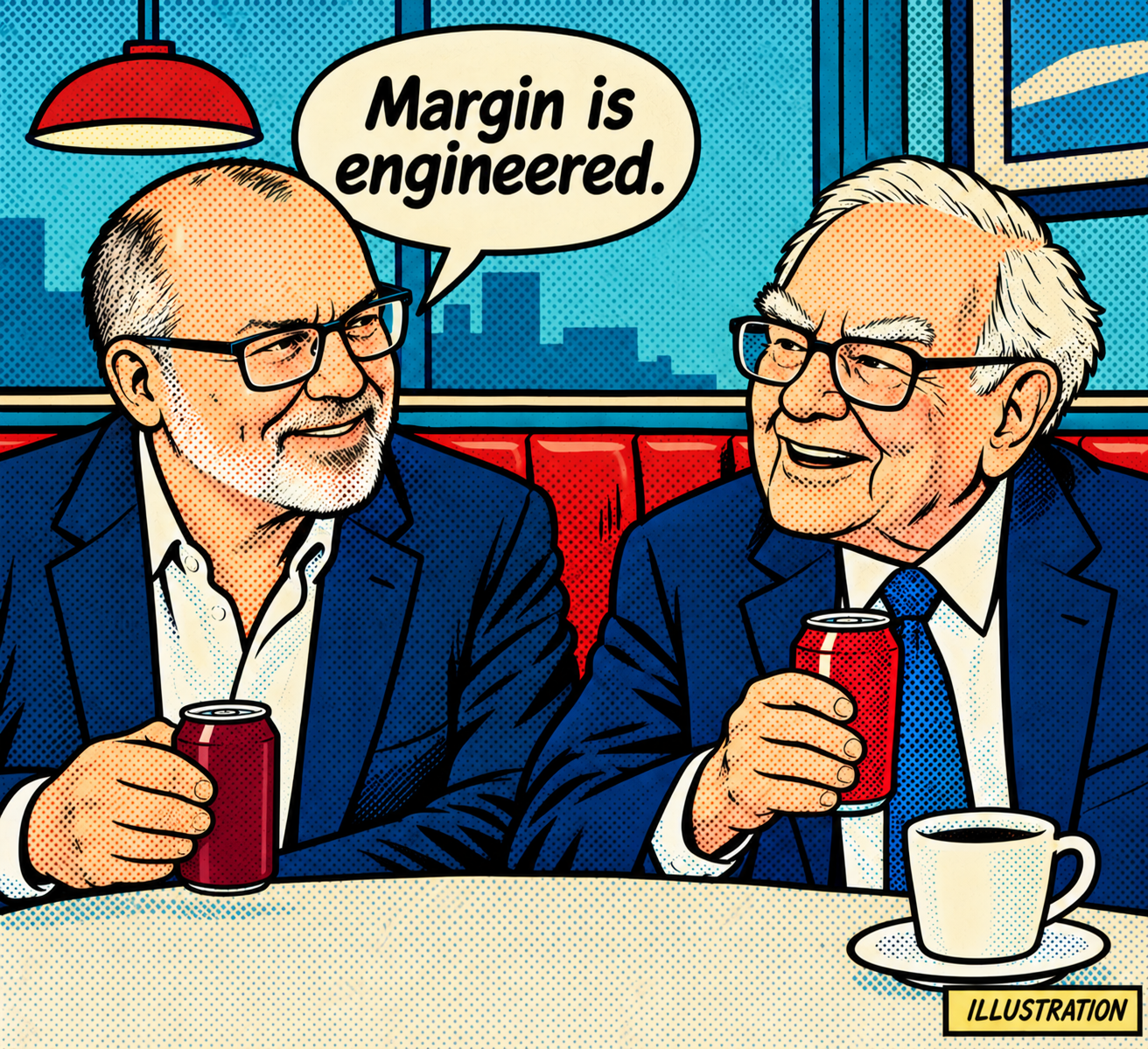
In May 1969, Warren Buffett told his partners that their $100 million of assets ruled out most of what was left to buy, “since commitments of less than about $3 million cannot have a real impact on our overall performance.” At 3% of the fund, a position below that line couldn’t move his results however right he was about it. Twelve years later, writing to Berkshire Hathaway shareholders, he put the rule in one line: “we try to avoid small commitments – ‘If something’s not worth doing at all, it’s not worth doing well.’” Every operator runs the same kind of portfolio: time, capital and attention spread across menu items, marketing channels, vendors and the development of the cast. When everything gets an even share, nothing gets enough to compound. In my framework, every outcome is either designed or defaulted. An even spread isn’t a design. It’s the default of an operator who never decided what the business is betting on.
What Buffett Actually Said
Buffett wasn’t writing a lesson on diversification. He wrote the line in the letter where he told his partners he was winding the partnership down. He’d concluded that the fund had grown too large for the opportunities left, and that small positions couldn’t do the job. Rather than make bets too small to matter, he stopped making them.
That’s the discipline in it. The 3% line isn’t a sizing formula. It’s a refusal. Below a certain size a commitment costs time, attention and capital without being able to change the result, so you don’t make it. The 1981 line says the same thing from the other side: if something isn’t worth doing at all, doing it well doesn’t redeem it.
Perspective: The Threshold Comes First
You can’t size a bet until you know what the business is for. That’s the Perspective work: who the Guest is, what the restaurant is built to give him, and what it refuses to be. Without it there’s no threshold, because there’s nothing to measure a commitment against. Every menu item, channel and project looks equally reasonable, so each one gets a little.
The operator with a settled Perspective has the question Buffett asked before every commitment: do I believe in this enough to make it a real bet? Anything that serves what the business is for gets a real share. Anything that doesn’t gets cut, however long it’s been there.
Product: The Menu Item Held By Inertia
The menu is where the default shows first. The item that sells 2% of the mix never moves the business, however clean its food cost is. It still takes prep time, inventory, a line on the order guide and a share of the kitchen’s attention every shift. Most menus carry several of them, held by inertia because nobody decided to cut them.
The menu is engineered, not accumulated. The operator who engineers it knows which items are the reason Guests come in, and builds the menu, the kitchen and the prep around executing those items every shift. Everything else has to earn its place against them. An item that can’t earn it isn’t a hedge. It’s a small commitment.
People: Development Is A Real Bet Or It Isn’t One
A cast member who gets one performance conversation a year and a generic development path isn’t being developed. He’s being managed. Spreading development thinly across everyone feels fair, but it develops no one, and the cast member who was ready for more six months ago leaves for an operation that gave it to him.
Development has to be a real bet, scheduled and protected. Every cast member gets a path. The depth goes where readiness is: the cast member who is ready for the next rung gets the investment before he starts looking for it somewhere else. That’s not favoritism. The rungs are earned through demonstrated discipline, and the development is sized to match.
Performance: The Channel You Post To Because You Should
The marketing channel that gets 5% of your attention will never build the momentum to compound. Neither will the vendor kept out of habit rather than performance, or the project that gets an hour whenever there’s an hour. Each one looks cheap on its own. Together they’re the restaurant version of owning thirty stocks at 1% each: diversified enough that nothing can hurt you, and nothing can help you either.
The question is the same in every category. Is this a real bet? If it is, concentrate on it: real time, real budget, real follow-through. If it isn’t, cut it, and put what it was consuming where it compounds.
Where The Rule Stops
The rule applies to commitments, never to Guests. Every Guest is family from the moment he accepts the invitation. That status doesn’t get re-sorted by how often he comes or what he spends. The operator who ranks Guests by frequency and spend and pours his energy into the top of the list has stopped running a relationship and started running a ledger. That’s the transactional road, however warm the language around it.
What gets concentrated is the design of the relationship: the decisions about what every Guest is given, built into the menu, the cast and the production. You bet on the experience. You don’t bet on people.
The Closer
Profit is the scorecard for how the bets were sized. The operator who spread everything evenly reads a P&L where nothing moved, because nothing was big enough to move it. The operator who concentrated reads one where his convictions show up in the numbers, and where every gap points back to a bet that was too small or shouldn’t have been made. Buffett didn’t build Berkshire by holding a little bit of everything. The operator running thirty commitments at 1% each isn’t balanced. He’s just busy. Small bets stay small, so make the ones worth making big.
What You Do Monday Morning
Pick one category: the menu, cast development, marketing or vendors. List everything in it. Ask Buffett’s question about each one: do I believe in this enough to make it a real bet? Cut the ones where the answer is no, and move what they were consuming to the ones where it’s yes.
Digging Deeper
Positions on the record
- The Summers Principle — https://kb.jeffreysummers.com/docs/0015-the-summers-principle/
- Every Guest Is Family — https://kb.jeffreysummers.com/docs/2670-every-guest-is-family/
- The Cast Development That Never Happened — https://kb.jeffreysummers.com/docs/3565-the-cast-development-that-never-happened/
- The Menu Audit — https://kb.jeffreysummers.com/docs/5-x-the-menu-audit/
- QFO Big Menu Or Small Menu — https://physics.jeffreysummers.com/qfo-big-menu-or-small-menu-2/
- Margin Is Engineered — https://physics.jeffreysummers.com/margin-is-engineered/
- Profitable By Design — https://kb.jeffreysummers.com/docs/5-x-profitable-by-design/
Terms used in this piece: Summers Principle, Temporal Discounting. Definitions in the Knowledge Base.
Discover more from Restaurant Physics
Subscribe to get the latest posts sent to your email.