
Your own ordering door keeps the Guest only when it’s the better way to order from you, because the Guest doesn’t prefer DoorDash, Uber Eats or the Olo App, he prefers the vehicle, and the operator who builds the better vehicle keeps him.
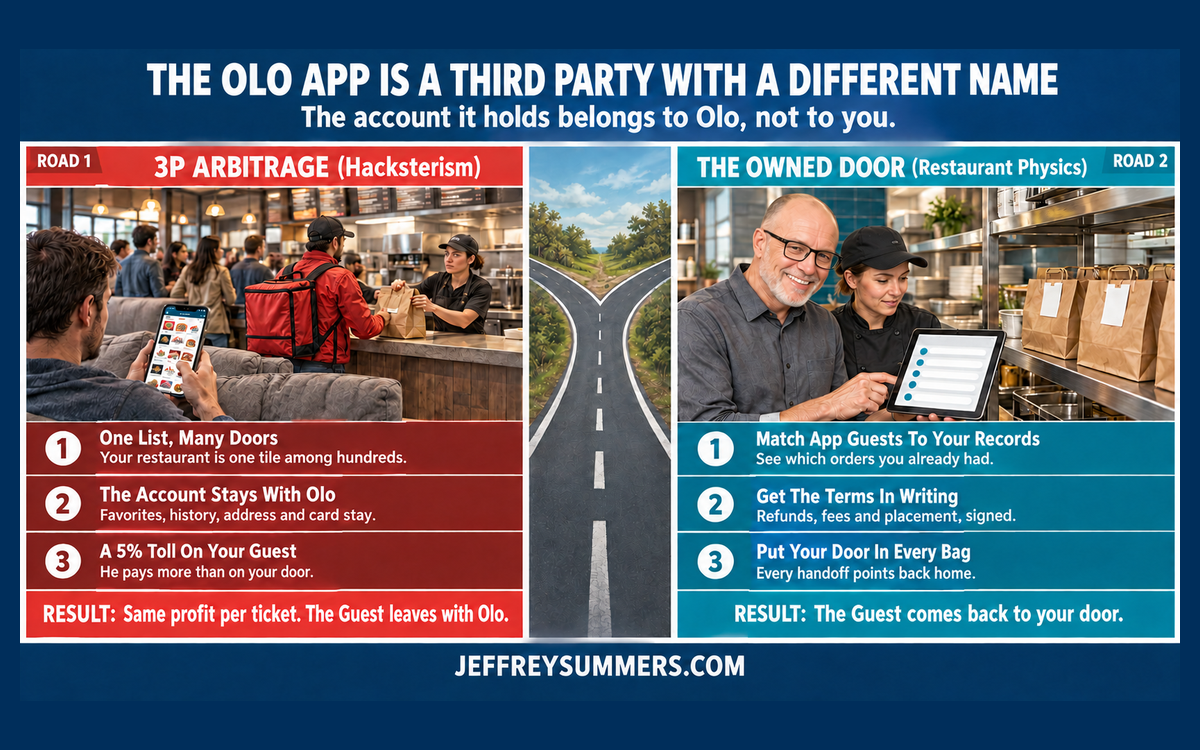
In October 2026, Olo, the company many operators pay to build their own ordering, opened the Olo App, a third door to the same list as DoorDash and Uber Eats. The three differ in one place, who pays the rent. The restaurant pays DoorDash and Uber Eats 15 to 30% in commission. The Olo App charges the restaurant nothing and the Guest 5%. All three hold the Guest’s account, and the account places the next order. The fourth door is the operator’s own, his website and his app. That’s [Gap Arbitrage]: the operator who scans for the vehicle his Guest needs and builds it keeps the vehicle, and the operator who doesn’t hands it to a third party by default. The gap isn’t the ordering software. Most operators already have it. The gap is the reason the Guest comes back to it. It runs on every operator with direct ordering. It costs him the next order every time a list gives the Guest a better reason than his door does. What’s at stake is the Guest he already has.
Olo’s Own Survey Says The Second Order Is Won In The Building
Olo and Restaurant Dive’s Studio surveyed 150 restaurant leaders and published the results in October 2026. Nearly two-thirds of brands keep fewer than one in five first-time Guests past 90 days. Nearly nine in ten keep fewer than 30%. Half of brands don’t know who their third-party Guests are.
Then the survey names what the brands that keep them do differently. They are 44 percentage points more likely to have optimized kitchen capacity and load balancing, 48 points more likely to have improved digital ordering and checkout, and 48 points more likely to offer better handoff and pickup. The report says it in one line: “a first-time guest needs more than a reason to return … they also need an experience that makes returning worthwhile.”
Two of those three are inside the restaurant. The third is the operator’s own checkout. None of them is on a list. The company that just opened a list published the proof that the second order is won by the operation the Guest returns to, not by the shelf he found it on.
Read Every Order By The Guest Who Placed It
The Olo App serves two different Guests, and the operator has to read them apart, because the app won’t.
The first Guest would have ordered on DoorDash or Uber Eats. Glass built the app for him: “We built this for the big middle: guests who love variety.” For this Guest, the Olo App saves the restaurant the commission and the marked-up menu. There’s one exception. The DashPass or Uber One member already paid $9.99 a month for his delivery, so he stays where his membership is. The operators at BWG Global’s October 21 delivery forum said that membership “limits the addressable switching pool.”
The second Guest already orders on the operator’s own door. For him, the app saves the restaurant nothing. Glass said so when I put it to him: “If they DO order through the Olo App, the restaurant gets the same guest data and same profit as a direct order.” Same profit as the door the operator already built, paid by a Guest who now pays 5% more and opens Olo’s app to do it.
The reports won’t separate them. Glass told Restaurant Dive an app order “looks exactly to the restaurant as if it came through that first-party ordering platform.” So the operator reads by Guest, not by channel. Every app Guest he can match to his own door’s records from before the launch is the second Guest. Every one he can’t is the first. That read decides whether the app is adding Guests or moving the ones he has.
Build The Door Around How The Guest Lives
The Guest isn’t choosing between restaurants when he opens a list. He’s choosing between vehicles. That’s the [Value Market]: what he’s choosing between, and what he’ll judge worth it. The list gives him one account, his favorite brands, his order history, his address and his card in one place. That’s the vehicle he prefers, and it’s why [Customer Architecture] works. The list produces Customers for whoever owns the list.
The operator can’t win that on variety, and he shouldn’t try. Three companies already fill that category. A category already full of competitors isn’t a gap. It’s a crowded market. His gap is the vehicle only he can build, the reason his Guest orders from him again. Build it around how the Guest lives his life, not around what’s easiest for the kitchen or cleanest on the spreadsheet.
Price the door at the room. The marketplaces’ commission is why restaurants mark up their menus there. Glass said it himself: “restaurants have offset that by charging a higher price on the marketplaces.” If the operator’s own door is priced above his room, he’s handed every list its argument. At the room price, the only price difference the Guest ever sees is the toll the other doors add.
Make pickup the direct offer. Pickup carries no delivery charge on any door. On the operator’s door, it carries no 5% either. Restaurant Dive put it plainly: Guests who balk at the network fee “are free to order through the restaurant’s owned channels.” A Guest who picks up from the operator’s door pays the room price and nothing else. That’s the cheapest way to get his food anywhere, and the Guest should know it before he orders, not after.
Make the bag say whose food it is. On a list, the restaurant is a tile. In the bag, it’s the restaurant. The bag is the one thing every off-premise Guest holds, no matter which door he came through. The operator’s door goes on it.
Recognize the Guest who came back. The survey measured five loyalty and win-back actions, among them second-visit offers, offers based on a Guest’s first order, follow-up after a first order and loyalty invitations. Brands that run three or more are nearly three times as likely to keep at least one in five first-time Guests. Each of those only works on a Guest the operator can identify. On his own door, he can.
Design The Handoff With The Person Who Runs It
Off-premise GX/CX is delivered at the handoff. The Guest never sees the kitchen. He sees the counter, the shelf, the bag and the person who hands it to him. The person who knows that standard closest is the one standing there at seven on a Friday. Design the handoff with her, not for her.
Every door shares that counter. App delivery orders go through Olo Dispatch, and Restaurant Dive reports the drivers are often DoorDash and Uber Eats couriers. So the pickup Guest, the courier and the Guest standing in line all meet at the same counter in the same rush. When the order is late or wrong, the Guest blames the restaurant. That’s why the survey’s leaders win on kitchen capacity and load balancing. The kitchen manager sets the pace of what the kitchen takes on, the person at the handoff sets where the bags wait and who gets greeted by name, and neither one is handed that job by a list.
Ask her three things: where the orders stack up, what the Guest asks most at the counter, and what happens when an order goes out wrong. The answers are the design.
Measure The Second Order, Not The First
The first order tells the operator someone found him. The second tells him the door worked. Olo’s own baseline question is the right one: “What share of first-time guests order again within 90, 180, and 360 days?” Run it on the operator’s own door, by Guest, every period.
Split the read three ways: first-time Guests on his door, returning Guests on his door, and app and marketplace Guests matched against his door’s records. The first number is the one the door is built to move. Two-thirds of brands are under one in five. The second tells him whether the Guests he has are staying on his door. The third tells him how many of them a list is now carrying.
The Diagnostic
The Price Test. Is every item on your own door priced at what it costs in your room? Yes or no.
The Pickup Test. Is pickup on your door the cheapest way to get your food anywhere, and does the Guest know it before he orders? Yes or no.
The Handoff Test. Did the person who runs your handoff during the rush help design it? Yes or no.
The Return Test. Do you know what share of last period’s first-time Guests on your door have ordered again? Yes or no.
The Contract Test. Do you have these four answers from Olo in writing: who pays the remake or refund on a bad app order, whether the 5% Guest fee and the zero commission are in your contract, whether placement on the list will ever be sold, and what network-level data from your Guests is shared and with whom? Yes or no.
Five yes answers, and the door is built. A no on Price, Pickup or Handoff means a list is the better vehicle for some of your Guests. A no on Return means you can’t tell whether the door is working. A no on Contract means you’re on a list whose terms you haven’t read.
Only The Fourth Door Changes The Economics
Against DoorDash and Uber Eats, the Olo App saves the restaurant the 15 to 30% commission, less the courier it now pays through Dispatch and any per-order fee on top, net of the delivery charge it passes to the Guest. Against the operator’s own door, it ties the ticket, charges the Guest 5% more, and keeps the account that places the next order. Neither level changes the economics. A cheaper toll is still a toll. The fourth door does. No commission, no toll, and the next order stays with the restaurant that earned it. The Guest picks the vehicle. The operator who builds the better one keeps him.
What You Do Monday Morning
Pull every Guest who placed a first order on your own door three periods ago, and count how many have ordered again. Then take that number to the person who runs your handoff during the rush and walk the last ten feet with her: where the bag waits, who hands it over, and what it says about whose food it is. That number is what your door is built to move. Read it again next period.
To understand what not to do, as it exists in the wild, go to Hacksterism.
Digging Deeper
Positions on the record:
- The Olo App Is A Third Party With A Different Name — https://hacksterism.jeffreysummers.com/the-olo-app-is-a-third-party-with-a-different-name/
- Demand You Create Is The Only Demand You Own — https://physics.jeffreysummers.com/demand-you-create-is-the-only-demand-you-own/
- Growth Is Capability You Own, Not Sales You Buy: A Starbucks Example — https://physics.jeffreysummers.com/growth-is-capability-you-own-not-sales-you-buy/
Terms used in this piece: Gap Arbitrage, Value Market, Customer Architecture. Definitions in the Knowledge Base.
Sources Cited In This Piece
- Olo and Restaurant Dive’s Studio by Informa TechTarget, Restaurant Growth By The Numbers, October 2026 — survey of 150 restaurant leaders; nearly two-thirds keep fewer than one in five first-time guests past 90 days; nearly nine in ten keep fewer than 30%; half don’t know who their third-party guests are; leaders 44 points more likely on kitchen capacity and load balancing, 48 on digital ordering and checkout, 48 on handoff and pickup; three or more of five loyalty and win-back actions nearly three times as likely to retain 20%; “a first-time guest needs more than a reason to return” — https://www.olo.com/hubfs/Olo%20and%20Restaurant%20Dive_%20Restaurant%20Growth%20by%20the%20Numbers%20Report.pdf
- Olo, How To Drive Sales Growth By Focusing On Three Numbers, October 2026 — “What share of first-time guests order again within 90, 180, and 360 days?” — https://www.olo.com/blog/how-to-drive-sales-growth-by-focusing-on-three-numbers
- Restaurant Dive, October 21, 2026 — 5% network fee to the Guest, no restaurant commission, Dispatch, couriers often DoorDash and Uber Eats drivers, app orders look like first-party orders, restaurants “charging a higher price on the marketplaces,” Guests “free to order through the restaurant’s owned channels” — https://www.restaurantdive.com/news/olo-app-delivery-commission-fees-aggregator-competition/833536/
- Noah Glass, LinkedIn, October 2026 — “We built this for the big middle: guests who love variety”; Olo Accounts carry favorite brands, order history, delivery addresses and payment details — https://www.linkedin.com/feed/update/urn:li:activity:7519005068302573568/
- Noah Glass, LinkedIn reply to Jeffrey Summers on Ben Coley’s post, October 19, 2026 — “same guest data and same profit as a direct order” — https://www.linkedin.com/feed/update/urn:li:activity:7518008659159838720/
- Olo, LinkedIn, March 2026 — “restaurants share network-level data” — https://www.linkedin.com/posts/olo_icymi-we-announced-the-olo-app-a-second-party-activity-7437880346337230848-s9dC
- Olo Support, Dispatch Payment Flow — restaurant pays the delivery service, less the delivery fee passed to the Guest — https://olosupport.zendesk.com/hc/en-us/articles/360000412152-Dispatch-Payment-Flow
- Olo Support, What is the difference between Rails and Dispatch? — per-order transaction fee — https://olosupport.zendesk.com/hc/en-us/articles/13470115810203-What-is-the-difference-between-Rails-and-Dispatch
- DoorDash for Merchants, FAQ — 15%, 25%, 30% delivery commission; DashPass on the 25% and 30% plans — https://merchants.doordash.com/en-us/faq
- DoorDash, DashPass — $9.99 a month — https://about.doordash.com/archive/products/dashpass
- Uber, Uber Eats Marketplace Fee Changes, effective March 11, 2026 — 20%, 25%, 30% — https://help.uber.com/en/merchants-and-restaurants/article/uber-eats-marketplace-fee-changes–?nodeId=2cec9c6f-a7b8-47b5-8cc8-07c8a2c24569
- Uber, Uber One — $9.99 a month — https://www.uber.com/us/en/uber-one/
- BWG Global, Restaurant Delivery Services Outlook forum summary, October 21, 2026 — membership “limits the addressable switching pool” — https://bwgglobal.com/research/coverage/
Discover more from Restaurant Physics
Subscribe to get the latest posts sent to your email.