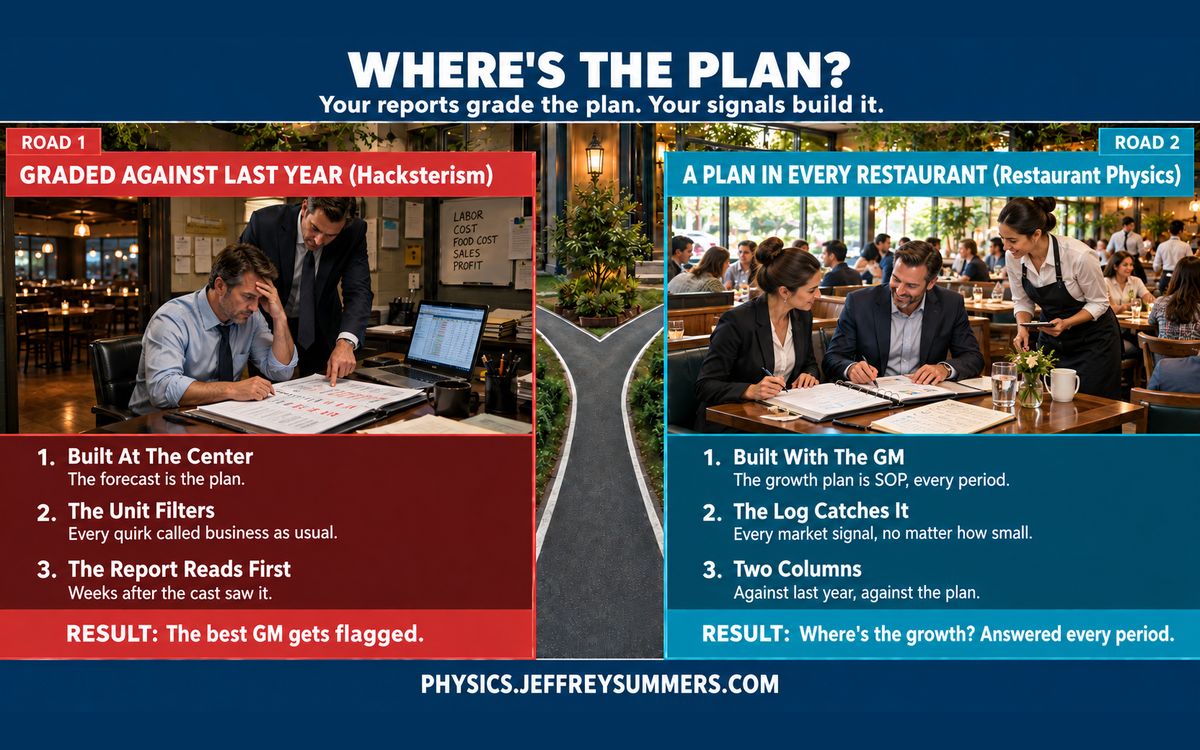

Your report is the last signal your restaurant sends. The cast sees drift first, the log catches it, and the pattern goes back into the plan.
This is part two of two. Part one, Where’s The Plan? Part 1, argued that a forecast built off last year is a plan to hold last year, that accountability for the design starts at the top, and that the growth plan has to be built in each restaurant, where the market reads happen. Part two is the signal chain: how what the cast sees every shift gets logged, read for patterns and taken back into the plan weeks before any report shows it.
The first signal that a restaurant is drifting never shows up on the report, because by the time labor or food cost moves, the drift has already been running for weeks through every small thing the cast saw and nobody passed up, and a restaurant with no growth plan isn’t drifting at all. It’s defaulting.
Diane Hodges, a director of operations running ten restaurants across three concepts, asked the question on LinkedIn this week: “What operating signal do you check first when a location starts to drift?” Her own list was labor against the forecast, food cost and inventory, Guest feedback, and whether managers have the training and authority to solve problems. “The numbers tell you where to look. The field conversation tells you why.” Almost every answer in the thread named a report: schedule drift, labor variance, remakes by shift. Every one of those is a lagging trace. The question assumes the first signal is a number. It isn’t, and the signal that catches drift doesn’t start where the report does. It starts with the cast and travels up: to the GM, to the multi-unit manager, or MUM, working ten GMs, and to the area operator, or AO, working ten MUMs. Accountability for the design runs from the top down. Signals about the operation run from the bottom up. A restaurant company that has both running doesn’t wait on a report to tell it what its own cast saw weeks ago. One that has neither reads labor against the forecast and calls it management.
Signals Come From The Bottom Up
Her question has another assumption buried in it: that the person at the top of the chain is the one who catches drift first. It’s the other way around. Signals start where the work happens and travel up, and every level up hears them later than the one below.
The first person to see a quirk isn’t the GM. It’s the cast. The server hears the regular mention he’s been going somewhere else for lunch. The line cook sees the case of chicken come in short. The host notices the 6:30 crowd is thinner than it was a month ago. The GM sees one shift. The cast sees every table and every station in it.
From there each level reads something the one below it can’t. The GM sees one shift, in depth, and that’s where the cause lives. The MUM sees ten, so he can tell whether something belongs to one unit or is showing up across several. The AO sees a hundred, and that’s where a pattern shows: something in the design itself that no GM and no MUM could see from where they stand. The reverse holds too. The AO can’t read the cause in any one of those hundred shifts. Pattern recognition tells him something is happening across thirty units. It can’t tell him why. The why only exists in the shift.
That puts one rule at the bottom of the chain and it is the critical one: the unit does not decipher individual events. The GM separates market noise from market signal, and that’s the only filter he runs. Every signal gets logged and reported, no matter how small. He doesn’t decide whether it matters, because from inside one unit he can’t know. One Guest asking about an item that came off the menu, one late truck, one server calling out on a Tuesday. In one unit each is nothing. Across thirty it’s a pattern. The MUM collects all of it and reports all of it up, and the MUM and the AO decipher the patterns. When a pattern comes back down, the GM is the one who reads why it happened in his unit, and the design fix goes back down with it.
The quirks don’t all have to be reported. They have to be logged. Catalog them, and you build the knowledge base of events that impact the business. That’s what keeps the volume from drowning anyone. The MUM isn’t fielding every small thing as it happens. He’s reading a catalog. My book already says it about post-shift: if it is worth knowing, it is worth writing. Almost every restaurant keeps a manager’s log. Most of them are a record of the shift that nobody reads again.
And what good does logging and cataloging all of it do if you don’t look at it and use it to analyze the current situation? None. A log nobody reads is a diary. The log is what the GM and the MUM bring to every planning conversation. The plan goes into the shift, the cast sees what it produces, the quirks get logged, someone reads the log for patterns, and the pattern goes back into the plan. The market reality that tells you the current plan won’t work as is shows up in the log before it shows up on the report.
The independent reads the same log across time instead of across units. One building, period over period, the same quirk turning up in March and again in May. The pattern a chain sees across a hundred units, the owner sees a hundred shifts deep in his own restaurant. Without the log he’s relying on memory, and memory is where business as usual does its filtering.
The cast end of that chain already has a name in my work. [Voice Of The Employee Harvest Architecture] is the designed 1-on-1 through which any level pulls the information the cast carries and nobody above them can see: owner with GM, GM with shift lead, lead with server, every shift, to some degree. Its output is durable operating intelligence used to correct read gaps, act on missed Guests and design against drift. What the multi-unit chain adds is that the harvest can’t stop at the GM’s office. It has to keep traveling.
Which means if I’m the AO and I see a pattern I wasn’t read in on beforehand, that’s a systemic failure regardless of market performance. Every piece of that pattern started in a shift, passed through a GM and a MUM, and stopped somewhere on the way to me. The AO’s pattern recognition isn’t discovery. It’s connecting pieces he’s already been told about. He should never be surprised by any piece of it. And a strong market doesn’t fix a broken line. It hides it, and the first period the market turns, the line is still broken.
Business As Usual Is The Filter
This is where most restaurant companies lose the signal, and nobody has to hide anything for it to happen.
A GM decides a quirk is just part of the business. The late truck, the regular who skipped a week, the short-handed Tuesday. Each call is reasonable on its own. But every quirk labeled normal is one the MUM never collects and the AO never sees. Business as usual is the filter, and it runs one unit at a time, one reasonable decision at a time. That’s why business as usual gets lost in translation. Nothing travels up, so above the unit the pattern doesn’t exist.
Until a report shows a leak. By then the money has been leaking for weeks at least, through every quirk that got called normal, and the report is just the first place it becomes visible above the unit. My work calls the distance between when the decline starts and when the operator sees it [Detection Lag]. Covers, average check, labor percent and food cost percent are lagging traces, not live readings. They report what already happened, through a reporting cycle that adds its own delay on top of the decline’s head start.
So Diane’s first signal is the system’s last.
That’s also why the first read is never the report. The report’s job is to confirm or correct what the live read already told you, never to be the first thing you look at to find out how the operation is doing. My work calls that the [Primary Read]. And if all you need is a computer report, why have a GM at all? A report can tell you labor is three points over. It can’t tell you the lead stopped covering the hole on the line two weeks ago, or that the regulars at table 12 stopped coming in. Only someone standing in the shift can read that. That’s the job, and it’s why you pay a GM instead of a subscription.
The Environment Is The Design
The whole chain stands on one condition: the cast has to be able to talk about what they see without any possibility of a negative consequence. The same holds at every level up.
If a small report gets read as an excuse, or as a GM who can’t handle his unit, GMs start filtering to protect themselves, and the AO only ever sees what made it through. That’s Jason Taliaferro‘s review room from part one again, killing signals instead of bets. It starts at the table. A server tells her GM about her regulars, who they are, how often they come, who they bring, and she’s handed him exactly what the system needs. If he answers with koozies and a half comp, the signal ends at the GM. Nothing about those Guests goes up to the MUM, and nothing comes back down to her about what to do next. She learns what the report was worth.
My work already has the lateral version of this. [Embedded Repair] is the cast’s capacity to detect, bring forward and correct errors before they compound, a cast function and not a management function, and the condition under it is that a cast member never pays for revealing a miss. High-performing teams don’t make fewer mistakes. They reveal them. The signal chain asks for the same thing in two new directions. Not only errors but everything the cast sees, whether or not anything went wrong. And not only sideways inside the shift but up, cast to GM to MUM to AO, with the same environment holding at every level, or the signal stops wherever it doesn’t.
That raises the obvious question: how do you hold people accountable for growth and promise them no negative consequence at the same time? You do both by sharpening their reads. As the cast comes to you with more and more, you filter it with them, what’s market signal and what’s just market noise. The cast’s read is raw. The GM’s read is more refined and more market-oriented, because he knows what to look for from working the plan with the MUM. Teaching the cast that difference is how you grow the cast and their ability to read the business just as well as you’re growing your GMs. Nobody pays for bringing something forward. What they get back is a sharper read.
The Diagnostic
Run these against your own company this week.
Test One — The Surprise Test. Name the last pattern you learned about across your units. Did it reach you from below, piece by piece, before any report showed it, or did a report show it first? If a report showed it first, your signal line is broken somewhere between the cast and you, whatever the market is doing.
Test Two — The Quirk Test. Ask a GM for the five smallest things his cast reported to him last week. Then ask his cast what they saw last week that they didn’t mention. The gap between those two lists is the filter.
Test Three — The Log Test. Pull a unit’s log for the last four weeks. Count the market signals in it, then ask when anyone above the GM last read it. An empty log is a filter. A full log nobody reads is a diary.
If you fail one test, you have a gap in the design. If you fail all three, you don’t have a signal system. You have a reporting cycle, and it’s telling you what your cast already knew weeks ago.
The Closer
Diane’s first signal is the system’s last. By the time labor or food cost moves, the drift has been running for weeks through every quirk the cast saw and the unit decided was business as usual. The cast sees it first. The GM separates market noise from market signal, logs every signal no matter how small, and sharpens his cast’s read in the process. The MUM and the AO read the log for patterns across units, and the independent reads it across time. The pattern goes back into the plan at every recalibration, and the report grades the result. A restaurant company that has all of that doesn’t need its report to tell it what its cast saw weeks ago. One that has none of it is reading its last signal and calling it the first.
What You Do Monday Morning
Pull each unit’s log for the last four weeks and count the market signals in it. Any unit with an empty log goes to the top of your list, ahead of anything the labor report flagged. Then sit down with that GM and his cast, ask what they saw last week that never made the log, and take what you hear into his plan.
Digging Deeper
Positions on the record:
-
Where’s The Plan? Part 1 — https://physics.jeffreysummers.com/wheres-the-plan-part-1/
-
Your Server Is Where Hospitality Is Turned Into A Relationship — https://jeffreysummers.com/your-server-is-where-hospitality-is-turned-into-a-relationship/
-
Every Body You Throw At A Broken Shift Makes It That Much More Broken — https://physics.jeffreysummers.com/every-body-you-throw-at-a-broken-shift-makes-it-that-much-more-broken/
Terms used in this piece: Voice Of The Employee Harvest Architecture, Detection Lag, Primary Read, Embedded Repair. Definitions in the Knowledge Base (https://kb.jeffreysummers.com/).
Sources Cited In This Piece
-
Diane Hodges, LinkedIn post, September 2026 — “What operating signal do you check first when a location starts to drift?”; her signals: labor against the forecast, food cost and inventory, Guest feedback, and whether managers have the training and authority to solve problems; “The numbers tell you where to look. The field conversation tells you why”; 10 restaurants, three concepts — https://www.linkedin.com/posts/diane-hodges-a35b171b5_in-multi-unit-restaurant-operations-consistency-share-7510393932967579649-PdfJ/
-
Jason Taliaferro, LinkedIn post, September 2026 — “The worst labor number in the room belonged to the GM with the best plan”; labor up over the prior months and over last year, productivity down; “It was glaring. Nobody needed it pointed out”; one extra host and one extra server above the labor model for 90 days; lunch paid for both within six months and two or three more were added; the strongest lunch sales in the region for years after — https://www.linkedin.com/in/jasontaliaferro/
Discover more from Restaurant Physics
Subscribe to get the latest posts sent to your email.


[…] why the plan itself has to be built in each restaurant, where the market reads happen. Part two, Where’s The Plan? Part 2, is the signal chain: how what the cast sees every shift gets logged, read for patterns and taken […]