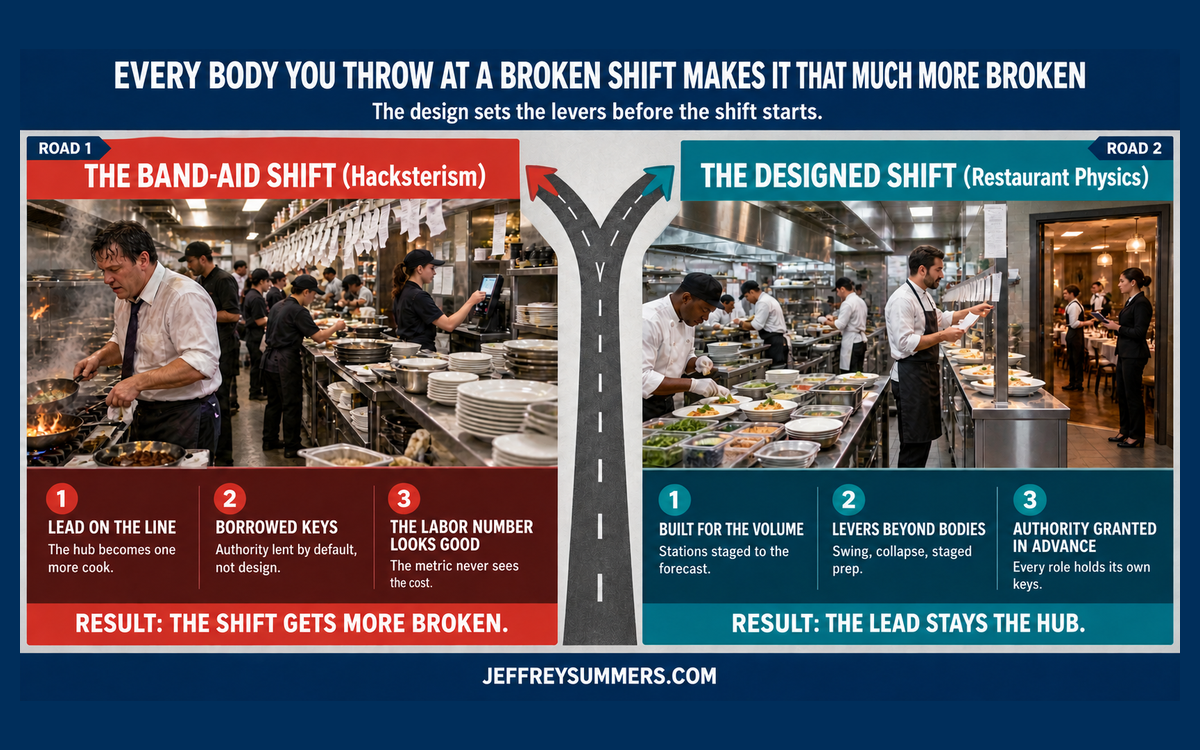

Every body you throw at a broken shift makes it that much more broken, because the shift didn’t break for lack of hands, it broke because the production model was never designed for the volume, and a broken design leaves only one lever at the point of the leak: another body.
Fred Brooks put this in one sentence in 1975, writing about software: “Adding manpower to a late software project makes it later.” Every new person has to be trained by someone who was already doing the work, and every new person adds lines of coordination to a job that was already behind. A restaurant shift in the weeds is a late project with the Guests already seated. The default fix is always a body: the lead jumps on the line, someone gets called in, a cook gets held on overtime. Each one adds load to a system that was already over its capacity, and the lead’s is the worst of them, because the body he adds is the one that was supposed to be running the shift. Most chains schedule a single lead per shift with very little overlap, even on high-volume shifts, and grade him on a labor number he has no authority to change. When the shift falls behind, his own body is the only lever he has. So he takes a station, the shift loses its hub, and his keys go to whichever cast member he trusts that night. None of that is the lead failing in the moment. All of it was decided before the shift started, by a production model that was never designed. The fix is not a better body at the point of the leak. It is a design that never opens the leak.
What Brooks Actually Said
Brooks’s argument has two halves, and almost everyone who quotes him keeps only the first.
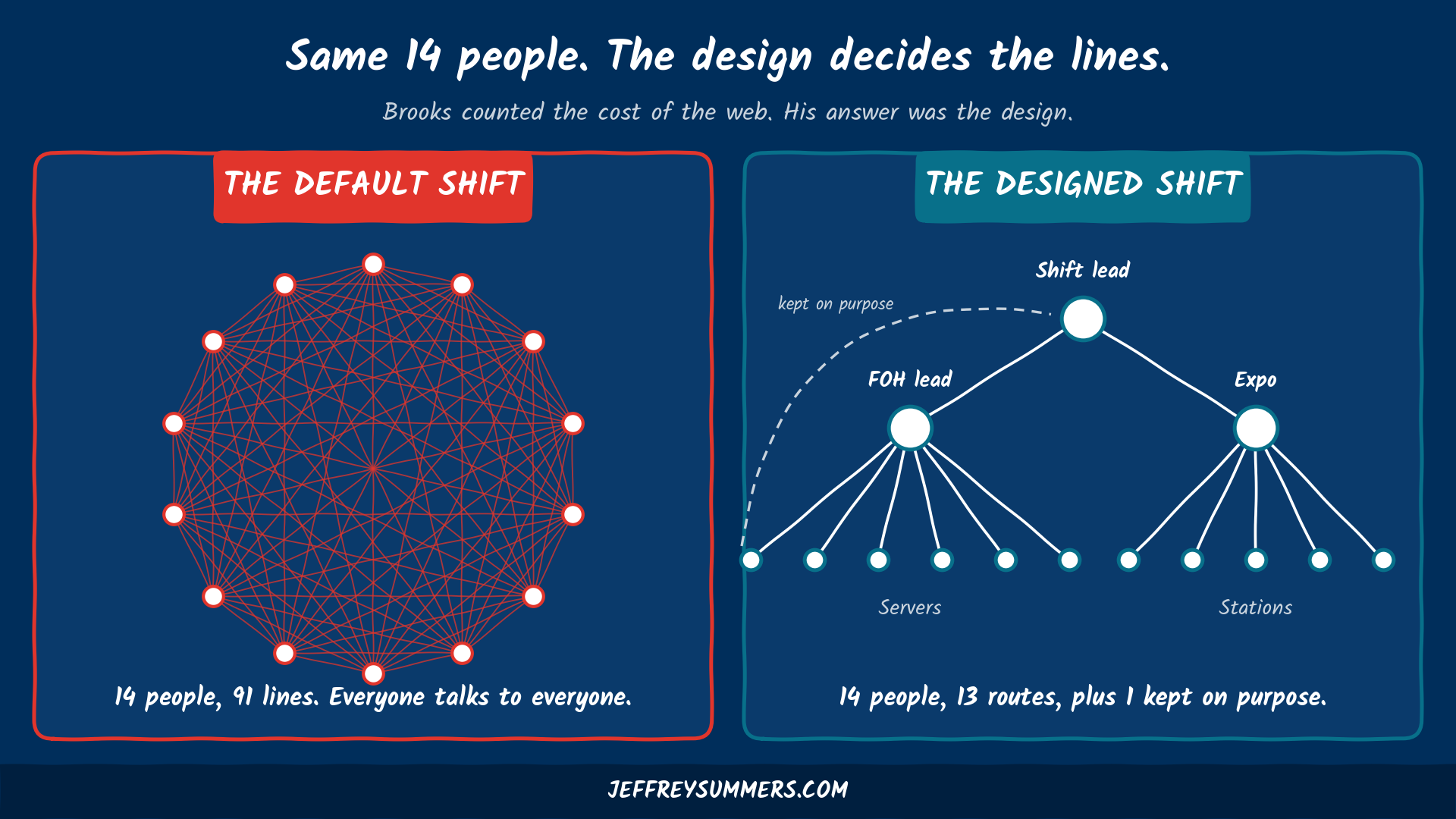
The first half is the cost. In chapter 2 of The Mythical Man-Month he named two costs that every added person brings. One is training: “Each worker must be trained in the technology, the goals of the effort, the overall strategy, and the plan of work.” That training “cannot be partitioned,” and the person doing it is someone who was already doing the work. The other is coordination: “If each part of the task must be separately coordinated with each other part, the effort increases as n(n-1)/2.” Three people carry 3 lines. Fourteen carry 91. Capacity goes up one person at a time. Coordination goes up much faster. That is why the late project gets later.
The second half is the answer, and it is design. In chapter 3 Brooks took up a proposal from Harlan Mills: organize the team “like a surgical team rather than a hog-butchering team. That is, instead of each member cutting away on the problem, one does the cutting and the others give him every support that will enhance his effectiveness and productivity.” Every role is defined. Every role knows what it supports and whom it answers to. The coordination runs through the design, not through everybody talking to everybody. Brooks didn’t conclude that you should stop adding people. He concluded that you design the team so that the people you have work as one system.
A restaurant kitchen has run this way for more than a century. Stations, the pass, expo, the FOH lead over the servers. Nobody in a working brigade talks to everybody. Routes are designed. The shift in the weeds is the shift where the design wasn’t built for the volume it got, and the default response, more hands cutting away at the problem, is exactly the hog-butchering team Brooks warned against.
The Lesson That Kept The Cost And Dropped The Answer
Brooks’s math gets quoted far more than his answer. A recent version, from a management coach’s list of “11 lessons most teams learn the hard way,” runs: “New hires add complexity faster than capacity. 3 people share 3 lines of communication. 14 people share 91. Every hire adds some capacity. And requires a lot more coordination.”
The math is right. The conclusion stops at a hiring caution, which is a conclusion Brooks never drew. He used the same numbers to argue for designing the team. The same list carries the pieces of that answer, unconnected: “Adding processes and rules whenever something breaks” slows a team down, “When multiple people are in charge, no one is responsible,” and “Every team has a system.” Put those next to the 91 lines and you have Brooks’s chapter 3. Left apart, they’re four tips.
That is [Mental Model Reduction]: a working model gets used, and its mechanism doesn’t survive into the conclusion drawn from it. The operator who takes the hiring caution home learns to be careful about headcount. The operator who takes the model home learns that the headcount was never the variable. The design was.
The Design Sets The Levers Before The Shift Starts
Here is the part that matters at 7:30 on a Friday. The levers a lead has in the moment are fixed by the design before the moment arrives. Nobody gets a lever in the rush that the design didn’t build.
A lead running a designed production model has choices when the tickets stack. He has a cook cross-trained to swing from fry to sauté. He has a prep list staged for the volume the forecast called for. He has a station he can collapse into its neighbor, because the menu and the line were built so it could be. He has a FOH lead who owns the servers, so the dining room doesn’t run through him. When the rush hits, he moves one of those, and he stays the hub.
A lead running a default production model has one lever: himself. The stations were set by habit. The prep was set by last week. Nobody is cross-trained because nobody was scheduled to train. When the rush hits, his body goes to the station that’s sinking, because there is nothing else to move.
That is why telling a lead not to get bogged down on the line gets the timing wrong. By the time the leak opens, the choice has already been made. It was made when the production model either got designed or didn’t. In the moment, he’s only executing what the design left him. His accountability is real, but it belongs at the design: he failed to build a shift that didn’t force him into the defaulted position. The moment was lost long before it arrived.
Why The Lead’s Body Is The Worst Body
Every added body costs the shift training and coordination. The lead’s costs it something more: its hub.
The shift is a coordination system. The lead is where the lines meet. He reads the tickets against the room, decides the 86s, makes the comp, catches the table that’s turning sour, moves the cast where the volume is. Brooks’s 91 lines are survivable on a shift of fourteen because most of them run through one person who isn’t cutting. Put that person on a station and every line he carried is either dropped or rerouted to whoever happens to be standing closest.
The authority goes with them. A lead who can’t leave the station can’t walk to the terminal, so the manager card, the void and comp codes and the drawer go to a cast member he trusts. On paper the shift has one lead. In practice it has a second tier nobody hired, trained, titled or paid for the authority it’s using. That breaks [Authority Responsibility Pairing] in both directions at once. The lead keeps the responsibility and the accountability for decisions someone else made. The cast member holds authority that came with no responsibility and no accountability, granted by default instead of by the operator’s design. Every void and every comp that night gets logged to the wrong person.
The Guest pays for it in the one moment that decides whether he comes back. A recovery after a bad plate depends on who’s holding the keys and whether they’ll use them. A designed shift makes that the same answer every night. A default shift makes it whoever the lead trusted tonight.
The Number That Can’t See The Cost
The reason the default holds is that the number grading it says it’s working.
The lead is salaried. His pay is a fixed cost, already paid before the shift starts. The labor metric tracks the variable cost, hourly wages. When he takes a station in place of an hourly cook, variable labor goes down and the number improves. Read on dollars, the metric is accurate.
What it cannot see is what the fixed salary was buying. It was buying a hub: someone to read the shift, run the cast and own the decisions. Once his body goes to a station, the operation is still paying for the hub and getting a line cook. No line on the P&L records management work that didn’t get done. The keys going out is what that missing work looks like on the stage, and the number reports a good night.
That is [Measurement Lock-In]: the instruments determine the question. The question the labor metric answers is whether wages came in on target. The question the operation needed answered is what the shift cost. The metric answers its own question correctly and never asks the other one. The move it rewards is not rational. It’s compliant. It answers the metric instead of the business.
Every Band-Aid Is The Same Move
The lead on the line is the purest case, but every default fix to a broken shift runs the same way.
The call-in adds a body who arrives mid-rush, has to be told where the shift is, and pulls someone off the work to tell him. The overtime cook adds a body who is the most tired person in the building at the moment the shift needs the sharpest one. The new rule written the morning after a bad night adds a step to every shift that follows, whether that shift broke or not. My work names that last one [Complexity Decline]: every workaround, every added process, every undocumented exception contracts the operation’s capacity a little more, and none of them ever gets taken back out.
Each of these is [Repair Work]. It solves the problem inside the frame the problem lives in and returns the operation to the state it was in before the problem showed up. Tonight’s gap gets covered. Tomorrow the same production model produces the same gap, and the same band-aid gets reached for, because it’s the only lever the design left. The band-aid isn’t the failure. It’s the evidence of one.
Design The Production Model For The Volume
The correct move is upstream, and it is the operator’s to make: design the production model so that capacity and throughput are maximized by design, not rescued by a default move at the point of the leak.
That means building the shift from the volume backward. What volume does the forecast call for, by hour? What station load does that volume produce? Which stations sink first, and which cast member is trained to swing to them? What prep has to be staged before open so that the rush is cooked, not prepped? Which station collapses into which when the volume drops, and which one splits when it climbs? Who owns the dining room so the lead doesn’t have to? What authority does each role hold, granted by the operator in advance, so that nothing has to be lent in the middle of a rush?
A shift built this way still gets busy. It still has nights it didn’t forecast. But when the rush hits, the lead has levers that aren’t his body, the hub stays the hub, and the keys stay with the people the design gave them to. That is [Designed Architecture] applied to the production model. What most shifts run on now is [Default Architecture]: the parts were not ruled from inside the building. The staffing model and the labor metric were ruled somewhere else, and everything after that is the building living with parts it didn’t rule.
The Diagnostic
Run these against your own last busy weekend.
Test One — The Station Count. For your three busiest shifts, how many minutes did the lead spend working a station during the peak? If the answer is more than none, write down which station each time. That list is your design gap, not his.
Test Two — The Keys Test. Pull every manager override, void and comp from those shifts. For each, who was physically at the terminal? If the answer is anyone but the person whose card was swiped, your shift is running on borrowed authority.
Test Three — The First Move. Ask your lead what he does first when the shift falls behind. If the answer is a body, his own, a call-in or a held cook, then the design left him nothing else.
Test Four — The Lever Count. Ask him to name three moves he can make in a rush that don’t add a body: a swing, a collapse, a staged prep. If he can’t name three, the shift has no levers but people.
If you fail one test, you have a gap in the design. If you fail all four, you don’t have a production model. You have a shift that runs on whoever shows up and a lead who covers the difference with his body.
The Closer
Brooks didn’t tell anyone to stop adding people. He told them that adding people to a late project makes it later, and that the answer is a design where every role knows what it supports. Restaurants built that design a century ago and then let the labor metric take it apart one shift at a time, until the lead became the band-aid and the band-aid became the job. The rush doesn’t decide what the lead can do. The design does, before the shift starts. Every body you throw at a broken shift makes it that much more broken. Build the shift so you never have to throw one.
What You Do Monday Morning
Take last Friday’s peak. Write down every time the lead left his position to work a station: which station, for how long, and who held his keys while he was there. Next to each one, write the design move that would have kept him off it: a cook cross-trained to swing, a prep item staged, a station built to collapse, an authority granted in advance. That list is your production model’s first draft. Start with the station that appears most often.
Digging Deeper
Positions on the record:
-
Hands-On Or Hands-Off: What Type Of Leader Is Best — https://physics.jeffreysummers.com/handson-or-handsoff-what-type-of-leader-is-best/
-
It’s the Architecture, Stupid! — https://physics.jeffreysummers.com/its-the-architecture-stupid/
-
Every Input That Moves Your Margin Has An Owner — https://physics.jeffreysummers.com/every-input-that-moves-your-margin-has-an-owner/
-
Your Current Business Design Will Eventually Fail — That Is Not A Prediction, It Is A Guarantee — https://physics.jeffreysummers.com/your-current-business-design-will-eventually-fail-that-is-not-a-prediction-it-is-a-guarantee/
Terms used in this piece: The Summers Principle, Mental Model Reduction, Authority Responsibility Pairing, Measurement Lock-In, Complexity Decline, Repair Work, Designed Architecture, Default Architecture. Definitions in the Knowledge Base.
Sources Cited In This Piece
-
Frederick P. Brooks Jr., The Mythical Man-Month, 1975, chapter 2, “The Mythical Man-Month” — “Adding manpower to a late software project makes it later”; “If each part of the task must be separately coordinated with each other part, the effort increases as n(n-1)/2”; “Each worker must be trained in the technology, the goals of the effort, the overall strategy, and the plan of work. This training cannot be partitioned” — https://web.eecs.umich.edu/~weimerw/2018-481/readings/mythical-man-month.pdf
-
Frederick P. Brooks Jr., The Mythical Man-Month, 1975, chapter 3, “The Surgical Team” — Harlan Mills’s proposal that the team be organized “like a surgical team rather than a hog-butchering team. That is, instead of each member cutting away on the problem, one does the cutting and the others give him every support that will enhance his effectiveness and productivity” — https://web.eecs.umich.edu/~weimerw/2018-481/readings/mythical-man-month.pdf
-
Dave Kline, LinkedIn post, “11 lessons most teams learn the hard way,” October 2026 — lesson 1: “New hires add complexity faster than capacity. 3 people share 3 lines of communication. 14 people share 91. Every hire adds some capacity. And requires a lot more coordination”; lesson 3: “Adding processes and rules whenever something breaks”; lesson 4: “When multiple people are in charge, No one is responsible”; lesson 11: “Every team has a system” — https://www.linkedin.com/in/davidkline/
Discover more from Restaurant Physics
Subscribe to get the latest posts sent to your email.