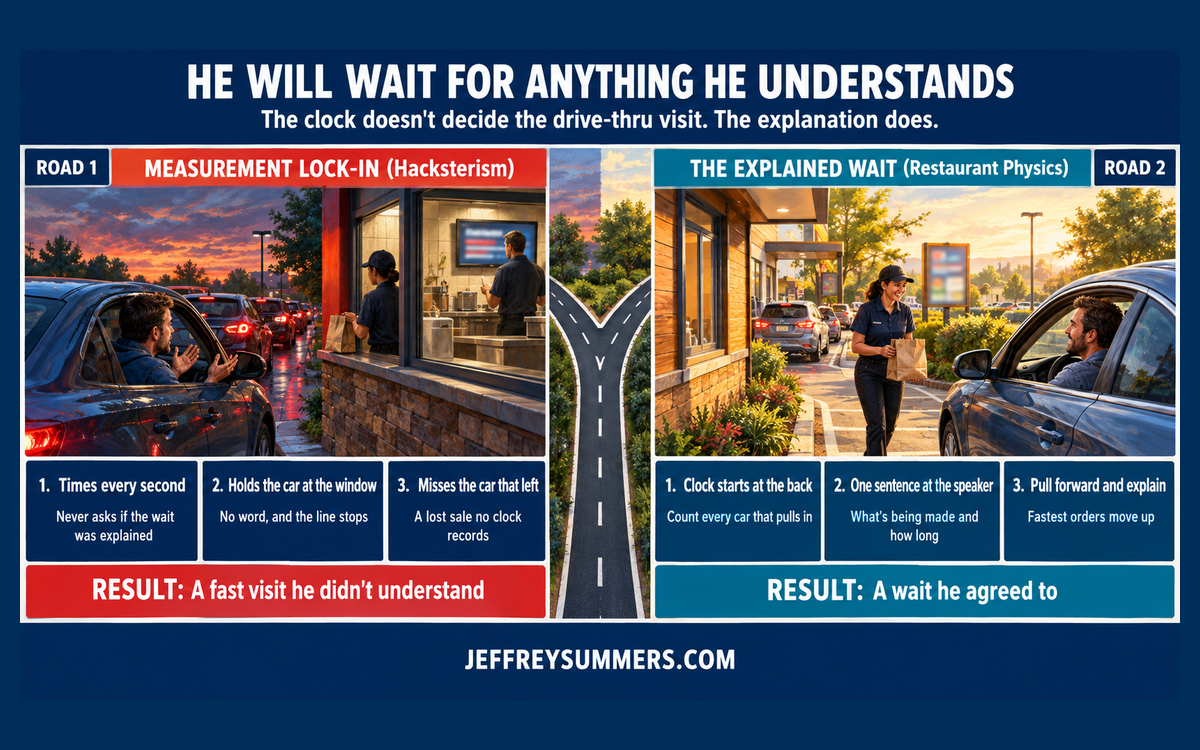

The drive-thru Customer will wait for anything he understands and forgive almost nothing he doesn’t, because the verdict on a drive-thru visit is set by whether the wait made sense to him, not by the clock, and the industry’s main drive-thru study times every second of the wait without once recording whether anyone explained it.
Intouch Insight’s 26th Annual Drive-Thru Study ran 2,145 mystery shops across thirteen brands in June and July 2026 and timed every one of them from the moment the car joined the lane. Its own tables show that the clock is not what decides the visit. Customers whose visit ran slower than they expected averaged 9:57 and 12.8% were very likely to recommend. Customers whose visit ran as expected averaged 5:09 and 43.3% were. The visits that ran past ten minutes had the best order accuracy of any visit length, 92.0%, and the lowest satisfaction, 84.9%. The difference is not speed. It is whether the Customer knew what he was waiting for. A Customer who can see four cars ahead of him, or who was told at the speaker that his fries are being dropped fresh, has already agreed to the wait. A Customer held at the window with no word about why has not. The drive-thru runs on a per-visit deal, and the operator who wants to win it has to design three things the clock never sees: when the clock really starts, what the Customer is told at the speaker, and what happens at the handoff.
What The Study Measured And What It Didn’t
Start with what the study is good at. It records wait time, service time, window time and total time on every visit. It records whether the order was accurate, whether the order was confirmed back, whether a suggestive sell was offered, whether the employee said “thank you,” and whether the service felt friendly. It records how the Customer felt about the speed against his own expectation.
It does not record whether anyone told the Customer what he was waiting on. Not at the speaker, when the order went in. Not at the window, when the car was held. Not when a car was pulled forward. The confirmation numbers make the gap plain. 85.3% of visits got some form of confirmation, a board or a read-back, and 77.7% of visits without a board had the order read back. That confirms what the Customer ordered. It says nothing about what fulfilling that order would take: the fresh drop, the special request that adds three minutes, the nugget count that runs behind the burger. Read-back protects the accuracy of the order. An explanation protects the wait. The study measures the first and has no column for the second.
That is [Measurement Lock-In] at the speaker. What the instrument records becomes what the operation manages, and what it does not record stops existing in the operator’s read. An operator who runs his drive-thru on this study will work on his times, his accuracy and his upsell rate, and he will never see the one sentence that decides whether a long visit is forgiven.
The Clock Starts At The Back Of The Line
The study starts the clock “from the moment the car joins the lane.” That is the right instinct. The Customer’s clock starts when he commits, when he pulls in behind the last car, not when he reaches the speaker. Every honest drive-thru measure starts there.
But the study never says where the lane starts when the line runs out past the entrance, through the parking lot or onto the street. That is exactly where its slowest brand lives. Chick-fil-A is last in the study by total time, at 7:06. Divide that by the cars in line and it is second best in the study at 2:21 per car, because it runs three cars deep on average, more than double the study average of 1.3. A total-time number ranks the busiest lane as the worst performer. It is reading the queue, not the operation.
And the car that pulls in, sees the line, and leaves never starts a clock at all. It is not slow. It is not counted. It is a lost sale that appears nowhere in a study built on cars that stayed. That is the [Visibility Trap] in a drive-thru: the decision about the lane gets made on the cars that were visible, and nothing registers the cars that left. The operator who wants the real read starts his own clock at the back of the line and counts every car that enters and exits without ordering.
The Customer Agrees To The Wait He Can See
The study’s own numbers say the Customer is grading the wait against what he expected, and the expectation is set by what he can see and what he is told.
Customers who rated the lane perfectly smooth averaged 4:45 and 97.1% were satisfied. Customers who rated it frustrating averaged 11:18 and 42.9% were. The time doubled. Satisfaction fell by more than half. But look at the middle of the time table: visits from three minutes to ten minutes held satisfaction between 94.2% and 94.7%. Seven minutes of spread produced half a point of movement. The Customer is not timing the visit. He is judging whether it made sense.
He can see the line. Four cars ahead of him at lunch is a wait he understands before he orders, and he has already agreed to it by pulling in. A big order in front of him is a wait he understands. A burger he asked to be made without cheese is a wait he understands. What he does not understand is being stopped at the window with no word, watching cars behind him get their bags, and not knowing whether his order has been forgotten.
That is the governing distinction, and it is plain: an explained wait is part of the deal, and an unexplained wait is a broken deal. The [Customer Contract] for a drive-thru visit is speed, accuracy and a fair order of service. A Customer will accept a slower visit he understood. He will not accept a faster one he didn’t.
The friendliness numbers point the same direction. When service was rated friendly, 98.6% were satisfied and the average visit ran 5:16. When service was rated not friendly, 26.8% were satisfied and the average visit ran 5:41. Twenty-five seconds apart. Satisfaction seventy-two points apart. How the Customer was dealt with moved the verdict. The clock barely did.
Explain It At The Speaker
The cheapest moment in the drive-thru is the speaker. It is the only time before the window that the cast has the Customer’s full attention, and it is where the expectation for the rest of the visit gets set.
If anything about the order will change how it is fulfilled, the cast says so at the speaker. “Your fries are dropping fresh, about three minutes.” “The no-cheese burger is made to order, so I may ask you to pull forward.” One sentence. It turns a wait the Customer would have resented into a wait he signed up for. And it changes what pulling forward means later. A Customer who heard at the speaker that he might be asked to pull ahead takes the request as the plan he was told about. A Customer who hears it for the first time at the window takes it as being set aside.
This is the step the industry’s scripting skips. The speaker script is built to confirm the order and offer the upsell, because those are the two things the study counts. Voice AI makes the point for it: at AI locations the suggestive sell was offered 79.2% of the time against 59.2% at the same brands’ other locations, and the Customer had to repeat part of the order 29.1% of the time against 20.4%. The machine never forgets to ask. It also never tells the Customer what his order will take.
The Handoff Decides The Visit
The window is where the explained wait and the unexplained wait separate, and holding a car at the window is the worst move in the drive-thru.
A car held at the window stops every car behind it. The Customer in that car is sitting at the one spot where he expected the visit to end, watching the cast work on everyone else’s order, and nobody has told him why. Every second there costs twice: once to him and once to the line.
The designed handoff runs the other way. If an order is not ready, the car goes forward to a marked spot, and the cast tells the Customer exactly what he is waiting on and about how long. Then the next order that is ready gets handed out, and the fastest orders move up. Customers understand this. They see a coffee and a cookie come out ahead of a family meal and they know why, as long as somebody told the family meal what it was waiting on. Pulling the fast order up is not unfair to the Customer who waits. Holding him without a word is.
The study shows where the gain has been coming from. Window time fell 7.5 seconds this year and accounts for nearly three quarters of the 10.3 seconds saved in service time. The handoff is where the operation is moving. Most of that movement is being measured in seconds, not in whether the held car was told what it was held for.
Build The Lane For It
The handoff only works if the lane has somewhere to put the car. A drive-thru with no pull-forward spot, no room to stage a car past the window, and no way out of the lane forces the cast to hold the car at the window, because there is nowhere else for it to go. That is not a cast failure. It is a design the cast inherited.
A designed lane carries a marked pull-forward spot or enough room past the window to stage a car, and an escape lane where the site allows it, so a Customer who changes his mind before the speaker can leave without waiting out the line. More lanes help only if they stay separate through the handoff. Two ordering lanes that merge into one window still hand off single file, and the merge becomes the new place the unexplained wait lives.
The Diagnostic
Run these at your own drive-thru during one lunch peak.
Test One — The Real Clock. Start your clock when the car pulls in behind the last car, not at the speaker. Count the cars that enter the lane and leave without ordering. If you have never counted them, you do not know what your lane costs you.
Test Two — The Speaker Sentence. Listen to every order taken in one hour. Count the orders that would take longer than normal to fulfill, and count how many of those got one sentence about it at the speaker. If the second number is far below the first, your Customers are finding out at the window.
Test Three — The Held Car. Stand where you can see the window. Count every car held there for an order that was not ready, and every car pulled forward. For each one, did the cast tell the Customer what he was waiting on and about how long? A held car with no explanation is the visit you are losing.
Test Four — The Pull-Forward Spot. Walk your lane. Is there a marked place to put a car whose order is not ready, past the window, where it does not block the line? If not, your cast has no choice but to hold the car at the window, and every training fix will fail against the lane.
If you fail one test, fix it this week. If you fail all four, your drive-thru is being judged on a clock you are not running and a conversation nobody is having.
The Closer
The clock is the easiest thing in the drive-thru to measure, so it is the thing the industry measures, and it is not what decides the visit. The Customer decides the visit by whether the wait made sense. He will sit behind four cars he can see. He will wait for an order he was told would take longer. He will watch a coffee go out ahead of his family meal and not mind, as long as somebody told him what he was waiting on. What he will not forgive is being stopped at the window with no word. He will wait for anything he understands. The operator’s job is to make sure he understands it.
What You Do Monday Morning
Write the speaker sentence and the window sentence, and put them in your next pre-shift. The speaker sentence is what the cast says when an order will take longer than normal: what is being made, and about how long. The window sentence is what the cast says when a car has to pull forward: what the Customer is waiting on, and about how long. Then pull one lunch peak and count, for every order that took longer than normal, whether either sentence was said. That count is the number the study never gave you.
Digging Deeper
Positions on the record:
-
Speed Is Not The Problem You Think It Is — https://physics.jeffreysummers.com/speed-is-not-the-problem-you-think-it-is-2/
-
I Read The Restaurant Industry News Wrong, And So Did Everyone It Reached — https://jeffreysummers.com/i-read-the-restaurant-industry-news-wrong-and-so-did-everyone-it-reached/
Terms used in this piece: Measurement Lock-In, Visibility Trap, Customer Contract. Definitions in the Knowledge Base (https://kb.jeffreysummers.com/).
Sources Cited In This Piece
-
Intouch Insight, 26th Annual Drive-Thru Study, 2026 — 2,145 mystery shops, 165 per brand, thirteen brands, June and July 2026; timing “from the moment the car joins the lane to the moment it leaves with the order”; total time 5:24, median 4:25; satisfaction by visit length (under 3 minutes 95.4% satisfied; 3 to 5 minutes 94.7%; 5 to 7 minutes 94.6%; 7 to 10 minutes 94.2%; over 10 minutes 84.9% satisfied, 60.4% would recommend, 92.0% accurate); Chick-fil-A 7:06 total time, 2:21 per car in line, 3.0 cars in line against a 1.3 study average; perceived speed (quicker than expected 3:54, 96.8% satisfied, 65.3% very likely to recommend; as expected 5:09, 95.1%, 43.3%; slower than expected 9:57, 82.3%, 12.8%); lane flow (perfectly smooth 4:45, 97.1% satisfied; frustrating 11:18, 42.9%); friendliness (friendly 98.6% satisfied, 5:16 average; not friendly 26.8% satisfied, 5:41 average); order confirmation (85.3% of visits; 77.7% read back where there was no board); voice AI locations against the same brands (suggestive sell offered 79.2% against 59.2%; had to repeat part of the order 29.1% against 20.4%); window time 7.5 seconds faster, nearly three quarters of the 10.3 seconds saved in service time — https://www.intouchinsight.com/resources/studies/drive-thru/
-
Intouch Insight, press release, October 1, 2026, “Average Drive-Thru Visit Is the Fastest Since 2018, Intouch Insight’s 26th Annual Drive-Thru Study Finds” — https://www.globenewswire.com/news-release/2026/10/01/3373023/0/en/average-drive-thru-visit-is-the-fastest-since-2018-intouch-insight-s-26th-annual-drive-thru-study-finds.html
Discover more from Restaurant Physics
Subscribe to get the latest posts sent to your email.