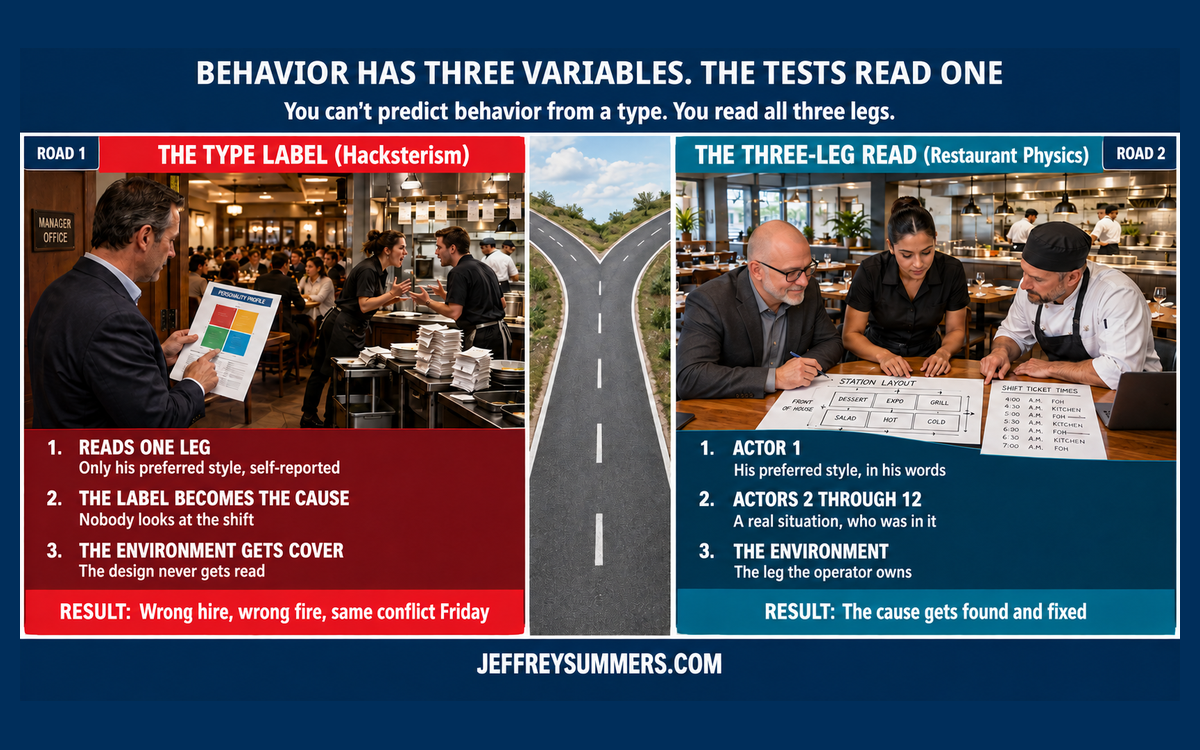

A personality type test can’t predict what a person will do in your restaurant, because behavior comes from three variables and the test reads one of them.
The three are actor 1’s preferred style, the preferred styles of actors 2 through 12 on the other side of every interaction, and the environment they are all in. DISC, Myers-Briggs and every type instrument built on the same idea read the first one, as the person reports it, and see nothing of the other two. In a restaurant the other two are the ones that move. The Guests change at every table, the cast and the kitchen manager change every shift, and the environment belongs to the operator. Used to hire, the test screens a person on a third of the cause. Used to explain behavior after the fact, it does worse. The label becomes the cause, so nobody looks at the shift, the people on it or the design that set them up. That costs the operator the wrong hire, the wrong fire, the conflict that comes back next Friday with a new name on it, and an operation that never reads its own environment. What replaces it is one read of all three legs, in the interview, on the trial shift and every time the operator has to understand why someone did what he did.
Their Own Publishers Say Not To Use Them For Hiring
The strongest case against the tests comes from the companies that sell them.
The Myers-Briggs Company publishes a list of what the MBTI can’t do. The list includes “Measure or predict job performance” and “Tell companies who they should hire.” Its MBTI Facts page says the assessment “is not intended for use as part of a hiring process, nor to assign people to specific teams, roles, or functions within an organization.” It also says that because the MBTI is not appropriate for selection, “there have (appropriately) been no meaningful studies evaluating the MBTI’s ability to predict job performance.”
Wiley publishes Everything DiSC. Its own hiring page says DiSC profiles are “not recommended for pre-employment screening,” because DiSC “does not measure specific skills, aptitudes, or other factors critical for a position.” Its comparison page is blunter: “Do not use Everything DiSC to screen candidates, decide promotions, or make employment decisions.” The same page tells buyers to avoid the tool when “The root problem is structural (unclear roles, decision rights, incentives), not interpersonal behavior,” and when the organization “lacks the capacity to facilitate responsibly and prevent stereotyping.” That is the publisher naming the environment and the label as the two places its own product goes wrong.
Then look at what the test actually is. It is a comparison of one person’s answers about himself against a general population. Not a read of the person. A read of his answers, ranked against averages. And the population is the industry-agnostic one the instrument was built against. To be sellable anywhere, it had to be built against nowhere. It has never been in your building.
Every honest answer describes how the person sees himself, and every dishonest one describes what he thinks you want. The instrument can’t tell the two apart, and the publisher says so. The Myers-Briggs Company explains that MBTI items are “clear-purpose,” meaning no attempt is made to disguise which preference an item is measuring, and that the assessment has no “lie scale” to flag a candidate who isn’t answering honestly. A test any candidate can steer, with nothing built in to catch it, is not a hiring instrument. Its own publisher agrees.
Then look at where the tests came from. The MBTI was built by Katharine Cook Briggs and Isabel Briggs Myers, and the Myers-Briggs Company says plainly that neither was a psychologist. They built it out of Carl Jung’s 1921 theory of psychological types, and the first version was developed in 1943. DISC comes from William Moulton Marston’s 1928 book, Emotions of Normal People, a theory of how people express emotion. Wiley’s own history says Marston “never created a psychological instrument to measure his model.” Wiley dates DISC measurement to the 1940s and Walter V. Clarke, and describes the test he built as “a test for personnel selection.” The line of tests started as a hiring tool, and its publisher now says not to hire with it.
A theory of types, not evidence. Put the person in a type, then predict what he’ll do from the type. That is how a horoscope works.
The Model Had The Environment In It. The Test Took It Out.
Wiley’s own account of Marston’s work says his four types stemmed “from the person’s perceptions of self in relationship to their environment.” An Inscape Publishing paper on the DiSC dimensions says “Marston never used his ideas as a typology—or a way to label individuals as a specific ‘type,’” and that he saw the styles as “part of a dynamic model.” When Inscape ran its own analysis of Marston’s adjectives, the two dimensions it found were the person’s “perception of personal power in the environment” and “perception of relative favorableness of that environment.”
The environment was in the model from the start. The test that came out of it dropped the environment and kept the label.
The selection research found the same thing from the other direction. Sackett, Zhang, Berry and Lievens reworked the validity estimates for the common hiring methods in 2022. They found that personality items predict better when they are tied to the work context, by adding “at work” to each item or asking how the applicant behaves at work, and the gain was big enough that they suggest treating those as a different type of assessment altogether. Two words about the environment changed the read. The type instrument leaves them out.
Behavior Has Three Variables
Actor 1’s preferred style. This is the only leg the test claims to read, and it reads it secondhand, through the person’s description of himself. A preferred style is real. It is how a person likes to work when nothing is pushing on him. It is not what he does when something is.
Actors 2 through 12. Nobody in a restaurant acts alone. A server works a different Guest at every table and a different kitchen manager on every shift. He works next to a host, a bartender, a busser and the other servers in his section. Every one of them brings a preferred style of his own, and behavior is what happens when those styles meet. The test reads one person. It never sees who is on the other side of the interaction.
The environment. The stage, the station layout, the cover count, the staffing, the menu, the ticket times, the rules, what each person is allowed to decide and what he is rewarded for. The environment belongs to the operator. Nobody else designs it, and nobody else can change it.
Change any one of the three and the behavior changes. The same server who is patient on a Tuesday is short on a slammed Friday when the operation runs him into the weeds. His style didn’t change. The environment did. The test holds two of the three variables at zero and calls what is left the person.
That is why the thing the test reports is never the thing you need to know. The test reports a disposition. You need to know whether he can hold your standard at seven-forty on a Friday when the kitchen is a station short and a four-top is unhappy. It reports agreeableness. You need to know whether he will tell you the truth about something that went wrong. It reports conscientiousness. You need to know whether he does the work when nobody is watching, which is a different thing than reporting that he does. It reports a type. You need to know how he behaves with this cast, in this room, under this pressure. None of that is self-reportable, and all of it lives in the two legs the test can’t see.
The Label Becomes The Cause
Once a person carries a type, the type gets used to explain what he does. He was short with a table because he is a high D. She didn’t speak up because she is an S. The explanation arrives before anyone looks, and once it arrives nobody looks. Nobody asks what the shift looked like, who was on the other side of the table or what the design set him up for.
That is the same bias people use to dismiss a whole group. The category explains the behavior, so nobody has to look at the cause. It doesn’t become respectable because the category came out of a workbook.
In my framework this is [Assumed Cause]: the causal read runs correctly and still produces the wrong answer, because the variables tested were never the causal variables. The operator does the work. He reads the write-up, pulls the profile, sees the pattern and rules on it. Every step of that is sound. The cause was assumed. The type was never the cause, so a careful process run on the type lands on the wrong person, and the environment that produced the behavior gets cover.
Six Things The Test Does To Your Hiring
It filters for people good at tests. Some of the strongest people you will ever hire in this business are not good at that particular exercise, and nothing about being bad at it predicts anything about a Friday night.
It launders a decision you should own. Hiring is a ruling. When it goes wrong, the operator can point at the report, which means nobody in the building is accountable and nothing gets learned. An operator who owns his hires gets better at hiring. One who defers to an instrument does not.
It selects for sameness. Run the same instrument against every candidate for two years and your cast converges on one profile. The instrument is a [Sameness Machine]: built outside your building, distributed identically into every building that buys it, producing the same cast everywhere it runs. A cast that is all one type can’t cover the range a dining room produces, and the operation gets more uniform in exactly the way that makes it ordinary.
It screens out the person who would have been your best hire. The candidate with an unusual history, an odd trajectory or an answer pattern the instrument flags is often the one with the most capacity. Instruments are built to reduce variance, and your best hires are variance.
It arrives before the read and replaces it. Once a report exists, the interview becomes a confirmation of the report. The operator stops asking his own questions. He meets the type before he ever meets the person.
It has no exposure. If the hire fails, the instrument company loses nothing. You lose the training, the shifts and whatever that person did to your cast while he was here. That is [Hiring Arbitrage]: a vendor profiting from the hiring problem without solving it, paid whether or not the hire works out, with revenue tied to your problem continuing to exist.
Team Communication Fails The Same Way
The usual answer is that the test isn’t for hiring, it’s for team communication. That is the use the publishers recommend. It fails the same way.
Two servers clash on a Friday, and the workshop says he’s a high D and she’s an S. The label explains the friction, so nobody looks at the shift, the station layout or the kitchen manager who set them against each other. The environment gets cover whether the test is used to hire or to coach. Wiley’s own page says not to use the tool when the root problem is structural. In a restaurant, the friction between two people on a Friday is the first place to look for a structural problem, because the structure is what put them in each other’s way.
No one who calls their company people first should go near a type test. People first means you know the person: what he does, in your operation, with the people around him. A type test swaps knowing him for a label. You meet the type before you ever meet the person. People first and type tests can’t both be true. One reads the person. The other reads the box.
How I Adjudicate Conflict
I settle conflict on the same three legs. What all the actors did, and their environment.
All the actors means everyone who was in it, not just the two who clashed. The kitchen manager who called the tickets. The host who sat the section. The Guest at the table where it started. Each one did something, in an order, and the order matters.
Their environment means what the shift actually was. The cover count against the staffing. Which station was short. What the ticket times were doing. What was different from a normal night, and who decided it would be.
Then the finding names the cause, wherever it sits. Sometimes it sits with a person, and then the conversation is about what he did, not who he is. Often it sits in the design, and then the fix is mine, because the environment is mine. Either way the ruling stands on what happened, and nobody walks away carrying a label for something the shift did to him.
How I Hire
Everything the test claims to do, the hire can do better in the building, as long as the operator does the read himself.
Write down what the role demands, in your building, before anybody is interviewed. Not a generic position description. The three or four things this person will have to do well on your worst Thursday. Then write out the three biggest challenges the operation is facing right now. Not the ones you wish you had. The actual ones. The position you can’t keep filled. The cast member who is almost ready to lead but not quite. The cost that is running above where it needs to be.
Tell the candidate. All of it, out loud, in the interview. If you won’t tell him what your actual challenges are, you can’t find out whether he can handle them. The operator who hides the problems because he doesn’t want to admit them in front of a stranger protects nothing. The minute the candidate is hired he will see every one of them on his first shift. The only thing the secrecy accomplishes is keeping you from finding out whether he could handle the reality you were about to put him in. Watch what happens. Some candidates get quiet. Some lean in. Some ask questions that tell you more about how they think than any script ever could. The best interview is a real conversation about your real business.
Ask if he has eaten here. If the answer is no, that tells you something. If the answer is yes, ask him to talk about it, and don’t guide him. The person who talks about the food gives you one answer. The person who talks about how he was treated gives you another. The person who noticed that the server checked back at the right moment and the room felt intentional is already reading your stage the way you need him to.
Cover all three legs.
Actor 1. I ask him his preferred style, in his own words. How he likes to work, what he does well and what wears on him. He is the authority on that, and it is the one thing self-report can actually tell you. You get it in a conversation, and you get to watch him tell it.
Actors 2 through 12. You can’t predict behavior, so you find a similar situation he has already been in and see how he solved it. Who else was in it, what they did and how it actually went. That tells me how he fits with the actors 2 through 12 he’ll work with here. I don’t ask him what he would do. A hypothetical gives him a scenario with only one leg in it, his preferred style. There is nobody on the other side of the table and no environment, so he answers with how he sees himself. A real situation had all three legs in it, and the follow-up questions are where the truth shows up.
This is not the behavioral interview. “Tell me about a time when you dealt with a difficult person” is a script, and every candidate over the age of twenty has a rehearsed answer to it. You learn how well he prepared for a performance. What I ask about is context for the problems I just put in front of him. Here is what is going on in my building. Have you been in something like it? Who was in it with you, and how did it go? The past situation is evidence about the present one, not a prompt he could have practiced.
The environment. I bring up the environment to see how he thinks it adds to the process. Ask how the environment shaped the situation he just described. One candidate talks only about what he did, or blames the people around him. He is reading one leg. Another says the station was short, the kitchen manager was new and the tickets backed up. He is reading all three. That is the thinking you want in anyone you hire, and you need it in anyone who will lead, because a lead who reads all three legs won’t need a label to explain behavior. He’ll go looking for the cause.
Run the filter. Three questions, and a candidate who doesn’t clear all three doesn’t get hired. Does he share your values, in the specific, about how to treat people, how to show up and how to take ownership? Does he have a genuine desire to serve, an observable impulse to make someone else’s day better? Describe a real situation from your stage, a Guest who showed up on the wrong night for a reservation or a regular whose usual server isn’t there, and watch whether his first instinct is to solve the problem or to ask whose job it is. Is he coachable? Can he take feedback without getting defensive and own a mistake without making excuses?
Listen for character. Ask him to define character. The candidate who has never thought about it gives you a packaged answer. Honesty. Integrity. Doing the right thing. The candidate who has lived it gives you something specific: a moment, a decision, a cost he paid. Then ask if he has a best friend, and why that person is his best friend. He isn’t performing for a job answer. He is talking about his actual life. Standardize the approach and not the evaluation. Same questions for every candidate, so you have a comparable signal, and no rubric for what you hear, because what you are listening for can’t be reduced to one.
Hire for friction, not fit. The candidate who made you comfortable in the interview is not necessarily the right hire. Familiar feels safe. The candidate who thinks like you, talks like you and came up the way you did is easy to read, and the one whose style is different and whose thinking produces some friction in the conversation feels like a risk. That discomfort is not misalignment. It is difference, and difference is what the cast needs. Values are non-negotiable. Inside them, hire the person who will tell you what you don’t want to hear. A gut that hires for comfort and a type test that hires for one profile end in the same place: a cast that shares the operator’s blind spots.
Test the work, not the person. Skills tests that measure the actual work have a legitimate place. Can he execute the task, at pace, to your standard? That is not a personality instrument. It is a demonstration. So is legally required or factual screening, certifications and right to work, which are facts, and nobody’s operation gets a vote on them. Everything else in the category is a substitute for a read.
Then watch the work. Put the person on the stage for a shift, at a real hour, and pay him for it. Your Guests, your cast, your kitchen manager, your Friday. The interview gets you a past environment with someone else’s actors. The paid shift is the only read with your actual actors 2 through 12, in your actual environment. Have your lead watch and report back, and read the shift against what you wrote down the role demands. Let your cast read him. The people who will work next to him know inside one shift. Ask them and mean it.
And remember the environment is yours. If the shift you put him on is broken, you’re not testing him. You’re testing your operation.
Read the reciprocity. What does this person get here that he can’t get down the street, and what is he going to put back? A hire that only works in one direction leaves.
Own the ruling and write down your reasoning. Why you hired this person, in a sentence, at the time. Then read it back later, against what he actually did. That is how an operator gets better at hiring, and no instrument can do it for him.
The research lines up behind this. In the Sackett 2022 rework, the strongest predictor of job performance was the structured interview, at a validity of .42, followed by job knowledge tests at .40, with work sample tests at .33. The methods that predict best are the ones built around the actual job.
Your Guests Get The Same Read
The label doesn’t stop at the cast. A Guest who is short with a server gets one too. Difficult. High maintenance. The same three legs apply to him: his preferred style, the cast he dealt with, and the environment you put him in, from the quote time at the host stand to the table he was walked to. Never assume a Guest is broken. Read what happened to him first.
The GX is delivered by the cast, in the environment, to a Guest with a style of his own. All three legs are at every table. An operator who reads behavior through a type misreads the cast and the Guest at the same time, and the GX pays for both.
What The Wrong Read Costs
The wrong hire costs the training, the shifts he works before anyone admits it, and every Guest he touches in between.
The wrong fire costs more, because nobody counts it. A good person gets let go for something the environment did to him. The next hire walks into the same environment, the behavior comes back, and it gets a new name and a new type. The operator pays to find, hire and train the same problem again, and the cause sits untouched in the design the whole time.
The conflict settled on a label costs a third time. It comes back next Friday, because the shift that produced it never changed.
And the instrument keeps billing through all of it. Every failed hire is a reason to run the next candidate through it.
Read All Three Legs
Behavior has three variables, and you can’t predict it from a type. You read it, all three legs, wherever you need to understand it: in the interview, on the trial shift, in the conflict and at the table. The test reads one leg and calls it the person. The operator reads all three and finds the cause, and the one leg he owns outright is the environment.
What You Do Monday Morning
Take your last five hires and write down, honestly, why each one worked or didn’t. Not the traits. The specific thing. He couldn’t hold pace. She told the truth when it cost her something. He never learned the room. She made the cast better. Then take the one that went wrong, or the last conflict you settled, and write down three lines. His preferred style. Who else was in it and what each of them did. What the environment was that shift: the covers, the staffing, the station, the tickets. Look at what you decided at the time and which leg you decided it on. If the answer was his type, or his personality, you ruled on one leg of three, and no instrument you own measures a single one of the reasons you just wrote down. On the next hire, write down what the role demands before anyone walks in, tell the candidate your three biggest challenges and put him on a paid shift on a real night.
Digging Deeper
Positions on the record:
- Personality Assessments & Other Hiring Instruments — https://kb.jeffreysummers.com/
- The Case Against Behavioral Interviews — https://hacksterism.jeffreysummers.com/the-case-against-behavioral-interviews-2/
- You Can’t Hire Better Cast. You Can Hire Better People. — https://physics.jeffreysummers.com/you-cant-hire-better-cast-you-can-hire-better-people/
- Your Cast Is Not The Problem. Your System Is. — https://physics.jeffreysummers.com/your-cast-is-not-the-problem-your-system-is/
- Every Body You Throw At A Broken Shift Makes It That Much More Broken — https://physics.jeffreysummers.com/every-body-you-throw-at-a-broken-shift-makes-it-that-much-more-broken/
- 3075 Stop Asking Goofy Questions — https://kb.jeffreysummers.com/
- 3055 Hire for Friction Not Fit — https://kb.jeffreysummers.com/
- 3025 You Dont Have a People Problem — https://kb.jeffreysummers.com/
Terms used in this piece: Assumed Cause, Sameness Machine, Hiring Arbitrage. Definitions in the Knowledge Base.
Sources Cited In This Piece
- The Myers-Briggs Company, All About the Myers-Briggs (MBTI) Assessment — under “What it can’t do”: “Measure or predict job performance,” “Tell companies who they should hire” — https://www.themyersbriggs.com/en-us/access-resources/all-about-the-mbti-assessment
- The Myers-Briggs Company, MBTI Facts — not intended for hiring “nor to assign people to specific teams, roles, or functions”; “no meaningful studies evaluating the MBTI’s ability to predict job performance”; neither Briggs nor Myers was a psychologist; built on Jung’s theory of psychological types — https://www.themyersbriggs.com/en-us/support/mbti-facts
- The Myers-Briggs Company, MBTI Facts (Asia Pacific) — items are “clear-purpose,” with no attempt to disguise which preference an item measures; no “lie scale” to flag a candidate not responding honestly — https://ap.themyersbriggs.com/themyersbriggs-mbti-facts.aspx
- The Myers-Briggs Company, Our Story — Jung publishes Psychological Types, 1921; MBTI developed during World War II — https://www.themyersbriggs.com/en-us/about-us/our-story
- The Myers-Briggs Company, Creating Clarity: Addressing Misconceptions About the MBTI Assessment — first version of the MBTI developed in 1943 — https://www.themyersbriggs.com/hubfs/Addressing%20misconceptions%20about%20the%20MBTI%20Assessment.pdf
- DiSCProfile.com (Wiley), Can I use DiSC for hiring? — “not recommended for pre-employment screening”; does not measure skills or aptitudes — https://www.discprofile.com/everything-disc/hiring
- Everything DiSC (Wiley), Everything DiSC vs Predictive Index — “Do not use Everything DiSC to screen candidates, decide promotions, or make employment decisions”; avoid when the root problem is structural or the organization cannot prevent stereotyping — https://llms.everythingdisc.com/disc-vs-predictive-index
- DiSCProfile.com (Wiley), History of DiSC — Marston’s 1928 Emotions of Normal People; types stemming from perceptions of self in relationship to the environment; Marston never created an instrument; Walter V. Clarke’s 1940s test for personnel selection — https://www.discprofile.com/what-is-disc/history-of-disc
- Inscape Publishing, DiSC Dimensions — Marston never used his ideas as a typology; a dynamic model; dimensions of personal power in the environment and favorableness of that environment — https://higherlogicdownload.s3.amazonaws.com/ASBOINTL/7f4599d9-481b-4592-b3cd-2068793398bc/UploadedImages/DiSC_Dimensions.pdf
- Society for Industrial and Organizational Psychology, on Sackett, Zhang, Berry and Lievens (2022) — structured interviews .42, job knowledge tests .40, work sample tests .33; personality items tied to the work context predict better — https://www.siop.org/tip-article/is-cognitive-ability-the-best-predictor-of-job-performance-new-research-says-its-time-to-think-again/
Discover more from Restaurant Physics
Subscribe to get the latest posts sent to your email.