
The Funding Order That Keeps Tomorrow Out Of Hock
The Verdict
The only cash worth borrowing against tomorrow is cash that buys a fix today, because tomorrow can only repay a mortgage out of what the fix recovers.
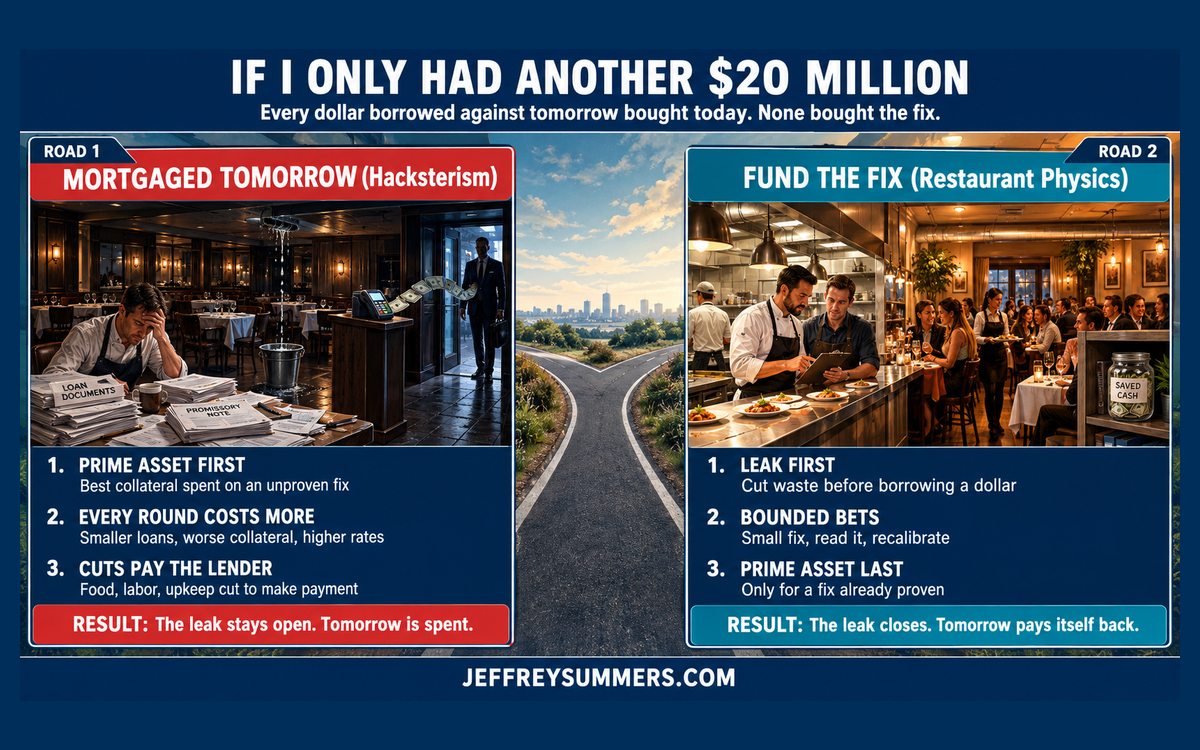
Every operator borrows against tomorrow. A lease does it, a walk-in on terms does it, a line of credit does it. That is not the danger. The danger is [Mortgaged Tomorrow]: spending tomorrow’s cash on today without buying a fix to the leak that created the need, so tomorrow inherits the obligation and the leak together. True Food Kitchen’s bankruptcy filings this month trace four years of it, from a more than $100 million equity round to a $20 million bankruptcy loan from its largest shareholder, and not one dollar traced to closing the leak its own declaration names. The architecture that prevents it is a funding order and one question asked before any money moves. Fund the fix from the leak first. Then bounded money against minor assets, for a fix that pays back faster than the money costs. The prime asset last, and only for a fix the operation has already proven.
The Question That Comes Before The Money
What investment are you making today, with tomorrow’s cash, that can fix the leak today so that tomorrow can recoup its mortgaged state enough to keep the business alive and breathing?
That question is the whole architecture. Everything else in this piece is how to answer it honestly.
An honest answer names three things. What the fix closes. How you will see it close. By when. An operator who can name all three is investing. An operator who cannot is buying a hope, and the paperwork does not change which one it is.
Then one more line, because the fix has to win a race. Write down the full price of the money: the rate, the fees, the holdback, the exit, the term. The fix has to out-earn that price inside that term. A fix that works but recovers less than the money costs still leaves tomorrow in hock.
Run The Arithmetic
The race is not close at the bottom of the ladder, and that is why the order matters.
Take the money True Food Kitchen could get at the end. Its banker contacted 38 lenders for the bankruptcy loan. Twenty-seven declined to participate. Two sent term sheets. The one that was not the owner wanted a 10 percent commitment fee on the full $20 million and a 9 percent exit fee on the balance. The owner’s version carried 10 percent interest paid in kind, a 3 percent commitment fee, a 3 percent funding fee on every advance, and a guaranteed $1.9 million return on the first $5 million funded. Before that, the owners’ own notes ran at 15 percent.
Now put any fix against that price. A fix funded with money that costs 15 percent a year has to recover more than 15 percent a year just to stand still. A fix funded with money that carries a $1.9 million return on $5 million has to recover 38 percent before it does anything for the operation at all.
Now put the same fix against money that costs nothing. Waste, overportioning, scheduling inefficiency, stale promotional spend. Those are [Efficiency Targets], the costs that leak value without generating anything a Guest receives. Every dollar recovered from them is a dollar of fix money with no rate, no fee, no collateral and no lender. The fix only has to work. It does not have to outrun anybody.
That is the first principle of the funding order. The cheapest money in the operation is the leak.
The Funding Order
First, the leak. Fund the first fix out of the [Efficiency Targets] and leave the [Experience Costs] alone. Experience Costs are the costs that produce what the Guest is paying for: the portion, the pour, the cast on the schedule, the dining room he sits in. Cutting those to find cash is not funding a fix. It is [P&L Arbitrage], and it opens the next leak while it pays for this one.
Second, bounded money against minor assets. When the leak cannot fund the fix by itself, take outside money against something that is not the operation’s best asset, for a fix that is named and bounded and pays back faster than the money costs. Two conditions hold it. The fix has to show up in the shift’s cash quickly enough to beat the price. And the repayment cannot force the cuts. A holdback that takes its share of every card swipe will push the operator into the four lines if the fix is slow, and then the bounded bet has built the same loop with worse money.
Last, the prime asset. The building, the brand, the equity, the thing a lender would most like to hold. It goes last for one reason. It buys one attempt. A lender who takes the best thing you have for the cheapest money you will ever see has also taken the asset that could have funded the second attempt. If the first fix fails, what is left to pledge is scraps, and scraps are priced the way True Food’s last term sheets were priced.
Going at the prime asset first is putting all your eggs in one basket, hoping against hope that this new fix will be the one. The prime asset is the right money only when the fix is large, named and already proven, and the prime asset is the only money big enough and cheap enough to pay for it. What makes the prime asset a gamble is the missing evidence, not the order.
The Order Produces The Evidence
Funding bottom-up is not caution. It is how the operation earns the right to spend the prime asset.
Every bounded fix is a turn of the [Operating Helix]. Fund a small fix out of the leak. Read whether it closed. Recalibrate. Fund the next one. Each turn costs little and produces something a lender cannot sell you: evidence from your own building that this fix closes this leak by this date. By the time the prime asset is on the table, if it ever is, it is funding a fix the operation has already watched work.
The opposite architecture funds a sequence of untested fixes with expensive money. True Food’s declaration describes successive management teams changing expansion strategy, brand direction and menu, and investing in product lines and concepts outside the core mission. Each direction was funded before the last was proven. That is the helix with the read step removed: money in, no read, new direction, more money in.
Where The Fix Shows Up
A fix is not a line on a financing memo. It shows up across the operation, and every one of these places is where the operator reads whether it closed.
In the read. The first question in the office is Test One, not how to make payroll. The operator who asks why the operation needs cash before he asks where to get it is reading the leak, not the calendar.
In the product. The fix protects what the Guest is paying for. The plate, the pour and the dining room hold while the waste behind them comes out. A Guest who notices nothing changed on his plate while the food cost line improved is the read that the cut landed on an Efficiency Target and not an Experience Cost.
In the cast. A bounded fix has an owner. A kitchen manager who owns a waste fix can name what it closes, see it close on the prep sheet and the waste log, and say by when. The cast learns one direction and gets the time to execute it, instead of a new one every time the money changes hands.
On the stage. The fix shows up in the shift. Ticket times, comps, remakes, the waste bin at close. If the fix does not show up on the stage, it has not closed anything, whatever the spreadsheet says.
In the money. The fix out-earns its own cost inside its term, and the premium asset stays unencumbered while it does. Tomorrow comes back out of hock on a schedule the operator can see, instead of carrying an obligation that rises every round while the collateral behind it shrinks.
The Closer
Tomorrow is the only money a restaurant has that it did not already spend. Borrow against it to buy a fix, and tomorrow pays itself back out of what the fix recovers. Borrow against it to buy the month, and tomorrow arrives already spent, with the leak still open and a smaller asset left to pledge. The funding order is not a financing strategy. It is the discipline of never mortgaging tomorrow for anything but the fix.
What You Do Monday Morning
Pick the one leak you would borrow to fix if a lender called today. Before you take a dollar from anyone, write down what it costs you every week in waste, overportioning, schedule hours that produce nothing, and promotional spend that brings back no one. Fund the first fix out of that number.
Then write Test One across the top of the page, and do not sign anything until the three answers are filled in: what the fix closes, how you will see it close, and by when.
To understand what not to do, as it exists in the wild, go to Hacksterism.
Digging Deeper
Positions on the record across my areas:
-
If I Only Had Another $20 Million — https://hacksterism.jeffreysummers.com/if-i-only-had-another-20-million/
-
Margin Is Built, Not Found — https://physics.jeffreysummers.com/margin-is-built-not-found/
-
An Open Letter To Wendy’s Part 2: Dear Meritage — https://hacksterism.jeffreysummers.com/an-open-letter-to-wendys-part-2-dear-meritage/
-
The Quagmire Of Franchising — https://hacksterism.jeffreysummers.com/the-quagmire-of-franchising/
-
Inside The P&L: The Four Specific Cuts That Make A Restaurant Look Profitable While It’s Failing — https://hacksterism.jeffreysummers.com/inside-the-pl-the-four-specific-cuts/
Terms used in this piece: Mortgaged Tomorrow, Efficiency Targets, Experience Costs, P&L Arbitrage, Operating Helix. Definitions in the Knowledge Base, https://kb.jeffreysummers.com/
Sources Cited In This Piece
United States Bankruptcy Court, Southern District of Texas, Case No. 26-90806, Declaration of Nathan Cook in Support of Chapter 11 Petitions and First Day Pleadings, Docket No. 22, filed October 5, 2026 — management turnover and frequent changes to expansion strategy, brand direction and menu; capital invested in product lines and concepts outside the core mission and menu — https://cases.stretto.com/public/x565/14929/PLEADINGS/1492910052680000000040.pdf
United States Bankruptcy Court, Southern District of Texas, Case No. 26-90806, Debtors’ Emergency Motion for Interim and Final Orders Authorizing Postpetition Financing, Docket No. 8, filed October 5, 2026 — 38 lenders contacted, 27 declined, two term sheets; competing proposal at a 10 percent commitment fee and 9 percent exit fee; $20 million DIP from HumanCo TFK IV at 10 percent paid in kind, 3 percent commitment fee, 3 percent funding fee, $1.9 million target return on the first $5 million; owner notes at 15 percent — https://cases.stretto.com/public/x565/14929/PLEADINGS/1492910052680000000026.pdf
Manna Tree Partners, September 8, 2022 — True Food Kitchen raises more than $100 million led by HumanCo and Manna Tree — https://www.mannatreepartners.com/true-food-kitchen-raises-100million/
Discover more from Restaurant Physics
Subscribe to get the latest posts sent to your email.