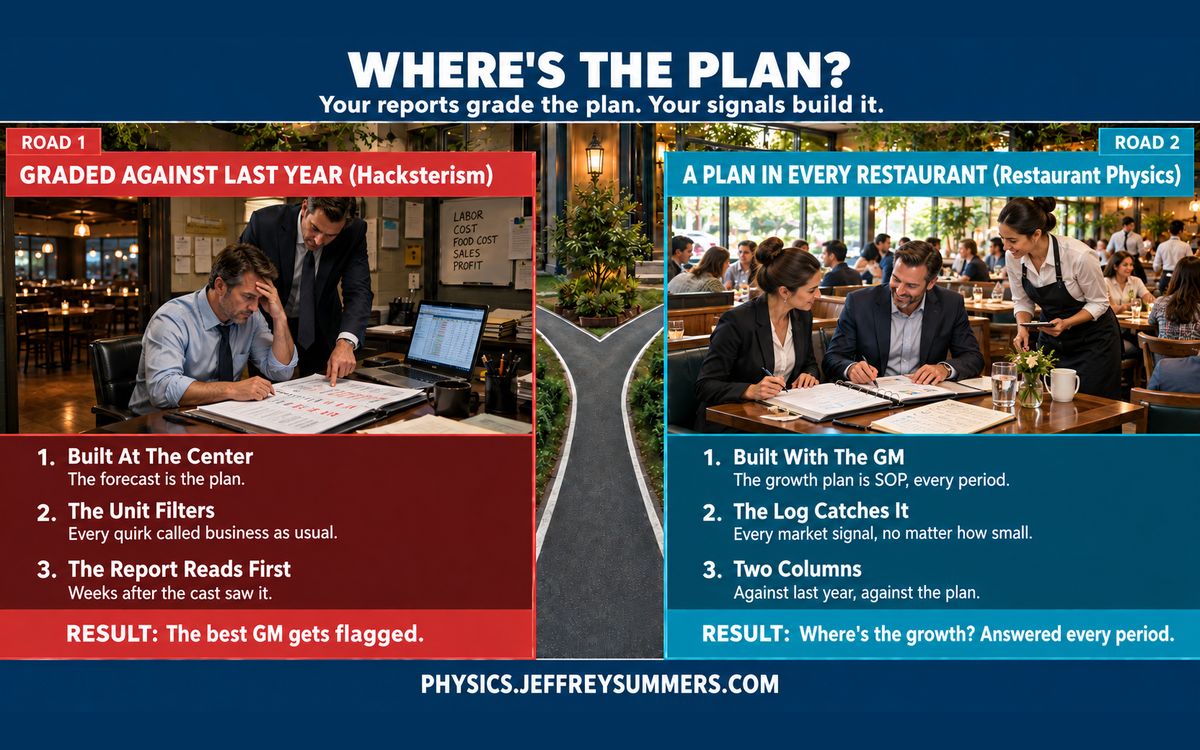

A forecast built off last year is a plan to hold last year. A growth plan has to be built in each restaurant, worked with the GM by the level above him, and read against last year and against the plan.
This is part one of two. Part one is the growth plan: why a forecast built off last year is a plan to hold last year, why accountability for the design starts at the top, and why the plan itself has to be built in each restaurant, where the market reads happen. Part two, Where’s The Plan? Part 2, is the signal chain: how what the cast sees every shift gets logged, read for patterns and taken back into the plan weeks before any report shows it.
A forecast built off last year is a plan to hold last year, and a restaurant measured against one will flag its best GM and pass the one quietly losing the business, because the only thing a forecast can see is distance from a year that’s already over.
Diane Hodges, a director of operations running ten restaurants across three concepts, asked the question on LinkedIn this week: “What operating signal do you check first when a location starts to drift?” Her own list was labor against the forecast, food cost and inventory, Guest feedback, and whether managers have the training and authority to solve problems. “The numbers tell you where to look. The field conversation tells you why.” Almost every answer in the thread named a report: schedule drift, labor variance, remakes by shift. Every one of those is a lagging trace. The question assumes drift starts in the location and that the job is to catch it. It starts higher than that, with a design that never required a growth plan, and accountability for the design runs from the top down.
The Signal That Flagged The Best GM In The Room
Jason Taliaferro told the story a few days ago. A quarterly business review, a brand built on quality food, quality service and tight costs. One restaurant stood out: labor up over the prior months and over last year, productivity down. “It was glaring. Nobody needed it pointed out.” When the GM’s turn came, he had a plan. His restaurant was surrounded by offices, and for a year he’d been losing lunch. He wanted it back. One extra host, one extra server, above the labor model, for 90 days. At 90 days more Guests were coming in and sales were growing. Within six months lunch paid for both of them and they’d added two or three more. For years after, that restaurant had the strongest lunch sales in the region.
Run that restaurant through the first signal on Diane’s list. Labor against the forecast flags it. By that read, the best plan in the region was the location that had drifted. The read that’s supposed to catch decline caught growth and put the GM who was building something in front of the room to explain himself, while the GM sitting right on forecast, quietly losing lunch to the office park, passed every check.
Jason put the cost of that in one line: “The review that grades the number and skips the cause kills the right bets right alongside the wrong ones.” And it doesn’t stop at the bet. Kill the right bet once and every GM at that table learns the lesson. Nobody walks into the next review with a plan above the model. They hit the labor number, staff by default, and the review ends up producing the exact operation it was built to prevent.
Every outcome in a restaurant traces to one of two causes, design or default. There is no third cause. The labor line can’t tell the difference. His two extra people had a purpose, a time limit and a measure. Put the same two heads on a shift because the lead is covering a hole on the line and the labor line reads them as the same number. One built the strongest lunch in the region. The other makes a broken shift that much more broken.
A Forecast Is Not A Growth Plan
Diane’s list measures every location against a forecast, and a forecast built off last year’s numbers is a plan to hold last year. That isn’t a growth plan. It’s a default plan. A location that drifts from it was already declining, because holding is not a state a restaurant can stay in. Everything in the operation is either getting better or getting worse, and the one that is holding is getting worse slowly enough that nobody has noticed yet. My work calls that [Static Decline].
In the ideal state there should have been a plan in place for growth. Where is it?
It can’t be something you ask for after the numbers move. “Show me your plan” is the question of a system that never required one. A growth plan has to be standard operating procedure: every GM, every period, built before the period starts and worked through it. The process is the SOP. The content belongs to each restaurant, because each one has specifics the others don’t. Reuters found one company-run McDonald’s in Fresno charging $5.69 for a Big Mac while another company-run restaurant two miles away charged $6.89 for the same sandwich. Same company, same sandwich, a 21% difference two miles apart. Costs vary even that close, and so does what a Guest is willing to pay. If price can’t be set at the center for two restaurants two miles apart, neither can a growth plan. Most operators can tell you what they’re serving tonight. Far fewer can tell you where the business is going and how they’re going to get there. I can tell within twenty minutes of walking into an operation whether the person running it has a plan, because the ones who have one are running the business and the ones who don’t are reacting to it, hoping that staying busy is the same as moving forward. It isn’t.
It’s a growth plan, so every report against it answers one question: where’s the growth? (Where’s Clara Peller when you need her?) If the answer this period is nowhere, that’s the drift, whatever labor and food cost say. The growth has two sides. The unit’s growth, the lunch Jason’s GM won back. And the GM’s, because a plan that hits its number and leaves the GM no more capable than he was when he built it has only done half its job.
What the growth is made of matters as much as where it is. A restaurant grows revenue three ways: more Guests, a higher average check, and more frequent visits. Deeper relationships with more Guests drive all three. A Guest who trusts you brings someone, comes back sooner, and orders the bottle instead of the glass. But average check has two ways up. It rises when the Guest buys more, and it rises when the same plate costs more, and on the report the two look identical. A price that covers a real increase in cost is holding, not growing. A plan whose only growth is the same Guests paying more for the same plates isn’t a growth plan. My work calls that an extraction schedule with a growth vocabulary, under [Restaurant Arbitrage]. Cracker Barrel’s last quarter shows why: average check up 4.2%, traffic down 6.1%. The check number alone can’t tell you which kind of increase it was. The 6.1% fewer Guests can.
That’s also the difference between working on your business and working in your business. Working on it isn’t removing yourself from the Guest relationship. It’s the architecture work that needs to happen in order for those relationships to compound. Working in the business builds relationships one table at a time. Working on it builds the architecture that lets them compound. It’s just a higher function.
That is why a growth plan carries a stretch. A real stretch goal can’t be hit by repeating last period, so the plan has to change to chase it. It has to be real, though. The stretch goal nobody believes in, set from above to make the base target look ambitious by comparison, is a decoy, and a GM will report against a decoy on schedule without ever chasing it.
No plan is a real plan without built-in flexibility. When one area is tough to execute, when lunch comes back slower than the plan drew it, the GM changes the route, not the destination. Different tactics for that daypart, more weight on the dayparts that are working, so the growth still comes from somewhere. Business dictates flexibility. The line to hold is that flexibility lives in the how. A growth target that keeps getting lowered to match what happened isn’t flexibility. It’s the plan quietly turning back into a forecast.
Name the criteria in advance that would tell you the plan isn’t working. Most people call them kill criteria, but they aren’t so much a kill as a critical showing that the reality in the market has told you the current plan won’t work as is. When one trips, you don’t walk away from the growth. You recalibrate the plan.
Every plan carries two reads at once: the read that says the plan is working and the read that says it isn’t. The two have to be reconciled at some recalibration event, with the GM and the MUM working it together.
Missing the target isn’t failure. A plan fails when you stop working it.
That’s also why the report can’t read a restaurant on its own. A flat line doesn’t tell you the story. It could be a GM 30 days into a 90-day build on lunch, with a plan in place and being worked. It could be a GM losing lunch to the office park and calling it business as usual. The flat line looks the same either way. Only the plan tells you which one you’re looking at. Without one, the flat line is all you have, and it tells you nothing.
And either way, growth is going to show up as a negative against the forecast, because it’s an investment of resources. You can’t manufacture growth out of thin air. You have to put resources behind it, those resources have to come from somewhere, and they show up running against a forecast that was created against a static point of results, usually last year. Jason’s two people ran above the labor model for 90 days before lunch paid for them. A forecast built off last year has no line for that. It doesn’t just miss the growth. It penalizes it.
The GM covering a hole on the line runs negative against the forecast too. The number can’t tell an investment from a leak. The plan can.
So the report has two jobs. Last year is the baseline, and the report shows progress against the baseline: did the unit grow? And it shows progress against the plan: is the plan working the way it was drawn? Read only against the baseline, the investment looks like drift. Read only against the plan, a soft plan looks like success. Read against both, the report tells you how good or how bad you’re working the plan. What it can’t tell you is whether the plan is being worked at all. That shows up somewhere else first.
Accountability Starts At The Top
If a growth plan is standard operating procedure, then a GM without one is working inside a system that never required one, and the system belongs to whoever sits above the unit. Accountability starts at the highest level that’s accountable for that unit.
That changes what the multi-unit manager’s job is. The MUM doesn’t wait for ten plans to land on his desk and sign off on them. He constructs and works the plan with each of his GMs. With, not for. The GM owns the plan. It was his lunch and his 90 days, and the authority to act on demand has to sit with the person creating it. The MUM is in the plan beside him: building it, pressure-testing it, working it every week, deciding with him when a route needs to change. Decisions about the GM’s unit are made in consultation with the GM who runs it, not over him. My work calls that [Consultative Methodology for Leadership].
This is why most growth efforts fail at the top of most chains. They’re top-down central planning. The plan gets written at the center and handed to the unit to execute, and the unit-level talent never gets enlisted to fashion it in the first place, even though the unit is where the actual market reads happen. My work names what that produces in [Institutional Process]: skip the first stage and you get top-down decrees disconnected from the reality of whoever actually works the ground the change affects, official but ungrounded, and usually resented.
The top can redo the menu, create hocus pocus marketing, or instigate some frequency scheme of the day. None of those can see the office park. Each one is built at the center for the average unit, and the average unit doesn’t exist. It lands the same in a restaurant losing lunch to an office park, one gaining dinner from a new subdivision and one fighting a competitor that just opened across the street. Those are the only levers the center can pull without the unit, which is why it keeps pulling them. Growth that comes out of a local market has to be built by the person reading it.
The record on the last decade’s turnarounds reads the same way. When Kevin Hochman took over Chili’s, he traveled the country, sat down with his GMs and the managers above them, and asked one question: if you were CEO, what’s one thing you’d change? He brought the answers back, built the action plans off them, and went back out a couple of months later to do it again. “Most of these ideas that we’ve rolled out literally come from the field.” A fry cook’s all-day counter. Fresh guacamole made daily instead of avocados sliced every four hours. A cook who told him she’d stop counting the shrimp. Chili’s ran national value campaigns too, and plenty of people give them the credit. But the menu those campaigns sold was rebuilt from the field and from the Guest. Guests told Hochman they wanted chicken tenders in bigger bundles with more sauces, the way they could buy them at KFC, Raising Cane’s or Chick-fil-A. Chili’s cut to one tender recipe, made it really well, and sold more than 40% more tenders than it had with two. Chili’s just finished five straight years of same-store sales growth, a 71% cumulative increase.
Cracker Barrel went the other way. A $600 to $700 million transformation designed at the center, an outside agency hired for the brand refresh and experience design, a new logo and a new dining room. The logo was reversed within days and the remodels were suspended within weeks. It had months of data-driven analysis and customer insights behind it, and it still forgot to take the Guest along for the ride. Nothing on the record shows anyone asked the cast that hears the Guest every shift. Traffic fell 10% in the second quarter of fiscal 2026 and 6.1% in the fourth, and the CEO stepped down in July.
Starbucks is the case people will point to on the other side, a plan announced on the new CEO’s second day. It wasn’t top-down planning in any fantastical way. It was a return to the core philosophy Starbucks was started with: about 30% of the menu cut, discount-driven offers reduced, cup writing, condiment bars, ceramic mugs and free refills brought back, bigger rosters in the stores. Going back to basics, Starbucks’ basics. Less menu, less promotion, more people. That’s the opposite of pulling the center’s levers.
How else do you grow GMs? A GM grows by building a plan, betting on it, reading the shift against it and finding out what he got wrong, with someone above him who has done it before working it alongside him. A training binder doesn’t do that. A variance report doesn’t do that. A director who reads labor against the forecast and then has the field conversation is auditing GMs. The MUM who builds and works the plan with each of them is developing ten operators at once. The plan stops being a control document and becomes the way the company grows its GMs.
The MUM has his own plan, and the work in it is planning with his GMs. The level above him is the area operator, or AO, the seat above the district manager, which may carry the title director of operations or regional manager. The AO works ten MUMs, each working ten GMs. Each level is accountable for the design of the level below it, and works the plan with that level, not over it.
None of this is limited to a chain. It scales to the chain, the franchise and the independent, because GM, MUM and AO aren’t an org chart. They’re three jobs: someone builds the plan where the market reads happen, someone works it with him, and someone reads the pattern across everything that comes up. In a franchise system the franchisor can’t require a franchisee’s plan, but the franchise area manager can most certainly insert the growth planning process into the franchisees he consults with, building it with them and working it with them until it’s part of the culture. A field visit that only audits brand standards is accountability for compliance, delivered as a franchisor service. A multi-unit franchisee already has the whole chain inside his own company. And the independent fills all three jobs with fewer people. The jobs don’t go away.
None of this is cover for the GM. It nests. The MUM owns requiring, building, resourcing and reviewing the growth plan with the GM. The GM still owns building it, running it and reading his shift against it. Accountability starting at the top doesn’t mean it stops there.
The critical factor for a CEO is to engage the troops and work the plan from the bottom up. If the plans that come up aren’t bold enough, he doesn’t rewrite them at the center. He goes back to the cast and raises the bar. That’s what a great CEO does.
And the accountability has to be for the right thing. Holding people accountable for compliance is static decline, because the best possible result is that nothing changes. Holding them accountable for maintaining results is accountability for a forecast, and it’s how Jason’s GM ended up in front of the room for growing lunch. The accountability that works is for growing results, and for growing the people who produce them.
The First Drift Shows Up In Attitude
So what is the first signal? It’s the first place the plan stops being worked, and that shows up before any number moves.
It shows up when reporting on the plan stops, or comes in late, or keeps coming in on time and stops changing. The same numbers, the same notes, nothing new week to week. A plan being worked always changes, because the shift never runs the way the plan drew it. A report that stops changing is a GM complying, not planning.
Underneath that is attitude. The GM’s posture shifts from growing the unit to holding it, and the conversation changes with it: from what he’s trying to why it’s down, from earning numbers to protecting them. The MUM working the plan with him hears it first, in the planning conversation, weeks before it reaches any report.
The deeper version is the lackadaisical attitude toward any planning at all. The plan built at the last minute, copied from last period, turned in because it’s due and never looked at again on the stage. That isn’t drift. Nothing drifted, because nothing was planned. Did you plan to fail, or fail to plan? If the MUM is working plans with his GMs, that attitude is visible in the first planning session. If it’s still there three periods later, it isn’t the GM’s attitude anymore. It’s the MUM’s default.
The Diagnostic
Run these against your own company this week.
Test One — The Plan Test. Ask for every unit’s growth plan for this period. Not the forecast. The plan: what growth, from where, by when, and what it takes. Count how many exist, and how many were built with the MUM rather than turned in to him. Every unit without one isn’t drifting. It’s defaulting.
Test Two — The Growth Test. Take each plan’s last report and answer one question: where’s the growth? If the answer is nowhere, and the target hasn’t moved but the route hasn’t changed either, the plan has stopped being worked.
Test Three — The Change Test. Lay the last three reports on each plan side by side. If they read the same, the GM is reporting, not planning.
Test Four — The Two-Column Test. Read the last report against last year and against the plan. If you can only read one column because there is no plan, you’ve failed it.
If you fail one test, you have a gap in the design. If you fail all four, you don’t have a growth plan. You have a forecast, and it’s grading your GMs against a year that’s already over.
The Closer
Labor against the forecast flagged the best GM in the region and passed the one losing lunch, because the forecast was a plan to hold last year. The drift didn’t start in the location. It started with a design that never required a growth plan. A growth plan is SOP, built by the GM in his own restaurant, worked with him by the MUM, recalibrated when the market says it won’t work as is, and read against last year and against the plan. Accountability for compliance is static decline. Accountability for maintaining results is a forecast. Accountability for growing results, and the people who produce them, is a plan. Where’s the growth?
What You Do Monday Morning
Pull every unit’s growth plan for this period. For each one, write down four things: when the GM last reported on it, whether the last report changed anything from the one before, where the growth is, and where the last report stands against last year and against the plan. Any unit with no plan, a late report or no change goes to the top of your list, ahead of anything the labor report flagged. Then sit down with the first GM on that list and build or rebuild the plan with him, not for him.
Digging Deeper
Positions on the record:
-
Where’s The Plan? Part 2 — https://physics.jeffreysummers.com/wheres-the-plan-part-2/
-
Every Body You Throw At A Broken Shift Makes It That Much More Broken — https://physics.jeffreysummers.com/every-body-you-throw-at-a-broken-shift-makes-it-that-much-more-broken/
-
It’s the Architecture, Stupid! — https://physics.jeffreysummers.com/its-the-architecture-stupid/
-
Hope Ain’t A Plan — https://kb.jeffreysummers.com/docs/112-hope-aint-a-plan/
Terms used in this piece: The Summers Principle, Static Decline, Consultative Methodology for Leadership, Institutional Process, Restaurant Arbitrage. Definitions in the Knowledge Base (https://kb.jeffreysummers.com/).
Sources Cited In This Piece
-
Diane Hodges, LinkedIn post, September 2026 — “What operating signal do you check first when a location starts to drift?”; her signals: labor against the forecast, food cost and inventory, Guest feedback, and whether managers have the training and authority to solve problems; “The numbers tell you where to look. The field conversation tells you why”; 10 restaurants, three concepts — https://www.linkedin.com/posts/diane-hodges-a35b171b5_in-multi-unit-restaurant-operations-consistency-share-7510393932967579649-PdfJ/
-
Jason Taliaferro, LinkedIn post, September 2026 — “The worst labor number in the room belonged to the GM with the best plan”; labor up over the prior months and over last year, productivity down; “It was glaring. Nobody needed it pointed out”; one extra host and one extra server above the labor model for 90 days; lunch paid for both within six months and two or three more were added; the strongest lunch sales in the region for years after — https://www.linkedin.com/in/jasontaliaferro/
-
Jason Taliaferro, LinkedIn reply, October 2026 — “The review that grades the number and skips the cause kills the right bets right alongside the wrong ones” — https://www.linkedin.com/in/jasontaliaferro/
-
Kevin Hochman, interview, How Leaders Lead, January 2025 — GMs and above-restaurant managers asked “if you were CEO, what’s one thing you change”; “we’d go back out a couple months later and do the same thing”; the shrimp-counting example — https://howleaderslead.com/leaders/175/kevin-hochman/
-
FSR Magazine, “A Deep Dive Into The Chili’s Turnaround That Shook Up Casual Dining,” April 2025 — “most of these ideas that we’ve rolled out literally come from the field”; the all-day counter; daily fresh guacamole replacing avocados sliced every four hours — https://www.fsrmagazine.com/feature/a-deep-dive-into-the-chilis-turnaround-that-shook-up-casual-dining/
-
Brinker International, fourth quarter and full year fiscal 2026 results, August 2026 — five consecutive years of Chili’s same-store sales growth, “an unprecedented 71% cumulative increase” — https://investors.brinker.com/news/news-details/2026/BRINKER-INTERNATIONAL-REPORTS-FOURTH-QUARTER-AND-FULL-YEAR-FISCAL-2026-RESULTS-AND-PROVIDES-FISCAL-2027-GUIDANCE/default.aspx
-
Cracker Barrel proxy filing, February 2024 — transformation plan “informed by months of data-driven analysis and customer insights” — https://www.sec.gov/Archives/edgar/data/1067294/000110465924112255/tm2423783d12_defa14a.htm
-
Cracker Barrel agency appointments, March 2025 — Prophet hired for strategic brand refresh and experience design — https://www.stocktitan.net/news/CBRL/cracker-barrel-appoints-new-agency-partners-to-support-brand-2copvsti75fh.html
-
CNBC, September 2025 — Cracker Barrel suspends restaurant remodels after the logo controversy; the old logo already restored — https://www.cnbc.com/2025/09/09/cracker-barrel-restaurant-remodels-logo-controversy.html
-
Restaurant Dive, March 2026 — Cracker Barrel traffic down 10% in fiscal Q2 2026 — https://www.restaurantdive.com/news/cracker-barrel-traffic-slides-10-percent-fiscal-q2-2026/813897/
-
FSR Magazine, September 2026 — Cracker Barrel fiscal Q4 2026 traffic down 6.1% — https://www.fsrmagazine.com/growth/chain-restaurants/new-ceo-charts-cracker-barrels-path-back-to-traffic-growth/
-
AP, July 2026 — Cracker Barrel CEO Julie Masino to step down after the rebrand backlash; reversed the logo “within a few days” — https://apnews.com/article/cracker-barrel-ceo-logo-masino-9a6f052d1d5105e5f5f593f54aa517d2
-
Starbucks, Back to Starbucks two-year letter, September 2026 — plan announced on Niccol’s second day; “We brought back cup writing, condiment bars, ceramic mugs and free refills”; “We reduced discount-driven offers”; “bigger rosters, better staffing and smarter scheduling” — https://about.starbucks.com/press/2026/back-to-starbucks-two-year-anniversary/
-
NPR, January 2025 — Starbucks to cut approximately 30% of its food and beverage menu by the end of 2025 — https://www.npr.org/2025/01/28/nx-s1-5278430/starbucks-cuts-drinks-food-simpler-menu
-
Cracker Barrel fiscal Q4 2026 earnings call, September 2026 — comparable store restaurant sales down 2.1%, traffic down 6.1%, average check up 4.2% — https://www.tradingkey.com/news/transcripts/262183487-tradingkey
-
Kevin Hochman, interview, How Leaders Lead, January 2025 — Guests wanted chicken tenders in bigger bundles with more sauces, “like you go to KFC or raising canes or Chick fil A”; down to one recipe instead of two and “selling over 40% More tenders” — https://howleaderslead.com/leaders/175/kevin-hochman/
-
Reuters, via Yahoo Finance, 2026 — “In Fresno, California, Reuters found one company-run McDonald’s charging $5.69 for a Big Mac while another company-run restaurant just two miles away wanted $6.89 for the same sandwich”; Reuters could not determine whether McDonald’s AI pricing engine caused the 21% difference — https://finance.yahoo.com/technology/ai/articles/mcdonald-ai-pricing-engine-widening-025257931.html
Discover more from Restaurant Physics
Subscribe to get the latest posts sent to your email.


[…] is part two of two. Part one, Where’s The Plan? Part 1, argued that a forecast built off last year is a plan to hold last year, that accountability for […]
[…] Where’s The Plan? Part 1 — https://physics.jeffreysummers.com/wheres-the-plan-part-1/ […]