

The gap between making it and being judged for it
Every business on earth has a gap between the moment it produces something and the moment the market renders a verdict on it. A manufacturer designs a vehicle and finds out four years later whether he was right. A packaged goods company runs panels, tests markets, ships, and waits two quarters for the sell-through data to mean anything. That gap is measured in years, and everything about how those industries operate is built to survive it. Forecasting exists because of it. Market research exists because of it. Inventory risk, patents, brand equity, scale — all of it is architecture for living inside a long gap. In your dining room, that gap is zero. You produce the thing and the verdict lands in the same moment, in the same room, in front of the person who produced it. A manufacturer pays years to find out whether he was right. You find out at 8:40 tonight for the cost of one cover. That is the cheapest verification environment in commerce, and this industry has never once been told it owns it. Operators get sold the opposite story — that the room is the hardest, least forgiving, most punishing operating environment there is, and that the intelligent move is to make it behave more like a factory.Why the gap is your instrument
Value expires. That is [Constant Expiry] and it is not negotiable. Which means sustained success is not a state you arrive at and hold — there is [No Static Achievement] in this business. It is a cycle you fund, over and over, for as long as you intend to keep operating. Innovation is the input to that cycle. The gap is the price of the input. The gap sets two things at once: what a single attempt costs you, and how many attempts you get. The manufacturer gets a handful of attempts a decade and each one costs a fortune, which is precisely why he must defend his innovations with scale, patents, distribution and brand. He cannot afford to be wrong very often. You get an attempt every night, and each one costs you almost nothing. Which means your differentiation can be small and continuous instead of large and episodic. That is a fundamentally different kind of advantage and it is the one nobody can strip from you. A competitor can copy your dish by Thursday. He cannot copy your rate of renewal. So the gap is not a hardship you tolerate. It is the instrument you use, and it is the reason a room can out-invent a company with a hundred times its capital.What only exists in the present tense
Here is why the gap has to be near zero rather than merely short. Acceptable leaves no evidence. No complaint. No object to inspect. No return visit that fails to happen loudly. Nothing in your hand at all. The only moment in which acceptable and unmissable are distinguishable from one another is while it is happening, in the room, in front of your cast. The second that Guest is on the sidewalk, the difference has evaporated and all you own is a number that reads identically either way. So you design the gap down in order to catch a difference that only exists in the present tense. That is not recovery. Recovery is what every business does after a failure and it is not what this is about. This is detection of the thing that never registered as a failure at all — the perfectly acceptable evening that quietly bought you nothing. Acceptable, night after night, read as success, is [Transactional Mediocrity], and it does not announce itself. Without near-zero latency you are operating a business whose entire margin of victory is invisible to every report you own. You will read covers. You will read the P&L. Both arrive late, both are silent on the only question that matters, and treating them as though they lead is [Lagging As Leading]. When a number arrives stripped of its cause, the operator supplies a cause himself, and that is [Assumed Cause]. When the count conceals what the count was made of, that is [Cover Blindness].What raises the gap
Anything that puts something between you and a Guest raises the gap. Some of it is purchased and some of it you installed yourself for free. Purchased: app ordering, kiosks, tabletop tablets, QR codes, third-party delivery, drive-through. Each one is sold on throughput or labor, and each one is paid for in the same currency — the ceiling on how much [Meaningfully Differentiated Value] your operation is capable of producing. Self-installed and free: too many tables per cast member to have an actual exchange at any of them. Nobody on the stage during peak who is capable of reading a table. Silent expediting. No table return. A manager in the office during the only hours that matter. A comment card or a survey link standing in for a conversation. Read that second list again. Every item on it is free to remove. The cheapest ceiling recovery available to you costs nothing and requires no vendor.The two ratchets
The ceiling is the most differentiated value your operation is capable of producing at a given gap. Push the gap out and the ceiling comes down, because you can no longer detect the difference between acceptable and unmissable, and you cannot systematically produce what you cannot detect. The floor is what now counts as acceptable to the Guest in front of you. And the floor moves too — upward, permanently, every time you buy floor work. Discount to fill a Tuesday and the floor price becomes the discounted price. Run a limited-time offer to manufacture traffic and the floor now includes novelty. Put your food on a delivery platform and the floor now includes a twenty-minute arrival. The Guest does not experience any of these as a temporary promotion. He experiences it as the specification, and he holds you to it from that point forward. That is [Contract Drift]. So there are two ratchets running at once, in opposite directions. Latency walks the ceiling down and it does not come back. Floor work walks the floor up and it does not come back. The space between those two lines is the only room you have to be worth choosing, and the standard industry playbook squeezes it from both ends while calling the result growth.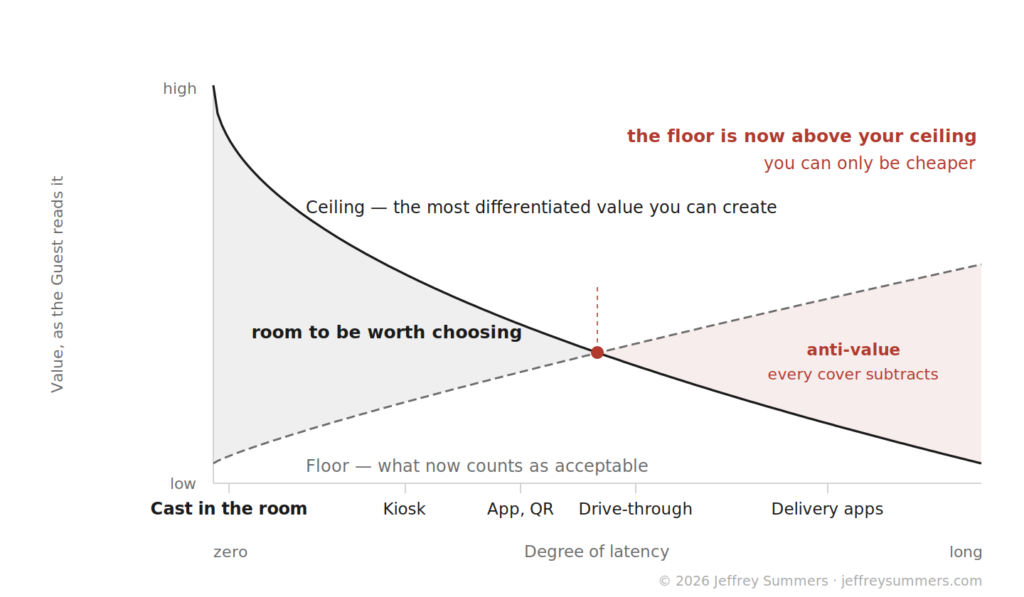 Floor work is where all the money and all the attention in this business go, for exactly one reason: the floor is purchasable, which means it can be invoiced. The ceiling is not purchasable at any price. It is architectural. You either designed the latency out of your operation or you did not. [By Design Or By Default].
And past the point where the rising floor crosses the falling ceiling, there is nothing left to sell but price. That is not a bad quarter. That is [Transactional Cost-Plus] as the only remaining move, arrived at through decisions the operator made one convenience at a time. Past that crossing, every cover subtracts — the Guest is receiving less than his own floor, so the transaction erodes your position instead of building it, and volume becomes the mechanism of the erosion rather than the cure for it.
You can run a room at a hundred percent of a collapsed ceiling. Full house, clean numbers, nothing on fire. You are not failing. You are succeeding perfectly inside a ceiling you sold.
Floor work is where all the money and all the attention in this business go, for exactly one reason: the floor is purchasable, which means it can be invoiced. The ceiling is not purchasable at any price. It is architectural. You either designed the latency out of your operation or you did not. [By Design Or By Default].
And past the point where the rising floor crosses the falling ceiling, there is nothing left to sell but price. That is not a bad quarter. That is [Transactional Cost-Plus] as the only remaining move, arrived at through decisions the operator made one convenience at a time. Past that crossing, every cover subtracts — the Guest is receiving less than his own floor, so the transaction erodes your position instead of building it, and volume becomes the mechanism of the erosion rather than the cure for it.
You can run a room at a hundred percent of a collapsed ceiling. Full house, clean numbers, nothing on fire. You are not failing. You are succeeding perfectly inside a ceiling you sold.
The diagnostic
Two audits. Run them this week. The signal audit. Take every signal your operation produces and put two numbers on it. First, latency — how long between the thing happening and you knowing about it. Second, cause — does the signal arrive with its reason attached, or does it arrive as a number. Zero latency with cause attached is a read. Long latency with cause stripped is a report, and a report is not [The Operator’s Read]. Sort every instrument you own into those two piles and count how many landed in the second one. The inhibitor inventory. Walk your operation and list every point at which something now happens between you and a Guest without a member of your cast in the middle of it. Mark each one purchased or self-installed. For the purchased ones, name what it is paying you — covers, labor line, throughput. For the self-installed ones, name why it is there. You will find that most of them exist because of a decision nobody remembers making. Then price them, because this is the calculation this industry has never been handed. Every inhibitor was bought with ceiling. Some are carrying real revenue and removing them is not free, which makes this an investment decision rather than a purge. [Everything Is An Investment]. But you cannot run the calculation until you admit what the currency is.What you do Monday morning
Pick your busiest shift this week and put yourself on the stage for the entire thing. Not expediting. Not covering a station. Not in the office with the door open. On the stage, in the room, reading tables. Your job for that shift is to find one table that is going to pay, is not going to complain, and is not coming back. Find it while it is still sitting there. Then name what, specifically, made it that table. That is the read that no report you own will ever hand you. And the fact that you had to clear your calendar to obtain it tells you precisely how far your gap has already been walked out.The frame you run now
The gap between producing the work and being judged for it is the single most valuable asset this industry owns, and it has spent fifteen years buying its way out of it one convenience at a time, each one sold as progress. The floor is purchasable. The ceiling never was. You cannot buy the ceiling back — you can only stop selling it. To understand what not to do, as it exists in the wild, go to [Hacksterism](https://hacksterism.jeffreysummers.com/nobody-priced-the-ceiling).Digging Deeper
Positions on the record- Nobody Teaches Operators To Grow — https://jeffreysummers.com/nobody-teaches-operators-to-grow/
- Everything I’ve Written Is Free — https://jeffreysummers.com/everything-ive-written-is-free/
- Nobody Priced The Ceiling — https://hacksterism.jeffreysummers.com/nobody-priced-the-ceiling
- [Meaningfully Differentiated Value] — https://kb.jeffreysummers.com/docs/meaningfully-differentiated-value/
- [Constant Expiry] — https://kb.jeffreysummers.com/docs/constant-expiry/
- [No Static Achievement] — https://kb.jeffreysummers.com/docs/no-static-achievement/
- [Transactional Mediocrity] — https://kb.jeffreysummers.com/docs/transactional-mediocrity/
- [Lagging As Leading] — https://kb.jeffreysummers.com/docs/lagging-as-leading/
- [Assumed Cause] — https://kb.jeffreysummers.com/docs/assumed-cause/
- [Cover Blindness] — https://kb.jeffreysummers.com/docs/cover-blindness/
- [Contract Drift] — https://kb.jeffreysummers.com/docs/contract-drift/
- [By Design Or By Default] — https://kb.jeffreysummers.com/docs/by-design-or-by-default/
- [Transactional Cost-Plus] — https://kb.jeffreysummers.com/docs/transactional-cost-plus/
- [The Operator’s Read] — https://kb.jeffreysummers.com/docs/operators-read/
- [Everything Is An Investment] — https://kb.jeffreysummers.com/docs/everything-is-an-investment/
Discover more from Restaurant Physics
Subscribe to get the latest posts sent to your email.


![What A Designed [VoG] Actually Looks Like](https://physics.jeffreysummers.com/wp-content/uploads/2026/08/Depositphotos_421424488_L.jpg)
![[Transactional Arbitrage]: The Five Bets Underneath Most Restaurants](https://physics.jeffreysummers.com/wp-content/uploads/2026/08/6.png)
