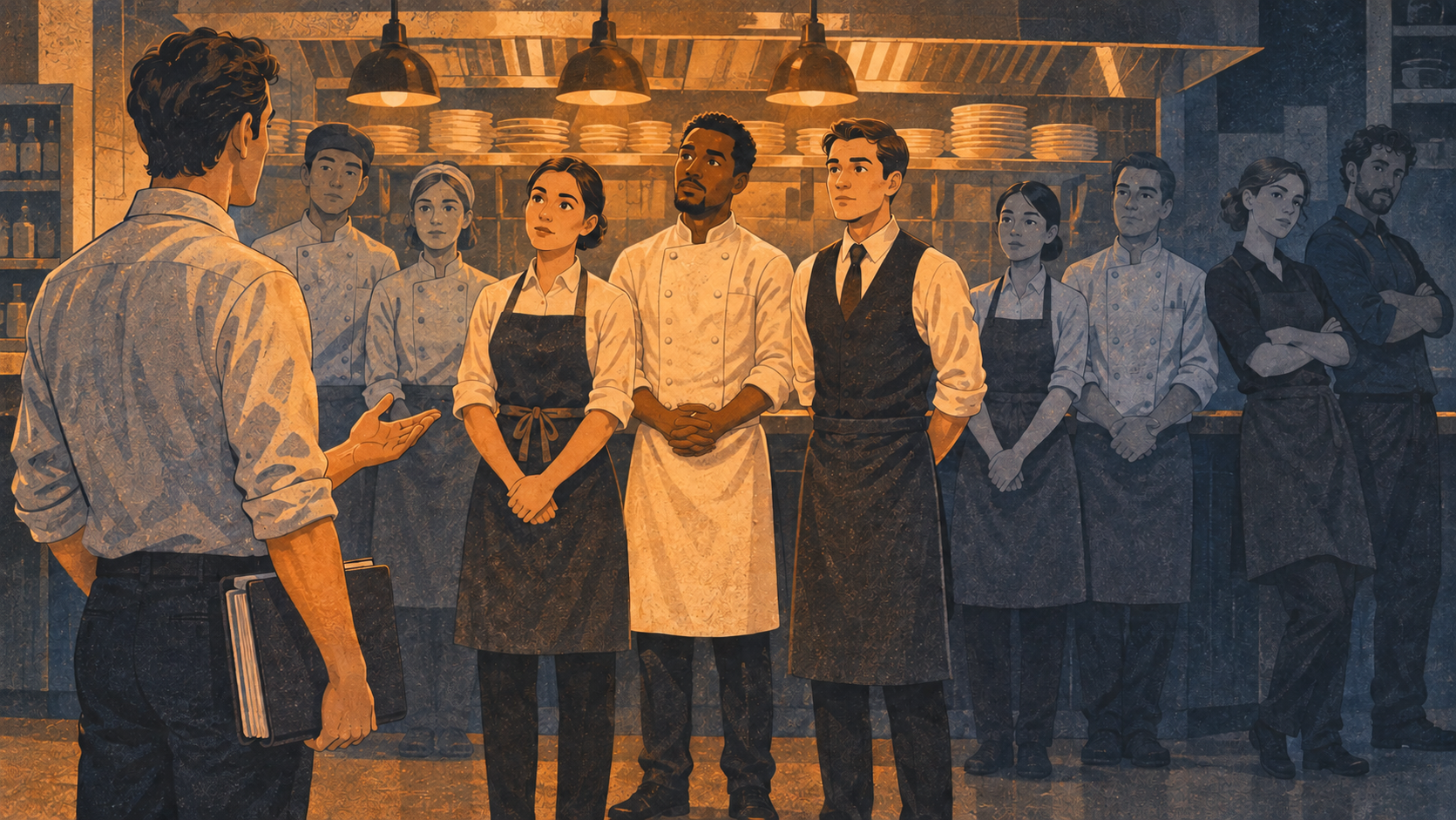

Gallup measured that the manager decides whether anything reaches the bottom line, then recommended a tool to stand in for him. In a restaurant, that manager is the operator, and nothing stands in for him.
Gallup’s State of the Global Workplace: 2026 Report runs about 251 pages. Its argument rests on one finding: engagement fell for the second year in a row, managers drive the decline, and managers decide whether a cast adopts anything, AI included. Then, on the same page that proves the manager is the variable, Gallup proposes AI coaching to make up for managers who were never developed. In a restaurant there is no layer of managers between the cast and the decision. The operator is the manager Gallup is describing. A tool installed on top of an operator who isn’t growing amplifies an operator who isn’t growing. Gallup puts the cost of low engagement at about $10 trillion a year. Obviously that’s not a number we, as operators, can relate to. In your restaurant, it’s paid one shift and one Guest at a time.
I took the whole report apart, chapter by chapter, through the restaurant business and my framework. This is the summary. The full review is a free download at the end.
Engagement Fell Again
Global engagement is 20%, down from 23% in 2022. It is the first two-year drop Gallup has recorded, and no region improved. Gallup now calls engagement “readiness for change.” Three of the twelve questions Gallup uses to measure engagement are about development, progress and the chance to learn and grow. In the U.S. and Canada, 31% of workers are engaged, 52% are not engaged and 17% are actively disengaged. For every 10 people on your cast, that’s about 3 who own the work, 5 who give you their time but not their energy, and 2 who resent the job. On a 30-person cast, that’s 9, 16 and 5. You can name the five. Gallup is measuring growth and calling it engagement. People leave an employer for one reason, no growth, and engagement is that same problem under a different name.
The Manager Is The Decline
Global manager engagement fell from 27% to 22% in one year and is down nine points since 2022. Gallup’s own line is that managers are “increasingly only as engaged as those they lead.” In a restaurant, that manager is the operator, and he sets the ceiling for everyone underneath him. An operator who keeps growing pulls his cast up. An operator who stops gets pulled down to the level of his cast. In Gallup’s best-practice organizations, 79% of managers are engaged, because those organizations treat leadership as long-term strategy. That’s a decision about leadership, and they keep making it. Put another way, about 1 leader in 5 worldwide is engaged, against 4 in 5 in those organizations. A restaurant doesn’t get an average. It gets one operator, and the cast feels which one on every shift.
AI Isn’t Failing. The Operation It Lands In Is.
65% of U.S. workers in AI organizations report personal productivity gains. Only 12% strongly agree AI has transformed how work gets done. Give a new tool to 10 cast members and, at those rates, 6 or 7 will say it makes them faster and 1 will say it changed how the restaurant works. When the manager actively supports AI, that number is 8.7 times higher, and in a restaurant there is one manager to ask: you. Technology amplifies the operation it is installed in, and freed capacity goes wherever the operation is designed to send it. When nothing is designed, it goes nowhere. The ceiling on what AI can deliver is the operator’s own judgment.
The Report Contradicts Itself
Gallup proves the manager decides whether AI works, then recommends AI to coach the manager. That treats a leadership gap as a tooling gap. The recommendation comes with no evidence, only “could” and “have the potential to.” In a restaurant, coaching the cast is a leadership discipline built one conversation at a time, and an operator can’t buy it as a subscription.
The Cast Works In The Least Engaged Category In The World
Gallup breaks engagement out by work location. Fully on-site workers who can’t work remotely are 17% engaged, the lowest of any location, and they also have the lowest thriving. Every restaurant cast falls in that category. Gallup prints the number and never discusses it. That category’s daily stress is the lowest of the four, so pressure isn’t the problem. What the cast is missing is a reason to stay, and that reason is growth.
The Job Market Turned Toward The Cast
Job-market optimism in the U.S. and Canada fell 10 points to 47%. The only gain anywhere came from fully on-site, non-remote workers, the group the operator hires from. Workers who feel they have choice in their work are nearly 50% more likely to see a good job market, in every region. Large employers are cutting staff after adopting AI, while smaller employers are adding staff. On your cast, that’s about 5 in 10 who think it’s a good time to leave, and about 2 in 10 who already believe technology will eliminate their job, so a new kiosk or ordering tool lands as a threat before you explain it. Gallup’s “smaller” employer still has 5,000 to 10,000 people, so the independent operator isn’t in this data. The direction is what matters. That split is Two Roads in miniature, and it points toward the independent operator if he designs for it.
The Operator Carries The Load
Leaders report more stress, anger, sadness and loneliness than the people they lead, with daily anger 12 points higher. On any given shift at the North American rates, about 5 of every 10 cast members walk in carrying a lot of stress and about 2 each carrying anger, sadness or loneliness. The leadership gap doesn’t need translating. In a restaurant it describes one person, the operator. Engaged leaders report less of all of it than their own cast. Independence is not isolation, and burnout is not overwork. The operator’s own growth is the only intervention in the chapter with a measured effect.
Gallup Never Measures The Guest
Gallup asks twelve engagement questions, and every one of them is about the employer. None asks about the person the work is for. In a restaurant, the cast’s attachment shows up in one place, the Guest’s experience, on every shift. Gallup measures the attachment and stops at the employer’s door. My framework follows it through the dining room, where it either pays off or gets lost. That loss has a name in my work: [Lost Opportunity Tax].
The Full Review
The full review goes through every chapter of the report. For each one it covers what Gallup found, what it means in a restaurant and what Gallup missed. It also covers the regional data, the North American age split and the Operator’s Scorecard, which runs again every year so the trend stays in one place.
Download the full review: State Of The Restaurant Workplace 2026 (PDF)
Profit is the scorecard, and Gallup’s scorecard is in. In your restaurant it reads 3, 5 and 2: three who own the work, five who give you their time and two who work against you, out of every ten. Not one of those numbers was decided in the profit column. They were decided earlier, in how leaders see the work, how the work is designed, how people are developed and how performance is read. Gallup measured all of it and handed the fix to a tool. In a restaurant, the operator is the fix. Every Guest. Every Experience. Every Day.
If you like this move, you should subscribe to The Monday Morning Move — one move, one asset, one test, every Monday: https://www.fromtheplaybook.com/subscribe
Digging Deeper
Positions on the record
- Your Cast Is Your Only Asset — https://kb.jeffreysummers.com/docs/3015-your-cast-is-your-only-asset/
- Restaurant Operational Philosophy: Why 90% of AI Rollouts Quietly Fail — https://physics.jeffreysummers.com/restaurant-operational-philosophy-why-90-of-ai-rollouts-quietly-fail-2/
- The Ceiling on AI — https://kb.jeffreysummers.com/docs/136-the-ceiling-on-ai/
- Engagement Is Not a Program — https://kb.jeffreysummers.com/docs/3390-engagement-is-not-a-program/
- Why They Leave, What It Costs, and What the Research Confirms — https://kb.jeffreysummers.com/docs/3580-why-they-leave-what-it-costs-and-what-the-research-confirms/
- Leadership Development Is the Highest-Leverage Investment — https://kb.jeffreysummers.com/docs/3190-leadership-development-is-the-highestleverage-investment/
- Burnout Is Not Overwork — https://kb.jeffreysummers.com/docs/3585-burnout-is-not-overwork/
- Independence Is Not Isolation — https://kb.jeffreysummers.com/docs/008-independence-is-not-isolation/
Terms used in this piece: Lost Opportunity Tax, Two Roads. Definitions in the Knowledge Base.
Discover more from Restaurant Physics
Subscribe to get the latest posts sent to your email.
