Transaction is the setting your operation came with. Nobody installed it and nobody argued for it. The instruments arrived measuring throughput, the counsel arrived describing throughput in relational language, and the architecture assembled itself out of what was already in the room. That condition has a name in my framework: [Transactional Default].
This piece is about the other option, and about the fact that taking it requires vocabulary before it requires tools. You cannot design an architecture you have no words for. So the build order runs Perspective first, then Product, then People, then Performance, then Profit — and the first thing you build is not a system. It is a dictionary.
Naming The Road Before You Choose The Instrument
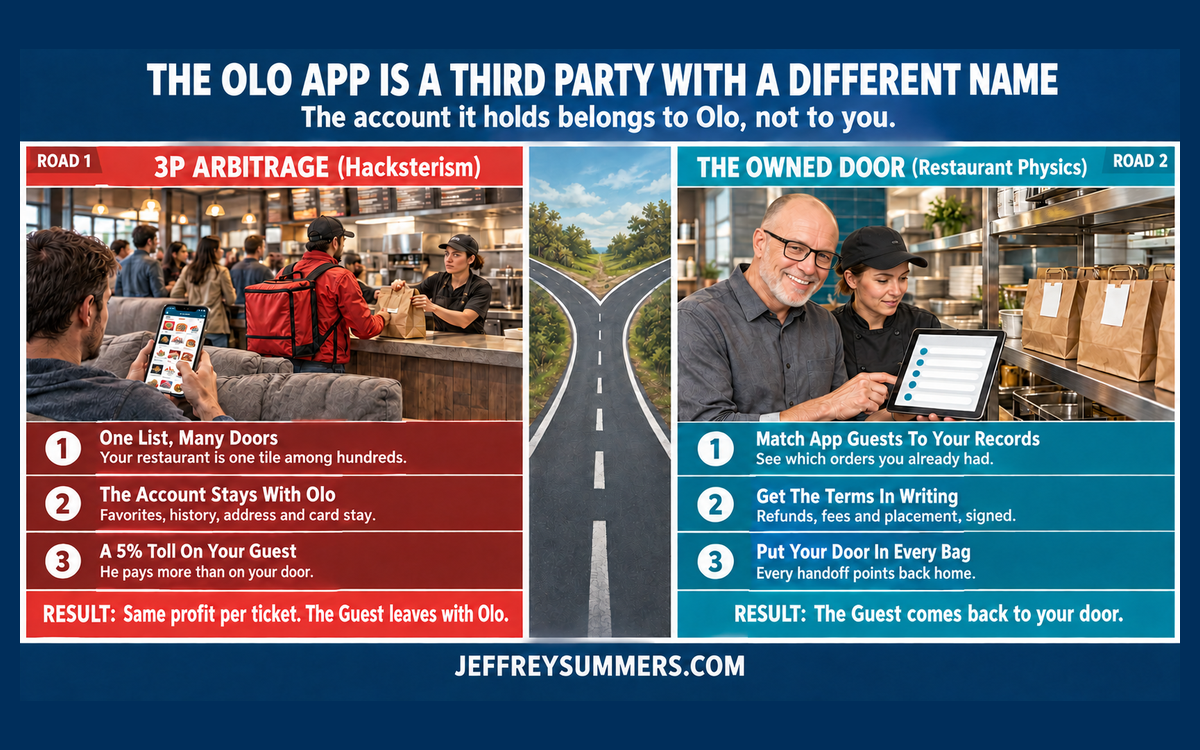
[Two Roads] is the fork. Road 1 accumulates transactions. Road 2 builds the human, relational, and operating capacity that produces durable outcomes. Both are legitimate architectures. A high-volume fulfillment operation running Road 1 on purpose, with matched instruments and honest language, is a coherent business. The failure is not Road 1. The failure is arriving on a road you never named.
So the governing discipline is simple to state and hard to hold: no instrument, program, metric, vendor, or piece of counsel gets evaluated until its road is named. Not whether the tool is good. Which architecture the mechanism serves, and whether that is the architecture you are running.
This is what a second dictionary is for. Guest against [Customer]. Hospitality produced against service executed. The [Guest Contract] against the [Customer Contract]. The GX as Product against the substrate as product. Every one of those pairs gives you a distinction the single-dictionary field cannot make, and each distinction is a decision you can now see well enough to make on purpose.
Teach the vocabulary to your leads and your cast, not just to yourself. A term that lives only in the operator’s head cannot govern a shift the operator is not working. Vocabulary the cast holds is the mechanism by which an architecture survives your absence.
Designing The Guest Experience As The Product
On Road 2 the [Guest Experience] is the Product. Not the food, not the room, not the pours — those are the substrate. The Product is the designed arc a Guest moves through from first awareness to post-visit, and it is the only thing in your operation that cannot be bought, copied, or price-matched by someone with more capital.
Design means naming the arc touchpoint by touchpoint and holding a standard at each one. First awareness, the reservation or the arrival, the greeting, the seating, the read of the table, the order, the delivery, the mid-meal check, the close, the departure, the after. Walk it in order. Mark each touchpoint Elevated or Static. Static means it functioned and produced nothing.
Then design the earliest Static mark, not the worst one. Earliest, because the arc compounds forward — a Static greeting taxes every touchpoint behind it, and an Elevated greeting funds them.
Underneath the arc sits the [Connection Floor]: the minimum a Guest should never go without, on your worst shift, with your least experienced cast, under your heaviest pressure. The Floor is not a target and it is not a guarantee. It is the minimum you should expect when the work is executed correctly, and it is the only part of the design that has to hold when everything else is going wrong.
Building The Capacity Before You Publish The Design
A designed arc that the cast cannot produce is a drawing. This is the step the industry’s counsel skips entirely, and it is the step that decides whether any of this survives contact with a Friday night.
Capacity is three specific things. Capability — can a cast member read a table, not just execute the steps at it. Coverage — is the capability present on every shift, including the ones you are not on. Cost — what the design takes to hold, in training hours, in staffing above the labor-percentage answer, in the lead’s attention on the stage.
So the People build runs in this order. Hire for the capability you intend to develop rather than for availability. Name a progression: what a cast member can do at ninety days that they could not do on day one, stated in reads rather than in tasks. Teach the read as a taught skill, because it is one. Then schedule to what the shift has to be able to hold, not to a percentage — the percentage is an outcome of the architecture, not an input to it.
And read your reward structure honestly, because it overrides everything you say. If the board in the back pays on add-ons, the board is your standard and the arc is your aspiration. Pay for what you intend to produce.
Reading The Arc Instead Of The Components
Component reads are not wrong. Covers, turn time, ticket average, and prime cost are real instruments and you need them. They are simply incapable of registering the Product, because the Product is produced in the handoffs between the roles those metrics measure separately.
So install the arc read alongside them. After a shift, take one specific party and walk their visit end to end with the lead. Arrival, seating, ordering, delivery, mid-meal, close, departure. Does it narrate as one arc, or as seven disconnected events that each went fine? That narrative — or its absence — is the read no dashboard produces.
Then put the lead where the read lives. On the stage, at altitude, reading the door, the room, the cast, and the pace at once. [The Read] is the aggregate discipline above the three thirds of your job, and it cannot be run from a screen in the office. Screens report what already happened. The stage is where in-shift leverage exists.
Keep the lagging numbers in their place and use them for what they are good at. Food cost, labor cost, and prime cost are strategic instruments — they set next period’s menu mix, staffing model, vendor conversations, and daypart decisions. They are not in-shift instruments. By the time they print, the shifts are over.
Building The Ledger That Actually Compounds
Road 1 profit comes from price, cost engineering, volume, and mix. Every one of those is available to every operator in your market, which is why the margin they produce has to be re-won every period.
Road 2 profit comes from the same Guests returning more often, bringing more people, and needing less to be spent on acquiring them. That requires a ledger the Default’s instrument set does not include: the same identifiable Guests, tracked across time. Not an aggregate satisfaction score. Names, visits, intervals, and referrals.
Read three numbers off that ledger. Return interval — is it shortening. Referral velocity — how many new Guests arrive named by an existing one. Cohort tenure — how long a cohort stays with you. Then read acquisition spend per cover against them. An operation buying the same Guest repeatedly is running Road 1 profit architecture no matter what its marketing says.
This is where the Default’s bill arrives, years after the architecture was defaulted, which is exactly why most operators never connect the two.
Holding The Design Against Constant Pull
The Default is not a resting state. It pulls. An operation that stops designing does not hold its position, it drifts transactional, because transaction is what the terrain produces when nobody is producing anything else.
That is [No Static Achievement] running at the architecture level. There is no version of this where the design is finished. Every position, standard, and capability you hold carries an ongoing motion cost, and the cost is paid every shift or the position decays. Name the recurring work — the arc read, the Floor check, the ledger read, the refusal list — and run it as a standing discipline rather than a project with an end date.
Keep a refusal list, current and named: the instruments and plays you will not run, and why, in road terms. A refusal list of zero means no standard is operating, because inside the Default every available instrument reads as neutral and reasonable.
What You Do Monday Morning
Write down the five fundamentals — Perspective, Product, People, Performance, Profit — and beside each one name the road it is currently running in your operation, with a piece of evidence. Not intention. Evidence: an instrument, a policy, a number, a reward structure.
You will get a mixed answer. Almost everyone does. Take the single Fundamental where the evidence most clearly contradicts the road you say you are on, and name the one standard that would have to be true for the evidence to change. One standard, in your words, not a tool.
That sentence is the first entry in your second dictionary. The instruments come after it, and they get chosen against it.
The Architecture Is Yours To Choose
Transaction was the setting you inherited, and inheriting it is not a moral failure. Keeping it without ever naming it is the only failure available here, because a default is still a choice — it just does not feel like one while you are making it.
Build the dictionary. Design the arc. Fund the capacity. Read the arc, not the components. Keep the ledger that compounds. Then pay the motion cost, every shift, because the pull never stops.
To understand what not to do, as it exists in the wild, go to Hacksterism.
Digging Deeper
Positions on the record.
-
What Is Restaurant Physics? — https://physics.jeffreysummers.com/what-is-restaurant-physics/
-
What The Guest Experience Actually Is — https://physics.jeffreysummers.com/what-the-guest-experience-actually-is/
-
The Twelve Laws of the Guest Experience — https://physics.jeffreysummers.com/the-twelve-laws-of-the-guest-experience-2/
-
9 Reasons Your Guest Experience Is Built To Fail — https://physics.jeffreysummers.com/9-reasons-your-guest-experience-is-built-to-fail/
-
A Mediocre Guest Experience Is the Cement Not the Platform — https://physics.jeffreysummers.com/a-mediocre-guest-experience-is-the-cement-not-the-platform-2/
-
The Tip Screen Isn’t The Problem. Your Contract Is. — https://physics.jeffreysummers.com/the-tip-screen-isnt-the-problem-your-contract-is/
-
The Industry Only Owns One Dictionary — https://hacksterism.jeffreysummers.com/the-industry-only-owns-one-dictionary/
Term definitions from the Knowledge Base.
-
[Transactional Default] — https://kb.jeffreysummers.com/docs/transactional-default/
-
[Two Roads] — https://kb.jeffreysummers.com/docs/the-two-roads/
-
[Guest Experience] — https://kb.jeffreysummers.com/docs/guest-experience/
-
[Connection Floor] — https://kb.jeffreysummers.com/docs/connection-floor/
-
[Customer] — https://kb.jeffreysummers.com/docs/customer/
-
[Customer Contract] — https://kb.jeffreysummers.com/docs/customer-contract/
-
[Guest Contract] — https://kb.jeffreysummers.com/docs/guest-contract/
-
[The Read] — https://kb.jeffreysummers.com/docs/the-read/
-
[No Static Achievement] — https://kb.jeffreysummers.com/docs/no-static-achievement/
Discover more from Restaurant Physics
Subscribe to get the latest posts sent to your email.