
Ask a room of restaurant operators what business they are in and the answers arrive in a predictable spread. Food. Service. Hospitality. Experience. Community. Family. Some version of “we take care of people.” The vocabulary is warm. The answers sound right in the room. And every one of them is a description of what the operator wants the operation to be, not a read of what the operation actually is.
That gap between the operation the operator describes and the operation the physics reveals is where my work lives. [Restaurant Physics] is the frame that closes the gap. Not by prescribing what the operation should be. By naming what it already is, whether the operator has seen it or not.
The Frame
[Restaurant Physics] is the actual, real-world structure of the restaurant industry. A two-strand architecture that constitutes the industry itself, whether the industry sees it or not. One strand centered on the Customer, running on [The Service Contract]. One strand centered on the Guest, running on [The Hospitality Contract]. Two complementary contract forms. Every operation running today is executing one, the other, or a confused mix of both — and the mix is what most operations run without ever naming it.
The physics is not authored. I did not construct it. No trade publication named it. No franchise system codified it. No industry association ratified it. The physics operates because contracts operate — the party-defining mechanism between operator and Guest, operator and cast, operator and market. The physics has always been there. My move was naming it so the operator could read it.
The physics operates the same way in every concept, every format, and at every price point. QSR drive-thru. Three-star tasting menu. Hospital cafeteria. Resort steakhouse. Ghost kitchen. Sports concession. Corner bar. Hotel breakfast buffet. The walls change. The customer base changes. The margin structure changes. The physics does not. That cross-format holding is not decoration on the frame — it is what makes the frame a physics rather than a preference. [Restaurant Constant] holds: every venue in the industry is a restaurant plus a contextual modifier. Different walls, different customer base, same business underneath. If a framework does not hold across every format an operator can name, it is not a physics. It is a house style dressed up as one.
Two more distinctions before the body opens. [Restaurant Physics] is not my framework. My framework is the discipline that reads the physics. The physics is what the discipline reads. Collapsing the two produces the industry’s most common misreading: treating the physics as a system the operator can adopt or reject. The physics is not adoptable. It is already operating. The operator can only read it or fail to read it.
And the physics is not neutral. It does not permit neutrality. Every operation runs one strand as its whole-business commitment or drifts between both and pays [Static Decline] on the mismatch. There is no third strand. There is no middle strand. There is no compounding mix. The mix that operators default into is what produces [Transactional Mediocrity] as its terminal state. The physics is binary at the whole-business altitude, and the operator who refuses to choose is choosing default.
The Standing Behind The Naming
I have been sitting inside the restaurant industry for forty-four years. Twenty as an operator. Twenty-four as counsel to operators. One hundred fifty concepts opened under my eye. Every format the industry runs. Every price point the industry serves. Every failure mode the industry produces. And for the last decade I have been watching the industry’s counsel class — trade publications, franchise systems, consultants, technology vendors — build an operating vocabulary that treats hospitality and service as interchangeable synonyms.
That collapse is the single most expensive mistake in the industry’s operating lexicon. It hides the physics from the operator. It allows [The Service Contract] operations to describe themselves under [The Hospitality Contract] language. It produces an operating class trained to see two strands as one thing, taught to execute one strand under the vocabulary of the other, and left without the diagnostic to name why nothing compounds.
I named [Restaurant Physics] because the industry’s counsel would not. And because until the physics is named, every corrective the operator attempts operates inside whichever strand the operation has already defaulted into — without the operator ever knowing which strand that is.
What The Body Of This Piece Delivers
Eight moves. The two strands, named as two contract forms and separated at the mechanism level. The load-bearing distinctions that keep [Restaurant Physics] from being collapsed into adjacent frames. The two forces operating on every building — [The Ride] — and why holding Road 2 is active work, not a settled choice. The two operating sequences the strands produce — [Compounding Loop] and [Contraction Loop] — and the daily lever that reads which one is running. The physics operating across all five fundamentals — perspective, product, people, performance, profit. Seven diagnostic tests any operator can run against their own operation this week. The industry-level failure pattern the physics reveals when read at scale. And the one move the operator makes tomorrow that starts the shift.
Read the whole piece before running the tests. The tests are the payoff. The frame is what makes them legible.
The Two Strands
[The Service Contract] is the transactional contract form. Offer, acceptance, compensation. The Guest arrives. The operation delivers food and beverage at the standard the protocol specifies. The Guest pays. The transaction closes. Compensation settles at the visit’s close-out and no consideration is deposited above the transaction. The Guest returns only if the next transaction reads favorably at that moment. There is no accumulated tenure to draw on because tenure was never the contract’s mechanism. Every visit is a spot contract. Every visit settles at that visit. No obligation carries forward on either side.
That is not a criticism of [The Service Contract]. [The Service Contract] is what most of the industry runs and most of the industry runs it at scale because it is what scales. Franchise systems scale [The Service Contract] because [The Service Contract] is codifiable in a training manual. QSR runs [The Service Contract] because the transaction density and the throughput math require it. Casual dining runs [The Service Contract] as its structural default with a service-standard veneer layered over it. Nothing about [The Service Contract] is dishonorable. What is dishonorable is running [The Service Contract] and claiming to run [The Hospitality Contract] because the marketing sounds better.
[The Hospitality Contract] is the relational contract form. Offer, acceptance, consideration. The Guest arrives. The operation produces hospitality — reading the person in front of them, responding to what they actually see, depositing consideration above the compensation of the transaction. The Guest pays for the food and beverage. The consideration deposited above the transaction is what remains between visits, accumulating across the relationship as tenure. The Guest returns because consideration has been deposited above compensation over time. The operator sustains the operation because the accumulated consideration is what produces natural-level output.
The verb pair is not incidental. You produce hospitality. You execute service. Those are two different verbs governing two different contract forms doing two different kinds of work. Any language that collapses the verb pair is language that hides the physics. Any operator who runs the collapse in their own vocabulary — using “hospitality” and “service” as if they described the same act — has already conceded the physics-honest read before the shift starts.
The two strands are complementary, not exclusive. Every operation runs both. [The Service Contract] governs the technical delivery of food and beverage — the execution of the sequence at the standard the protocol specifies. [The Hospitality Contract] governs the relational architecture the technical delivery sits inside. The question is not which strand the operation runs. The question is which strand the operation commits to as its whole-business choice, and whether that commitment is being executed by design or defaulted into by the vocabulary the operator inherited.
That commitment — named, defended, executed against — is the whole-business decision. Every subsequent decision inside the operation runs against that commitment or defaults against it. The physics does not care which strand the operator commits to. The physics only reads whether the operator has made the commitment and whether the operation is being built against it.
The contract-form choice propagates through counterparties. [The Guest Contract] — the contract signed by the operator and the Guest at each visit — takes its form from whichever parent contract governs the whole business. Under [The Hospitality Contract] as whole-business commitment, the Guest Contract deposits consideration above compensation and accumulates as tenure. Under [The Service Contract], the Guest Contract closes at the transaction with no consideration deposited. [The Cast Contract] — the contract signed by the operator and the cast at each shift — takes its form from the same parent. Under [The Hospitality Contract] as whole-business commitment, the Cast Contract deposits consideration above compensation as development, tenure trust, and participation in the operation’s future. Under [The Service Contract], the Cast Contract settles at pay period and nothing deposits above.
The counterparty consistency is load-bearing. An operator running [The Hospitality Contract] with Guests but [The Service Contract] with cast produces cast who cannot execute hospitality because they have not experienced hospitality. The parent contract form choice has to run consistently across counterparties or the mechanics break down. Cast members read the parent contract regardless of what the operator says about it. The Guest reads the same parent contract through the cast’s execution. Both counterparties are signing the same underlying contract form, whether the operator has named it or not.
The Load-Bearing Distinctions
[Restaurant Physics] is a container-tier frame. It holds every other locked term in my published work. Because it holds so much, it gets collapsed into adjacent frames easily. Seven distinctions keep the frame doing its work.
Not my framework. My framework is the discipline that reads the physics. The physics is what the discipline reads. Collapsing them treats the physics as a system to install rather than a reality to read. The physics is not installable. My framework is what makes the reading possible.
Not the read discipline itself. [The Summers Principle] is one of three integrated instruments my framework runs. It is the read discipline — the instrument that reads the physics from outside the operation. The physics is what the read reads. Collapsing them treats the instrument as the object, which produces the operator who confuses running a discipline with reading a reality.
Not the five fundamentals. The five fundamentals — perspective, product, people, performance, profit — are the anatomy inside each strand of the physics. They are what my framework reads through. The physics is the two-strand architecture the fundamentals sit inside. Every fundamental operates under both strands; the physics determines which strand each fundamental is being executed in. Collapsing them treats the anatomy as the architecture — which produces the operator who runs the fundamentals without knowing which strand they are running them under.
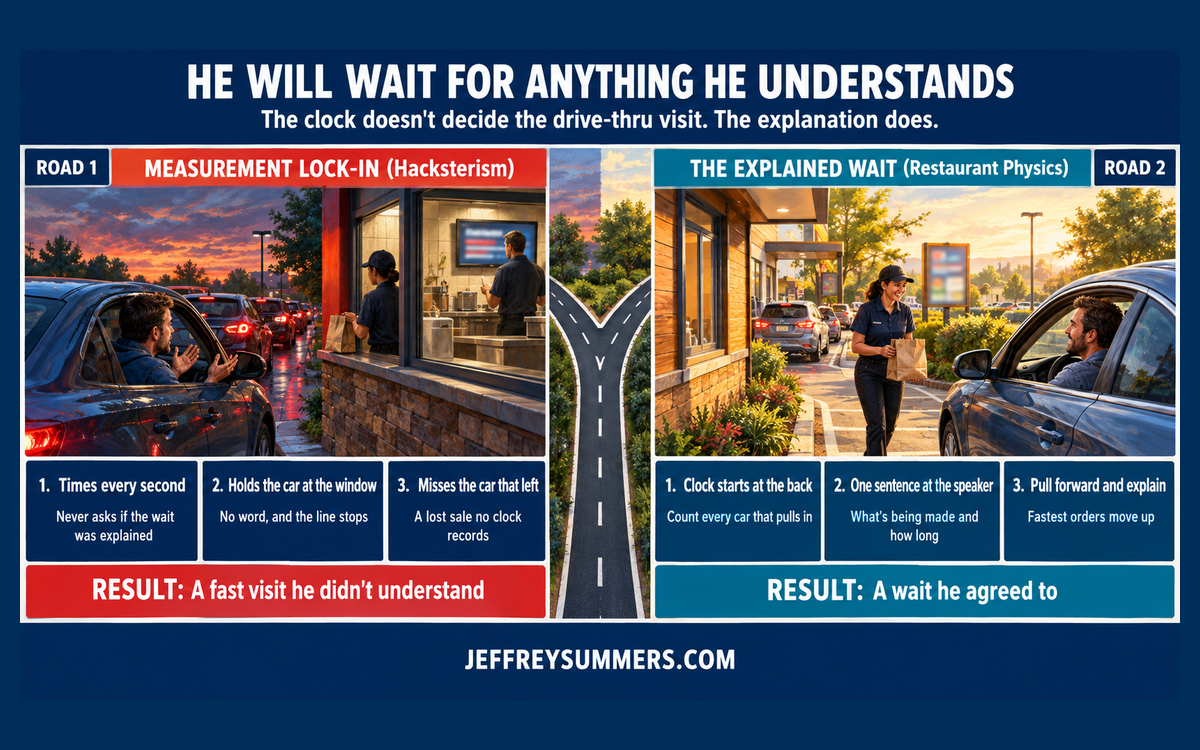
Not the road choice. [Two Roads OP] is the binary choice the physics surfaces at every decision point. Road 1 is transactional thinking. Road 2 is relational thinking. But [Two Roads] is what the read produces for the operator at each individual decision. The physics is the underlying two-strand architecture that makes the choice legible in the first place. Collapsing them treats one Road 2 decision as if it were a whole-business commitment to [The Hospitality Contract], which produces the operator who thinks running Road 2 in one moment converts the operation.
Not the daily lever. [Zero Plus Minus] is the per-shift altitude expression of the physics operating either forward or backward. Every shift, the operator either adds value (Plus) or defaults (Minus) — there is no third option. Plus is the physics running forward under Road 2. Minus is the physics running backward under Road 1 or under a confused mix. [Zero Plus Minus] is not the physics; it is the daily reading of the physics at shift altitude. Collapsing them treats the shift result as the physics, which produces the operator who reads today’s numbers as the whole read and misses the architecture underneath.
Not a methodology. [Restaurant Physics] is not something the operator installs, adopts, or opts into. It is not a set of rules imported from another industry and dressed up for restaurants. It is not a philosophy the operator agrees or disagrees with. It is the structural reality of the industry — what is, whether it is named or not. The operator who treats the physics as a methodology has already misread it. The physics is the read’s object, not the read’s product.
Not neutral. The physics does not permit neutrality. Every operation runs one strand as its whole-business commitment or drifts between both and pays [Static Decline] on the mismatch. There is no third strand. There is no middle strand. The mix that operators default into is what produces [Transactional Mediocrity] as its terminal state. Neutrality on strand-choice is a decision. It is the decision to default. Under the physics, the default is almost always [The Service Contract] executed under the vocabulary of [The Hospitality Contract].
Those distinctions matter because [Restaurant Physics] is the frame that makes every other frame do its work. Without the physics named, [The Service Contract] and [The Hospitality Contract] read as competing philosophies rather than as the two strands of the industry’s actual structure. Without the physics named, [Two Roads OP] reads as a stylistic preference rather than as the binary the industry’s architecture forces at every decision. Without the physics named, my framework itself reads as one more consultant’s system rather than as the discipline that reads what is.
Naming [Restaurant Physics] is what makes my framework a read of reality rather than a proposal about how restaurants should be run.
The Ride
The physics also produces a constant two-directional force operating on every full-service restaurant every day. I call it [The Ride]. Road 1 exerts a gravitational pull — standardization, hidden-wage economics, transactional Guest relationships, food-service comp logic, chain-format operating math — all of it dragging the building toward transactional architecture whether the operator authored the drag or not. Road 2 requires an active push — the operator holding the relational architecture in place against the pull every day the building is open.
The pull never stops. The push has to be deliberate, daily, and led by the operator. A building without push does not stay neutral. It drifts toward Road 1 by default. That is not because Road 1 is aggressive; it is because Road 1 is the industry’s ambient physics — the default gravitational field the building sits inside. Vendors default toward it. Trade press defaults toward it. Peer operators default toward it. Franchise documents default toward it. Consultants default toward it. Every external force operating on the building is pulling toward Road 1, because Road 1 is what the industry has learned to scale.
The operator who does not name [The Ride] runs the operation as if the Road 2 architecture were a settled achievement they built once and can now maintain by inertia. That misreading is where most Road 2 operations quietly convert to Road 1 operations without the operator noticing. The relational architecture does not collapse in a dramatic event. It erodes. One vendor decision that pulls toward Road 1. One hire whose defaults were built under Road 1. One menu change made under Road 1 comp logic. One cost pressure absorbed by cutting a Road 2 discipline. Six months later the operator is running a Road 1 operation with a Road 2 vocabulary and cannot explain why the compounding stopped.
Reading [The Ride] is what makes the Road 2 commitment real. The operator names the pull. The operator names the push. The push becomes a daily discipline rather than a founding decision. Every shift is another day of Road 2 held against the pull, or another day of drift the operation cannot recover from without reconstruction.
The Two Loops And The Daily Lever
The two strands do not sit still. They produce two different operating sequences the operation runs shift after shift, period after period, year after year.
[Compounding Loop] is the Road 2 operator’s default operating sequence. Six beats — Build the Read, Run It, Name the Decision, The Gate, Act at Speed, Read the Result — running forward. Each loop closes and opens again higher than it started. The floor rises in increments too small to be dramatic and too consistent to miss when the operator looks at the twelve-month read. The Guest base thickens with tenure. The cast develops. The options expand. The margin compounds not because the operator ran a program but because the relational architecture generates tenure and tenure generates natural-level output.
[Contraction Loop] is the Road 1 operator’s default operating sequence. The same six beats, run in reverse. Each loop closes lower than it opened. Not dramatically. Quietly. The operator reads from the dashboard rather than from the operation. Individual reads never converge. Decisions get made by default rather than by design. Actions land without a gate. The operator lands the action at the wrong speed on the wrong problem. The operator reads an improved number off the dashboard and calls it progress while the cause was never touched. [Contraction Loop] does not produce dramatic failure. It produces quiet decay: the floor dropping in increments too small to trigger an audit, the ceiling never moving, the Guest base thinning without complaint, the cast hollowing without drama, the options narrowing without announcement. By the time the P&L shows it, the shifts are already over.
Both loops run under the same higher law. [Law of Constant Motion] holds: there is no neutral in an operation. Every decision either compounds what came before it or contracts it. Because there is no standing-still option, every choice is already moving the operation in one direction or the other whether the operator notices or not. The operation is either running [Compounding Loop] under [The Hospitality Contract] or running [Contraction Loop] under [The Service Contract] executed as a whole-business default. There is no third loop.
[Zero Plus Minus] is the daily altitude expression of the law. At the per-shift altitude, the operator either adds value (Plus) or defaults (Minus). Plus is the shift running forward — the loop closing higher than it opened, the read sharpening, the next loop starting higher. Minus is the shift running backward — the upstream decision unexamined, the next loop starting at the same floor or lower. Every shift registers Plus or Minus. There is no third register. The operator who reads [Zero Plus Minus] honestly at end of shift is reading the physics at the altitude the operator can most directly affect. The operator who does not read [Zero Plus Minus] is running the physics without a daily instrument.
The forks resolve at named moments. Every [Point Of Experience] — every interaction between cast and Guest, every decision moment the operator faces, every fork the shift produces — resolves one way or the other. [Cast Member’s Fork] runs at the stage: serve the Guest by design or default into transactional behavior. [Operator’s Fork] runs above it: build the operation by design or default into the industry’s ambient physics. Every fork resolves at a [Point Of Experience]. There is no neutral resolution. The unresolved fork is the fork that defaulted.
The Physics Across The Fundamentals
[Restaurant Physics] operates across all five fundamentals. It is the physics the fundamentals sit inside, not a term nested under one fundamental. The [Five Fundamentals] run in a locked sequence — perspective → product → people → performance → profit — because you think it, then you build the system, then you fill the roles, then you run it, then you monetize it. Reversing the order produces failure at the reversal point. The sequence is not arbitrary; it is the logic of operational construction, running against the physics at every stage.
Perspective. Under perspective, [Restaurant Physics] is what the operator’s read is a read of. The operator’s job under perspective is to see clearly — and what the operator is seeing clearly, when perspective is running, is the physics operating in their own building. The operator without the physics named runs perspective without an object; they are looking, but at what they cannot name. The operator with the physics named reads the physics through perspective’s discipline. [Operator’s Read] is the master diagnostic under perspective — take a minute, read the situation, then reach for the response. The read runs simultaneously at six altitudes: the Stage Read (what is happening in the dining room right now), the Cast Read (what the cast is carrying into and producing during the shift), the Kitchen Read (what the kitchen’s output signals about the system underneath it), the Numbers Read (what the weekly metrics signal about the upstream decisions that produced them), the Competitive Read (what the market signals about whether the differentiation still holds), and the External Read (what is happening outside the four walls that the operator has to respond to). All six altitudes are reading the same physics. Perspective is the fundamental where the physics first becomes visible to the operator; every subsequent fundamental applies the physics the operator has now learned to see.
Product. Under product, [Restaurant Physics] determines what the operation is actually producing. Product is not the food or the menu. Product is the Guest Experience the food and menu are part of. [Experience As Business] holds: hospitality is not a product-delivery business or a service-delivery business. It is an experience-delivery business at every price point, in every format. The Guest does not come for the food. The Guest comes for the experience the food is part of. Success is determined by the aggregate actions that impact the Guest’s day, not by the food, the service model, or the drinks in isolation. The experience is the business. The physics determines what strand the experience is delivered under. Under [The Service Contract], the product is transactional throughput at protocol standard — efficient, standardized, replicable. Under [The Hospitality Contract], the product is the relational experience the Guest returns for — read, responded to, held. Product cannot be designed without first reading which strand of the physics the operation commits to. And the destination of the whole product cascade is [MDV] — Meaningfully Differentiated Value. What comes out the other side when an operator has seen clearly enough to play their own game: meaningfully (it matters, it lands, not novelty for novelty’s sake), differentiated (it is the operator’s own, it cannot be copied off a menu), value (it shows up as something people actually want and pay for). MDV is not a slogan. It is what the physics produces when the operation is built against the strand the operator has committed to.
People. Under people, [Restaurant Physics] determines which contract form the cast executes. [The Cast Contract] takes its form from the parent contract governing the whole business. Under [The Service Contract] as whole-business commitment, [The Cast Contract] runs transactional: compensation settled at pay period, offer/acceptance/compensation with no consideration deposited above. Under [The Hospitality Contract] as whole-business commitment, [The Cast Contract] runs relational: consideration deposited across tenure as development, participation in the operation’s future, trust accumulated above compensation. Cast members read the parent contract regardless of what the operator says about it. The physics determines which cast the operation is capable of building. And under people, [Cast Member’s Fork] runs at every [Point Of Experience]. The cast member who has not been built by design defaults. Not because they chose to — because the system they are operating inside did not equip them to choose otherwise. The fork is always live. The operator’s job under people is to build the cast so the by-design path is the default, not the exception.
Performance. Under performance, [Restaurant Physics] determines what the operation’s in-shift discipline is actually executing. Performance is where the strand-choice lands on the stage in real time — where hospitality is produced or service is executed at protocol standard, where the Cast Contract resolves at each Guest interaction, where [Compounding Loop] or [Contraction Loop] runs shift by shift. [Restaurant Constant] holds cross-format: whatever the format, the performance discipline runs against the same two-strand physics. Performance without the physics named is performance without a target — the operation runs the shifts but does not know which strand it is running them under. Performance with the physics named is performance disciplined against the strand the operation has committed to. And performance is where [The Ride] shows up most visibly: the pull is running against every shift, and the push has to be led by the operator every shift or the drift starts.
Profit. Under profit, [Restaurant Physics] determines whether the numbers compound or drift. Profit is the consequence fundamental — every profit outcome is the downstream consequence of a strand-choice made or defaulted into upstream. Under [The Hospitality Contract] executed by design, margin compounds because the relational architecture generates tenure, tenure generates natural-level output, and natural-level output produces margin that does not require constant transactional stimulus. Under [The Service Contract] executed by design, margin runs on transactional throughput and requires ongoing stimulus at the same intensity forever. Under a confused mix — the operation claiming one strand while defaulting to the other — [Static Decline] holds: the structural consequence of running transactional means against a relational goal, visible only after the runway is gone. The [Outcomes Formula] runs against every profit result: outcomes are the verdict on the thinking that produced them. Wrong outcomes reveal broken thinking. Luck is not a variable. The formula runs backwards — from outcome to thinking — and the thinking the formula reads is the strand-choice the operator made or defaulted into upstream. The physics is what makes the profit outcome readable in advance rather than diagnosable only after the fact.
Five fundamentals. One physics running through all of them. The operator who reads the physics reads the operation as an integrated whole. The operator who does not read the physics runs the fundamentals as five separate disciplines and wonders why they do not compound into a coherent operation.
The Diagnostic
Seven tests. Any operator can run them against their own operation this week. Each test reads one signal of which strand the operation actually commits to. Read them together — one test in isolation is a data point; seven tests together are a physics-honest read.
Test One — The Cast Contract Read. Walk into the operation for the first thirty minutes of open hours. Watch what the cast executes before the pace demands their attention, before the owner-presence adjustment kicks in, before the shift’s own gravity takes over. What contract are they executing? Are they producing hospitality — reading each Guest, responding to the person in front of them, depositing consideration above the compensation of the transaction? Or are they executing service — running the sequence at protocol standard, transactional politeness, nothing above? The cast defaults to whatever contract form the operation has actually built. The cast is the operation’s most honest read of which strand of the physics the operation actually runs, regardless of what the marketing copy says.
Test Two — The Vocabulary Gap Read. Read the operation’s public copy — website, menu, marketing, training materials — against the operation’s actual behavior. Look for the gap between what the operation says it produces and what the operation actually delivers. If the copy uses “hospitality,” “experience,” “relationship,” “family,” “community” while the operation is executing [The Service Contract] as its actual default, the operation is running [Transactional Redefinitions] — using the vocabulary of one strand to describe the execution of the other. Every operation has some gap. The size of the gap reads how far the operation has drifted from the strand it claims. And the gap is not neutral: it is a load-bearing surface where the physics has been mis-read, and the operator who cannot name the gap cannot close it.
Test Three — The Pressure Default Read. Watch what the operation defaults to when pressure hits — bad night, staffing shortage, unexpected volume, complaint escalation. Under pressure, the operation reveals which strand it has actually built as its structural foundation. An operation built under [The Hospitality Contract] does not become transactional under pressure; the relational architecture holds because it was built to hold. An operation built under [The Service Contract] but claiming [The Hospitality Contract] collapses to its actual foundation the moment pressure removes the performance layer. The pressure moment is the read. And it is [The Ride] made visible in real time: the pull toward Road 1 always intensifies under pressure, and the operator’s push either holds or does not.
Test Four — The Compounding Read. Read the operation’s Guest base over the last twelve months. [The Hospitality Contract] compounds — the Guest returns because consideration accumulated across visits, the Guest base thickens with tenure, the operation gains options as the relational architecture matures. That is [Compounding Loop] running. [The Service Contract] does not compound — the Guest returns only if the next transaction reads favorably at that moment, so the operation is running a permanent race against the last transaction’s freshness. That is [Contraction Loop] running, whether the operator has named it or not. If the operation is not compounding — same customer base year over year, no tenure deepening, no reference base growing — the operation is running [The Service Contract] as its actual whole-business commitment regardless of what the operator believes about the operation.
Test Five — The Cross-Format Read. Run the physics against operations outside the operator’s own format. Read a hospital cafeteria under the physics. Read a corner bar under the physics. Read a hotel breakfast buffet under the physics. Read a QSR drive-thru under the physics. If the physics does not hold across every format — if the operator finds a format where the two-strand architecture does not apply — the operator has not read the physics. They have read a version of their own operation and mistaken it for the industry structure. The physics holds cross-format or it does not hold at all. That is what [Restaurant Constant] locks: every venue is a restaurant plus a contextual modifier, and the same two strands operate under every modifier.
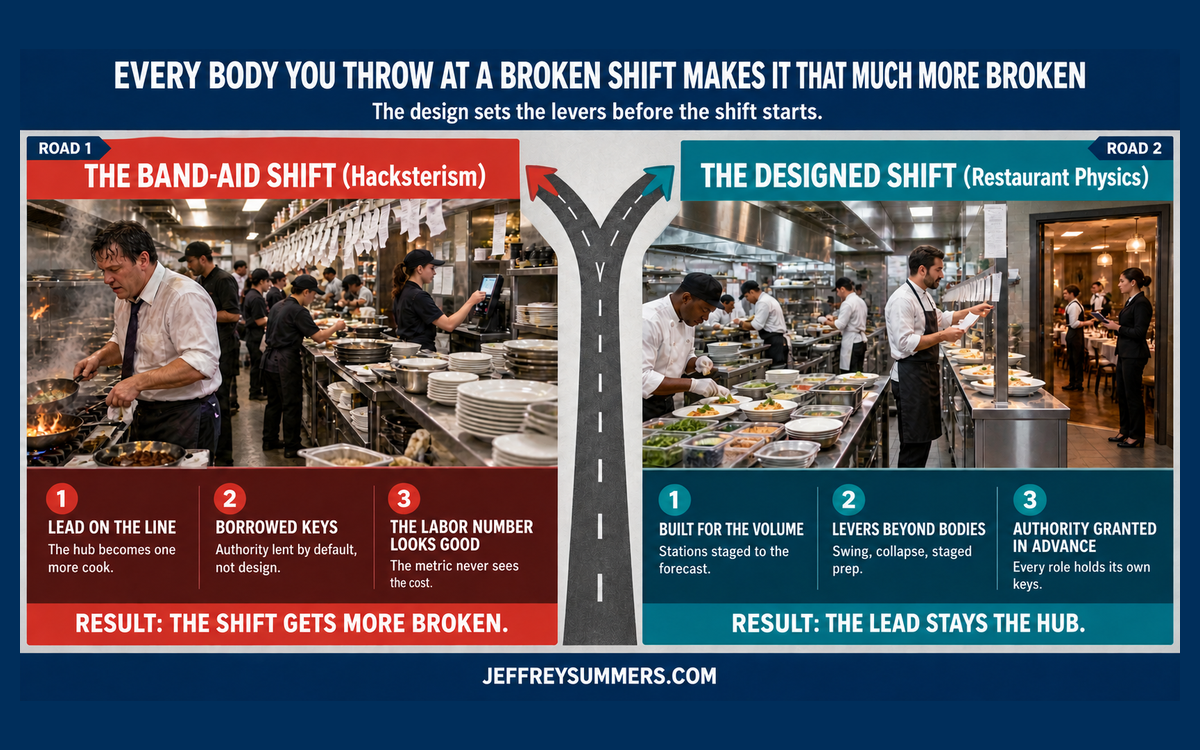
Test Six — The Industry Read. Read the industry’s dominant vocabulary. Count how often the industry’s counsel treats “hospitality” and “service” as interchangeable synonyms rather than as the two contract forms of the physics. That collapse is the industry’s default read — [The Service Contract] executed under the vocabulary of [The Hospitality Contract], at scale, as the industry’s operating norm. The operator who has read [Restaurant Physics] hears the collapse everywhere the industry talks about itself. The operator who has not read it hears the vocabulary and takes it at face value. And behind the collapse sits [Hacksterism] — the dominant industry worldview that success comes from finding and stacking transactional hacks rather than building a relational operation from the ground up. Hacksterism is not malicious. It is the natural worldview that forms when the operator has only ever seen transactional operators succeed at scale. The hack is the visible unit. The relational architecture underneath a successful operation is invisible. So the operator copies the hack and wonders why the results do not compound.
Test Seven — The By-Design-Or-By-Default Read. Pick any position the operation currently holds — hiring standard, menu decision, pricing structure, service standard, physical layout, cast development approach. Ask one question: by design or by default? [By Design Or By Default] runs as the verdict on every operator choice under the physics. There is no third option. Claims like “by experience,” “by intuition,” or “by what works” are fictions that collapse into by default. The instrument is [The Walk Question]: we walk our talk. By design or by default? If the operator can name the design — which strand it commits to, which fundamental it operates under, which road it runs — the position was designed. If the operator has to construct a rationale after the fact, the position defaulted. Under the physics, default is almost always a default into [The Service Contract] regardless of what the operator intended. The unread physics is the default physics.
Seven tests. Take them together. Name the strand the operation is actually running. Not the strand the operator intends. Not the strand the copy claims. The strand the physics reveals through the honest read.
The Industry-Level Read
The physics also matters at the industry level. Most industry-scale interventions — franchise scaling, chain expansion, private equity roll-ups, technology platform adoption — assume the industry runs on a single-strand architecture and apply a single-strand solution. The scaling of [The Service Contract] as a franchise system produces different outcomes than the scaling of [The Hospitality Contract], which most systems have not learned to scale at all. The industry’s investment logic, real estate calculations, labor models, and technology bets all assume a physics that treats the two strands as one.
That mistake is embedded in the industry’s operating math. It is why the industry’s ninety-percent-of-restaurants-fail statistic keeps holding — the failures are downstream of a physics that is unread at scale. Operations built to execute one strand while claiming the other collapse when the strand-mismatch compounds far enough that the operator can no longer hide it from the numbers. The physics did not fail. The physics is what was going to happen. The operator failed to read it.
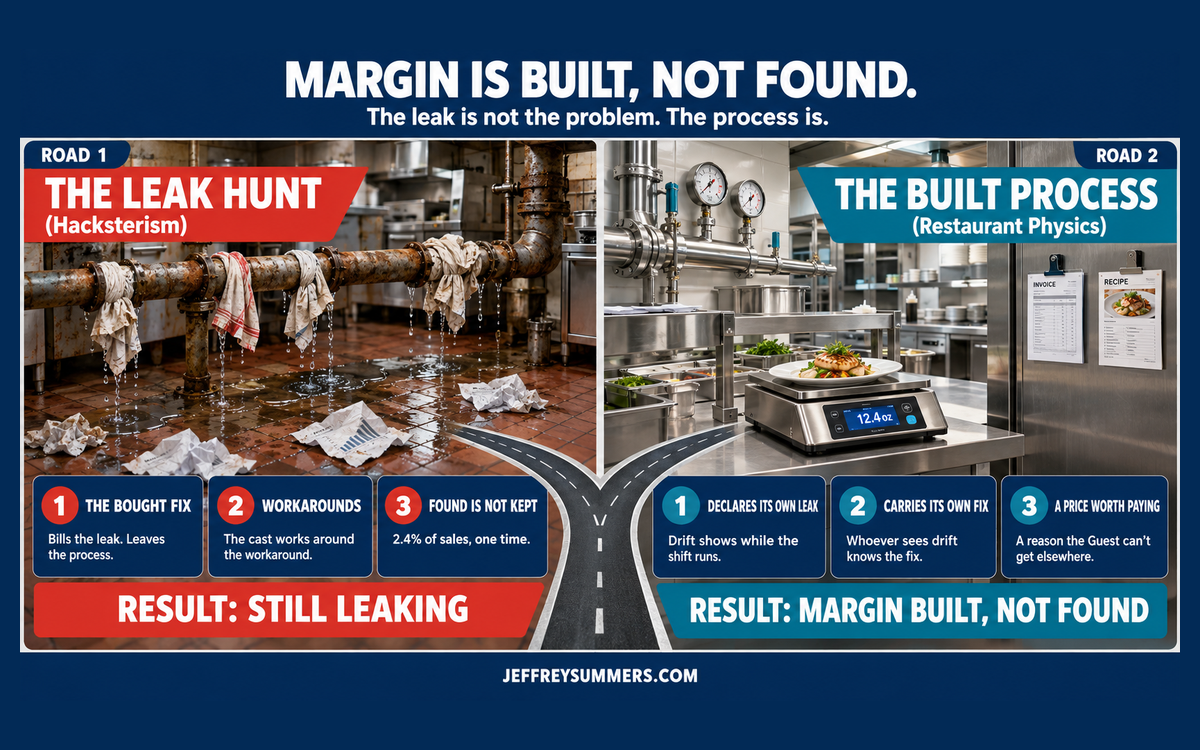
There is a named failure loop that describes exactly what happens when the operator tries to fix the strand-mismatch without reading it. [Operator’s Doom Loop]: the reverse-compounding cycle where the operator attempts to fix a structural, relational business deficit by repeatedly applying short-term transactional tactics. The loop creates temporary relief while compounding the underlying decay. It runs on three structural pillars. First, transactional substitution — the operator reframes core relational deficits (eroded trust, declining culture, flatlining cast leadership, absent MDV) as simple tooling or marketing deficits. Second, high-altitude seduction — the operator watches lagging outcome metrics on a spreadsheet rather than managing behavior in real time on the stage, trying to move P&L lines by pulling numerical levers directly and missing that dining room behaviors drive those numbers upstream. Third, downstream tax — because the upstream repair cost of tuning the operational base is skipped, the business base becomes leaky, effort fails to convert cleanly into performance, and the business pays a recurring tax of slow quiet erosion rather than building long-run momentum.
[Operator’s Doom Loop] is what most struggling operators are running. And every corrective the industry’s counsel class sells them — better dashboards, better POS integrations, better loyalty programs, better upsell scripts, better online ordering, better ghost-kitchen expansion, better franchise support — is another turn of the loop. The operator adds more transactional tools to fix a relational deficit and the deficit compounds under the added tools. The physics is not fooled by the tooling.
The industry’s counsel class carries the biggest share of that unread physics. Trade publications that pitch phrases like “hospitality-driven service” as if the two words could be coherently combined. Franchise systems that build “hospitality experiences” that execute [The Service Contract] under a hospitality vocabulary. Consultants who sell “Guest-centric transformations” that leave the strand-choice unnamed and therefore unmade. Technology vendors who market their platforms as “hospitality engines” and deliver transactional throughput optimization. Every one of those propositions runs the industry’s default linguistic collapse. Every one of them hides the physics from the operator. Every one of them leaves the operator in the position of running an operation without knowing which strand of the physics it commits to.
That is what my work is a corrective to. Not because the operators need another consultant. Because the operators need the physics named so they can read their own operations against it.
What You Do Monday Morning
Walk into the operation on Monday with one question live: which strand of [Restaurant Physics] is this operation actually committed to?
Run three reads before answering. First, watch the cast for the first thirty minutes of open hours. What contract are they executing when the pace has not yet forced them into it? Second, read the public copy against what the cast just executed. Where is the gap? Third, read the Guest base over the last twelve months. Is it thickening with tenure or running flat under transactional stimulus?
Take the three reads together. Name the strand the operation is actually running. Not the strand you intend. Not the strand the copy claims. The strand the physics reveals through the honest read.
Then make one decision. Does the operation commit to the strand it is currently running, by design, and build against that commitment? Or does the operation commit to the other strand and begin the build — starting with [The Cast Contract], because the cast is what will execute the change or default against it? Either commitment is legitimate under the physics. What is not legitimate is another day of running the confused mix and expecting the physics to bend.
That is the Monday move. Read the physics. Name the strand. Make the decision. Everything downstream — hiring, menu, cast development, capital allocation, service standard, marketing copy — runs against the strand the operation now commits to. Nothing runs by default because the default has been named and refused.
The Closer
The physics does not change. The operator’s read of it does. That read is the whole beginning of the discipline.
The industry has been running for a generation on a lexical confusion between hospitality and service. Naming the physics is what dissolves the confusion. Once the two strands are named as two contract forms — offer/acceptance/compensation versus offer/acceptance/consideration — the collapse in the industry vocabulary becomes visible. The operator who has read the physics hears it everywhere the industry talks about itself. The operator who has not read it hears the vocabulary and takes it at face value, and defaults into [The Service Contract] under the language of [The Hospitality Contract] without knowing they have made a choice.
That is what [Restaurant Physics] is. The actual structure of the industry, named. The read that makes every other read in my framework do its work. The frame the operator now runs against, or defaults against, at every decision from Monday morning forward.
Digging Deeper
Positions on the record.
-
What Is The Framework — https://jeffreysummers.com/what-is-the-framework
-
The Tool Stack Is Not A Framework — https://hacksterism.jeffreysummers.com/tool-stack-is-not-a-framework
-
The Chipotle Of X Is Framework Arbitrage — https://hacksterism.jeffreysummers.com/chipotle-of-x-is-framework-arbitrage
-
The Class That Cannot Defend What It Sells — https://hacksterism.jeffreysummers.com/class-that-cannot-defend-what-it-sells
-
Every Loyalty Program Redesign In QSR Is A Guest Contract Violation — https://hacksterism.jeffreysummers.com/every-loyalty-program-redesign-in-qsr-is-a-guest-contract-violation
-
Administered Pricing Without A Pricing Department — https://jeffreysummers.com/administered-pricing-without-a-pricing-department
-
The Case Study Is A Hack — https://hacksterism.jeffreysummers.com/the-case-study-is-a-hack
Term definitions from the Knowledge Base.
-
[Restaurant Physics] — https://kb.jeffreysummers.com/restaurant-physics
-
[The Service Contract] — https://kb.jeffreysummers.com/the-service-contract
-
[The Hospitality Contract] — https://kb.jeffreysummers.com/the-hospitality-contract
-
[The Cast Contract] — https://kb.jeffreysummers.com/the-cast-contract
-
[The Guest Contract] — https://kb.jeffreysummers.com/the-guest-contract
-
[Two Roads OP] — https://kb.jeffreysummers.com/two-roads-op
-
[The Summers Principle] — https://kb.jeffreysummers.com/the-summers-principle
-
[Five Fundamentals] — https://kb.jeffreysummers.com/five-fundamentals
-
[Restaurant Constant] — https://kb.jeffreysummers.com/restaurant-constant
-
[Experience As Business] — https://kb.jeffreysummers.com/experience-as-business
-
[The Ride] — https://kb.jeffreysummers.com/the-ride
-
[Compounding Loop] — https://kb.jeffreysummers.com/compounding-loop
-
[Contraction Loop] — https://kb.jeffreysummers.com/contraction-loop
-
[Law of Constant Motion] — https://kb.jeffreysummers.com/law-of-constant-motion
-
[Zero Plus Minus] — https://kb.jeffreysummers.com/zero-plus-minus
-
[Point Of Experience] — https://kb.jeffreysummers.com/point-of-experience
-
[Cast Member’s Fork] — https://kb.jeffreysummers.com/cast-members-fork
-
[Operator’s Read] — https://kb.jeffreysummers.com/operators-read
-
[MDV] — https://kb.jeffreysummers.com/mdv
-
[Outcomes Formula] — https://kb.jeffreysummers.com/outcomes-formula
-
[By Design Or By Default] — https://kb.jeffreysummers.com/by-design-or-by-default
-
[The Walk Question] — https://kb.jeffreysummers.com/the-walk-question
-
[Transactional Redefinitions] — https://kb.jeffreysummers.com/transactional-redefinitions
-
[Static Decline] — https://kb.jeffreysummers.com/static-decline
-
[Transactional Mediocrity] — https://kb.jeffreysummers.com/transactional-mediocrity
-
[Hacksterism] — https://kb.jeffreysummers.com/hacksterism
-
[Operator’s Doom Loop] — https://kb.jeffreysummers.com/operators-doom-loop
Discover more from Restaurant Physics
Subscribe to get the latest posts sent to your email.


[…] What Is Restaurant Physics? […]