
The operator who refuses to discount needs an architecture that makes the refusal executable. Without the architecture, the refusal collapses within a quarter. With the architecture, the refusal becomes the operating condition — the pricing discipline that produces stronger per-seat economics, stronger Guest composition, stronger positioning capital, and stronger competitive position than the discounting operation across the street will ever build.
The architecture has a name. It is [Reverse Discounting], and it is the discipline that answers the question every operator has after being told to stop discounting: what do I do instead.
The answer is not “hold the price and hope.” The answer is a full pricing architecture — a discipline the operator runs on the pricing decision the way they run their kitchen, their floor, and their Guest experience. Pricing is not a number. Pricing is an architecture.
The Anchor Question
Every discount decision begins with the wrong question. The wrong question is: what should I cut the price to?
The right question is: what is this moment worth?
That question is the operating pivot of [Reverse Discounting]. Not every seat is worth the same. Not every shift is worth the same. Not every Guest is worth the same. Not every experience is worth the same. The operator who prices as if all of these are the same is running reactive pricing — a flat number that cannot respond to what the moment actually is, so it defaults to being cut when the moment underperforms.
Strategic pricing does the opposite. Strategic pricing recognizes that pricing is a read on what the moment is worth to the Guest and to the operation together. When the moment is high-demand, the price reflects the moment. When the moment is low-demand, the offering changes — not the price of the base offering. The moment gets its own offering, at its own price, engineered for the Guest cohort that shows up at that moment.
This is not yield management as the airlines run it. This is [Reverse Discounting] as an experience-design discipline applied at Guest-experience scale.
The Base
Every price in the architecture starts from a base. The base is not plate cost. The base is plate cost plus [The X Factor].
Plate cost is the ingredient math. It is one line in a much larger cost stack, and any operator who prices from plate cost alone is structurally guaranteed to underprice, because plate cost is not what it costs to run the operation. Plate cost is what it costs to plate the item.
[The X Factor] is the full burden of operating costs beyond plate cost — labor, rent, utilities, insurance, marketing, equipment, maintenance, licensing, and profit margin. The full cost of running the operation, allocated to the item. When plate cost is 25 percent of what it costs to serve the item, [The X Factor] is the other 75 percent. Pricing from plate cost alone means pricing at a fraction of what the item actually costs to deliver.
The base — plate cost plus [The X Factor] — is the price below which the operation is operating at a loss. Not at reduced margin. At a loss. The operator who prices below the base is not being aggressive on price. The operator who prices below the base is subsidizing the Guest’s meal out of the operation’s runway.
The base is not the target price. The base is the floor. The target price is above the base. The upside is above the target. And the base is the hard floor below which the operation does not go, ever, under any operating condition, for any promotional rationale, for any period of time.
The Bands
From the base, prices move in asymmetric bands.
Premium upside bands. High-demand moments get premium pricing. Saturday dinner in season. Holiday windows. Event windows. Anniversary bookings. Prime-time reservations at the operation’s peak-demand shift. These moments are worth more to the Guest — the Guest is paying not only for the item but for the moment — and the price reflects the moment. This is not gouging. This is honest pricing of what the moment is worth to the Guest who is choosing to be there instead of somewhere else on that specific night at that specific time.
Standard bands. The middle of the demand distribution — the moments that are consistently in-band for the operation’s normal operating rhythm. These get the target price. The target price is above the base by a margin that reflects the operation’s positioning, the [Value Market] the operation serves, and the Guest cohort the operation is composed of.
Downside bands. Low-demand moments get downside pricing — but downside pricing is not the same offering at a lower price. Downside pricing is a distinct offering, engineered for the moment, priced at what the moment’s Guest cohort will pay for what the offering delivers. The Tuesday-night prix fixe is not the Saturday menu at Tuesday prices. The Tuesday-night prix fixe is a Tuesday-night offering — a curated three-course experience, a kitchen manager’s tasting, a wine-pairing evening, a themed prix fixe with a specific culinary read — priced for the Guest cohort who chooses Tuesday. The downside band is a different Product to a different Guest segment at a different price. The base offering does not move.
The bands are asymmetric because the demand distribution is asymmetric. Most operations have more upside potential than they price for, and every operation has downside moments that need engineering, not discounting. The pricing architecture reflects the asymmetry rather than fighting it.
The Hard Floor
The base is the hard floor. Below the base, the operation is operating at a loss. No exceptions.
Every operator who has ever operated below the base has done so under a strategic-loss narrative. “We are investing in acquisition.” “We are building for the long term.” “We are pricing to fill the room and make it up in volume.” “We are running a loss leader.” Every one of these narratives is an operator lying to themselves about what they are actually doing.
Operating below the base is not investment. Operating below the base is subsidy. The operation is subsidizing the Guest’s meal, out of the operation’s own runway, in the hope that the subsidized Guest will convert to a full-price Guest later. That conversion does not happen at a rate that recovers the subsidy. It has not ever, in any operating category, at any operating scale, over any operating horizon. The strategic-loss narrative is a hacksterism.
The hard floor holds because the physics does not permit the alternative. Below the floor, every additional Guest served makes the operation’s position worse, not better. The volume does not save the operation. The volume accelerates the operation’s decline. The floor is not a preference. The floor is a physical property of the operating architecture.
Strategic Value-Building: The Alternative To Markdown
The alternative to markdown is experience design. This is the load-bearing move of [Reverse Discounting] and it deserves its own read.
The discounting operator’s move on a slow Tuesday is: cut the price of what already exists. Twenty percent off the menu. Two-for-one entrees. Half-off appetizers. The offering is unchanged. Only the price is changed. This is the move that produces every failure mode the pair prosecutes.
The [Reverse Discounting] move on a slow Tuesday is: build a distinct offering. Not the same menu at a lower price. A different offering, engineered for the moment, priced at what the moment’s Guest cohort will pay for what the offering delivers.
-
Prix fixe menus for specific moments. A three-course Tuesday prix fixe with a curated wine option. The offering is a Tuesday offering. The Saturday menu is untouched. The Tuesday Guest gets a Tuesday experience.
-
Kitchen manager’s tastings during off-peak windows. A five-course tasting menu run one Wednesday a month. The kitchen manager builds the tasting around what is peaking in the kitchen that month. The event is priced for what it delivers. The base menu is untouched.
-
Wine pairings that turn a table from a food transaction into a curated evening. A pairing option that upgrades the shoulder-hour meal into an evening. Priced at what the pairing delivers. The base pricing is untouched.
-
Themed nights that give the Guest a reason to choose Tuesday over Saturday on the merits. A regional cuisine night, a producer’s-table event, a monthly guest-chef collaboration, a seasonal-ingredient night. The theme creates a moment. The moment is priced for the moment. The base offering runs unaffected.
The off-peak moment is not worth less. The off-peak moment is a different offering to a different Guest segment. The business manager who wants a quiet lunch, the student who wants an accessible dinner, the couple who wants Tuesday because Saturday is chaos — these are distinct Guest segments with distinct value calculations. The operation serves them with distinct offerings at distinct price points. Nothing gets discounted. Everything gets priced for what it is worth.
Two Roads: Why This Architecture Is Road 2
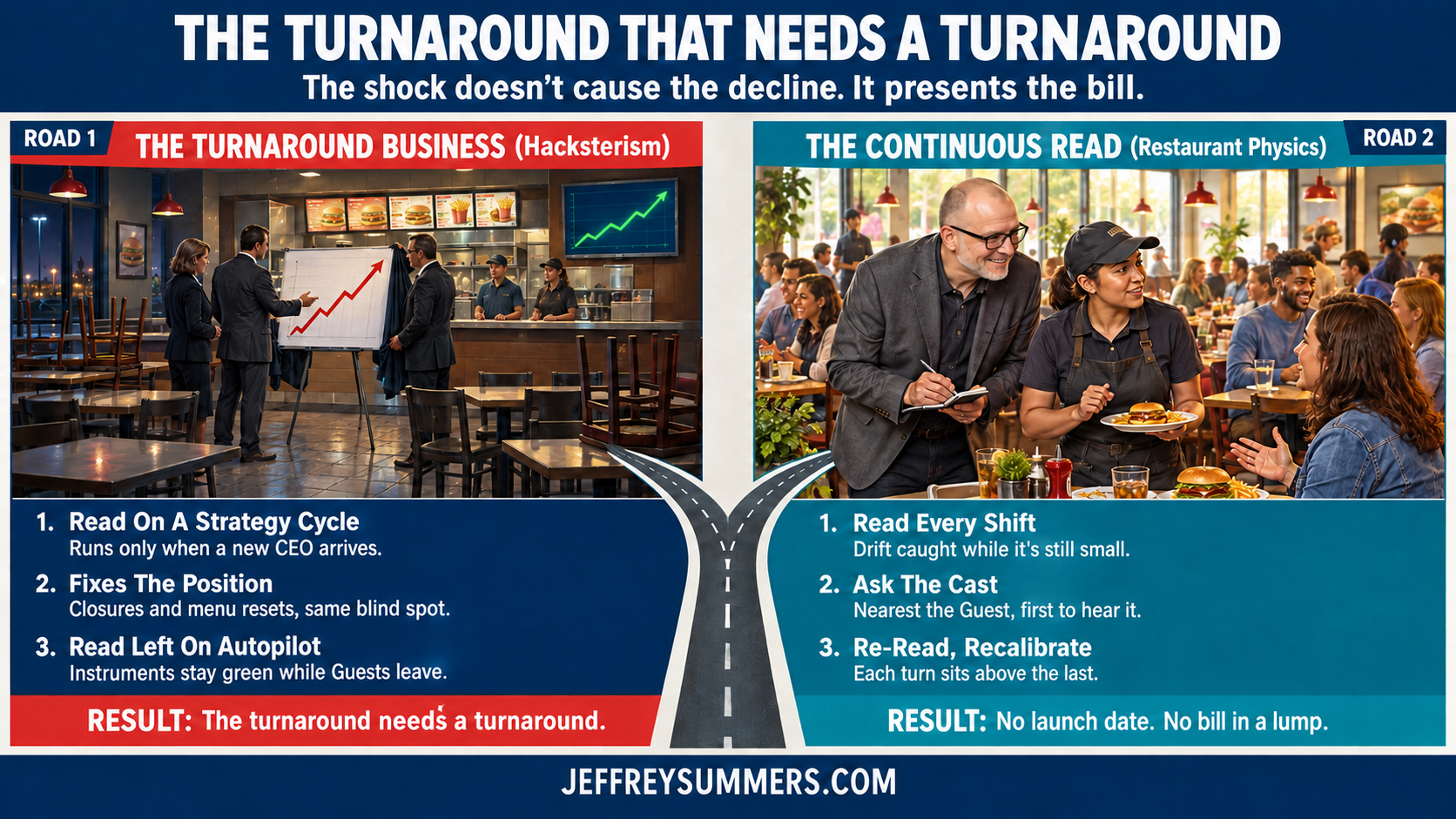
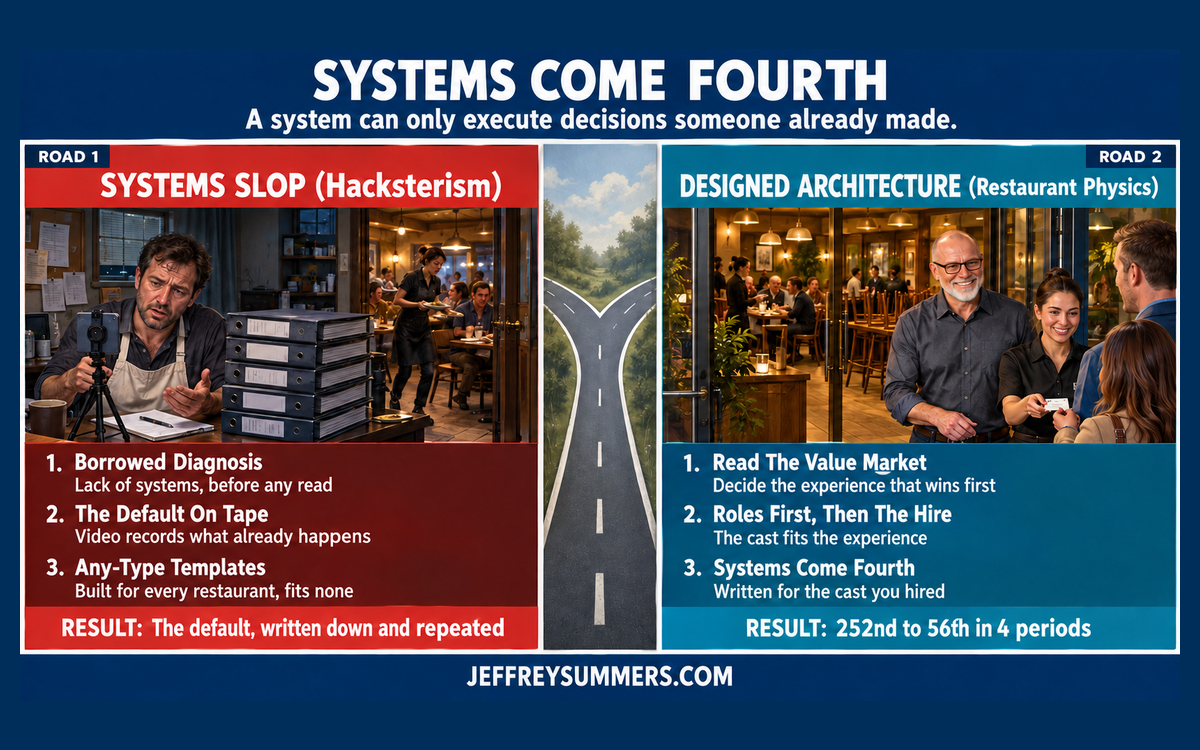
Every operating decision an operation runs sits on one of two roads. Road 1 is the transactional road — buy volume, cut price, chase acquisitions, run promotions, treat the Guest as a customer, treat the operation as a throughput machine. Road 2 is the relational road — build Product, hold price, compound positioning, price for what the moment is worth, treat the Guest as a Guest, treat the operation as a compounding relationship.
The discount reflex is Road 1. The pricing architecture that refuses the discount reflex is Road 2. This is not a rhetorical framing. This is a load-bearing operating distinction. Every operator running Road 1 pricing is building an operation with Road 1 physics — thin margins, borrowed volume, downward Guest composition drift, permission-structure dependence, and the [Static Decline] endpoint the [Road Cancer Family] concludes with. Every operator running Road 2 pricing is building an operation with Road 2 physics — held margins, earned volume, upward Guest composition compounding, positioning capital accumulation, and the operating condition the framework calls [The Guest Contract].
The architecture the physics piece teaches is [Reverse Discounting] as the Road 2 pricing discipline. Every element of the architecture — the base, the bands, the hard floor, the experience-design alternative — reads correctly only in Road 2 framing. Read the architecture through Road 1 and it looks like an expensive way to lose volume. Read the architecture through Road 2 and it becomes the discipline that produces the compounding position every operator claims to be building.
The Value Market Read
The architecture is downstream of a load-bearing read on the [Value Market]. The [Value Market] is not the low-price market. The [Value Market] is the market segment that reads value as the ratio of what they get to what they pay — quality over price, experience over price, moment over price, relationship over price.
The operator who reads the [Value Market] correctly understands that the [Value Market] is not price-sensitive in the way the industry counsel claims. The [Value Market] is value-sensitive. The [Value Market] will pay full price for what they read as full-value. The [Value Market] will not respect an operation that keeps confessing that its own price is wrong. The [Value Market] will move up-band toward operations that hold their pricing and deliver their Product, and away from operations that discount their pricing and dilute their Product.
The pricing architecture is engineered for the [Value Market]. Every element of the architecture — the base, the bands, the experience design, the hard floor — is legible to the [Value Market] Guest. The [Value Market] Guest reads the architecture and reads it correctly: this operation prices for what the moment is worth, this operation delivers what it prices for, this operation does not confess Product failure via discounts.
Revenue Performance
The revenue performance of [Reverse Discounting] versus reactive discounting is not close. The metric that matters is revenue per available seat hour — RevPASH — and the research is clear: operators who hold price and manage demand outperform operators who discount for volume on RevPASH by a wide margin.
Discounting moves seats. It also destroys per-seat economics. Twenty percent off the menu on a slow Tuesday might fill the room, but it fills the room with lower-yield seats, at lower-yield per-Guest spend, at higher-yield operating cost per Guest served (the same labor, the same rent, the same utilities, applied against a lower per-seat revenue). The RevPASH math is a disaster.
[Reverse Discounting] holds the per-seat economics and moves the demand pattern to fit them. The Tuesday prix fixe fills the Tuesday room at Tuesday-appropriate per-seat revenue. The kitchen manager’s tasting fills a slow Wednesday at premium per-seat revenue. The wine pairing evening fills the shoulder hour at upgraded per-seat revenue. Every band pulls in the Guest cohort priced for the band, at revenue that reflects what the moment is worth to the Guest and to the operation.
RevPASH is the metric because RevPASH tells the operator whether the operation is holding its economics as it moves through the demand distribution. Operations that hold RevPASH through the distribution are operations that are running [Reverse Discounting]. Operations whose RevPASH craters at the shoulder are operations that are running the discount reflex.
Failure Modes The Architecture Corrects
[Reverse Discounting] does not just refuse the discount reflex. It structurally corrects the failure modes the discount reflex produces.
-
The reference-price ledger holds. The base price is the base price. The Guest reads it, learns it, and calibrates to it. Reference prices do not collapse because the base offering is never discounted.
-
The [Positioning Capital] ledger compounds. Every moment the operation prices correctly is a moment the operation is telling the market what the operation is worth. Positioning capital accumulates with every held-price cycle.
-
The Guest-composition ledger shifts upward. The bands select for the Guest cohorts appropriate to each moment. The [Value Market] Guest is retained and compounded. The bargain-seeking Customer cohort is not attracted, not retained, and not composed into the operation’s Guest mix.
-
The competitor-signal ledger goes silent. The operation is not competing on price, so competitor discount moves do not require response. The competitor cuts price; the operation runs its Tuesday prix fixe; the competitor’s cut is irrelevant to the operation’s positioning.
-
The internal-team ledger holds. The team sees the operator hold price, deliver Product, and price for the moment. The team’s confidence in the Product compounds. The team’s willingness to sell at full price compounds. The team’s read of what they are building becomes accurate.
-
The loyal-Guest ledger holds. The loyal Guest never sees the operation confess that last month’s full-price purchase was overpriced. The loyal Guest’s read of the operator’s trustworthiness compounds instead of erodes.
None of these corrections require anything beyond running the architecture. The architecture does the work. The operator runs the discipline; the ledgers compound; the operating condition holds.
Everything Is An Investment: The Read Underneath
The architecture reads correctly only when read against the principle that [Everything Is An Investment]. Every operating move is a bet on a future outcome. The discount is a bet — a bet that today’s volume is worth more than tomorrow’s positioning. The bet loses, quarter after quarter, ledger after ledger, and the discounting operator does not read the loss because the loss compounds on ledgers that are not on the P&L.
[Reverse Discounting] is also a bet. The bet is: holding the price today produces stronger positioning, stronger Guest composition, stronger competitive position, and stronger economics tomorrow than discounting produces today. The bet wins, quarter after quarter, on every ledger — the visible ones and the invisible ones — because the physics of the two roads produces the outcomes each road’s physics produces.
The operator who runs [Reverse Discounting] is investing in the operation’s compounding position. The operator who runs the discount reflex is disinvesting from it. There is no third posture. Every pricing decision runs one direction or the other, and the direction determines the operation’s trajectory.
What Changes Tomorrow
The operator running the architecture tomorrow does three things.
First, calculate the base honestly. Plate cost plus [The X Factor], item by item, category by category. Not the ingredient math. The full burden. This is a real number, and until the operator has the number, the operator cannot know where the hard floor is. Every operation the framework has ever assessed has been surprised by how far above their current pricing the honest base actually sits.
Second, identify the bands. Which moments are premium-upside moments the operation is under-pricing? Which moments are standard-band moments that are correctly priced? Which moments are downside-band moments where the operation needs a distinct offering rather than a discount? The band map is the operating map for the next quarter’s pricing decisions.
Third, engineer the downside-band offerings. Not the same menu at a lower price. Distinct offerings. Kitchen manager’s tasting, prix fixe, themed night, wine pairing evening, producer’s table — pick the offerings that fit the operation’s Product identity, the Guest cohort available at the moment, and the operating capability the operation actually has. Design them, price them for what they are worth, and run them.
From the base, the bands, and the engineered downside offerings, the operation runs the pricing architecture. The discount reflex is not modified. It is refused. The refusal is not slogan; it is protocol. The protocol is the architecture the physics piece teaches.
Closing
The pricing architecture that refuses the discount reflex is not a marketing technique. It is not a promotional strategy. It is not a pricing tactic. It is [Reverse Discounting] — the operating discipline that holds the operation’s per-seat economics while moving the demand pattern to fit them.
The architecture is executable. The framework has published the architecture in the Knowledge Base. The operator who wants to run [Reverse Discounting] can read [The X Factor], can read the [Value Market] entry, can read [Two Roads], can read the full [Reverse Discounting] entry, and can begin running the discipline tomorrow. Nothing about the architecture is theoretical. Everything about the architecture has been operator-tested across forty-four years of operating work.
The discount reflex is the confession the paired prosecution piece dismantles. The pricing architecture is what the operator runs instead. Both pieces are load-bearing. The prosecution names the failure; the physics teaches the discipline.
To understand what not to do, as it exists in the wild, go to Hacksterism.
Digging Deeper
Positions on the record:
-
Hacksterism — The Discount Is A Confession — https://hacksterism.jeffreysummers.com/the-discount-is-a-confession
-
Jeffrey Summers — Read Perspective — https://jeffreysummers.com/read/perspective
-
Jeffrey Summers — Read Product — https://jeffreysummers.com/read/product
-
Restaurant Physics — The Wine List As Guest Architecture — https://physics.jeffreysummers.com/the-wine-list-as-guest-architecture
Term definitions from the Knowledge Base:
-
[Reverse Discounting] — https://kb.jeffreysummers.com/reverse-discounting
-
[The X Factor] — https://kb.jeffreysummers.com/the-x-factor
-
[Value Market] — https://kb.jeffreysummers.com/value-market
-
[Two Roads] — https://kb.jeffreysummers.com/two-roads
-
[Hacksterism] — https://kb.jeffreysummers.com/hacksterism
-
[Static Decline] — https://kb.jeffreysummers.com/static-decline
-
[Everything Is An Investment] — https://kb.jeffreysummers.com/everything-is-an-investment
-
[Positioning Capital] — https://kb.jeffreysummers.com/positioning-capital
-
[Guest Ranking Composition] — https://kb.jeffreysummers.com/guest-ranking-composition
-
[Guest Architecture] — https://kb.jeffreysummers.com/guest-architecture
-
[Customer Architecture] — https://kb.jeffreysummers.com/customer-architecture
-
[The Guest Contract] — https://kb.jeffreysummers.com/the-guest-contract
Discover more from Restaurant Physics
Subscribe to get the latest posts sent to your email.