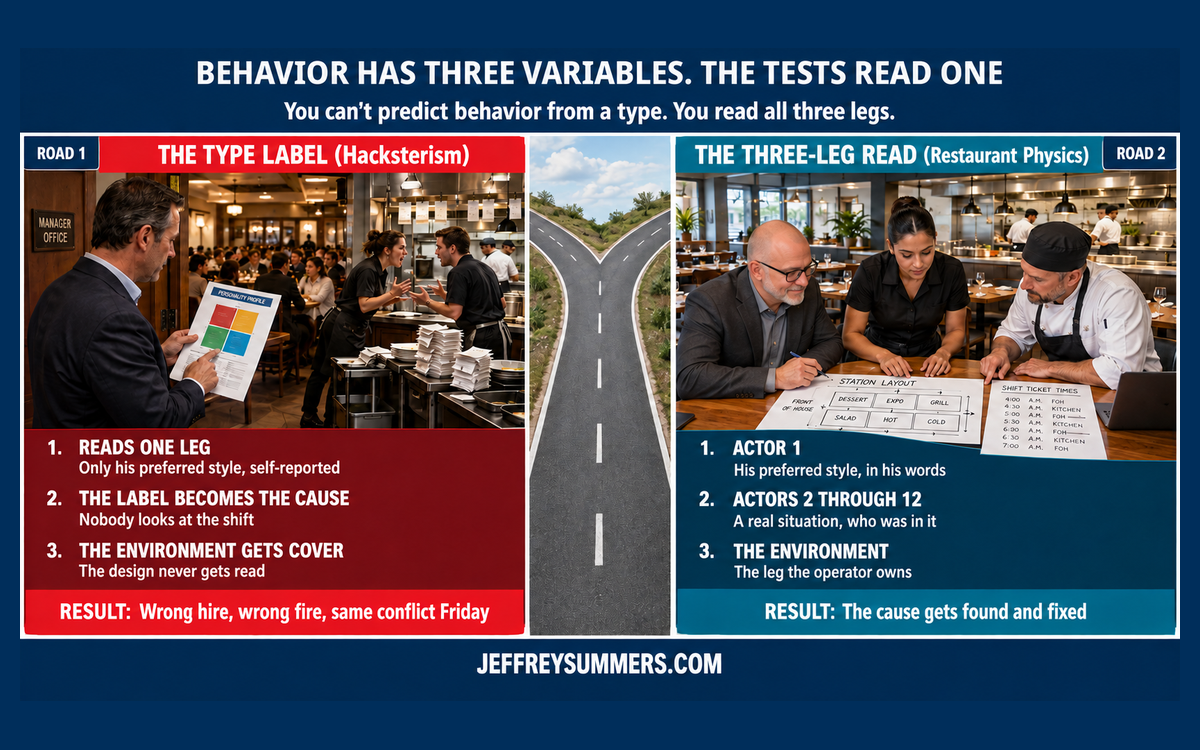

Good employees are not the business, because the employee who does the job well is only the floor the job description buys — and the difference between a building full of good employees and a business that succeeds is what you built above that floor.
Character matters, and I am not going to pretend otherwise — the argument collapses without it, and so does the argument on the other side, the one that blames your people for a design failure that is yours. The mechanism is simpler than either side admits: the role is the contract between character and structure. The role’s outcome defines the demands, character determines whether the individual can answer, and structure determines whether answering is possible and paid. Who it runs on is every independent operation that hired well and still didn’t grow. What it costs is the Lost Opportunity Tax — the revenue and value the operation was structurally capable of producing but did not, because an upstream gap foreclosed the possibility before the opportunity could land. And the industry’s most-quoted counsel, Michael Gerber’s “work on your business, not in your business,” is half of the reason the gap never closes. What is at stake is everything above the floor: the growth of the individual and the business, coupled, at neither’s expense.
The Labor Line Is Behaviorally Agnostic
The entire point of labor is to execute the designed GX/CX. That is why there is a labor line in the first place — the line is what the execution of the designed experience costs, and nothing else. Labor is not a cost of running the building. It is the production instrument of the experience the operation is designed to produce. Hold that, because the number cannot tell you whether the line is doing it.
Start with the hardest evidence, because it is the one the P&L cannot give you. The labor line is behaviorally agnostic. It carries no verdict on whether the number is too high. The number can be right and the line wrong, or the number wrong and the line right, and no report can tell you which is which — because a defaulted labor line is a metric for inputs wearing the costume of a decision.
The only question the number answers is a question about you: did you design your labor line as an investment with a defined return, or did you default to it as simply a metric for inputs? My framework calls that law [The Summers Principle]: every outcome inside the operating domain of the restaurant traces to either design or default. The same number is two different instruments. Designed as an investment, the labor line is a claim about what the operation produces — a wager that the payment above the role’s floor buys an increase in return, not just the trip from A to B. Defaulted as an input metric, the same line is a number managed downward, a cost to contain, and the people inside it are inputs to be optimized. The P&L shows the same dollars either way. It cannot show the difference between a wager and a containment.
And that is where the misread comes from. When the line is defaulted, the visible number stays low — it looks cheap — and the real cost loads somewhere else: turnover, the owner’s hours spent doing cast work, the premium paid to the two or three people who actually carry the read, the compounding that never happened because nobody was paid to compound it. The defaulted line costs less on paper and more in truth. It shows up on the books as “we didn’t grow,” which reads as bad luck, a bad market, a bad year. It is none of those. It is a design failure wearing the weather’s clothes.
That is the [Lost Opportunity Tax], and it is an established term in my framework for exactly this: the revenue and value the operation was structurally capable of producing but did not — because an upstream gap foreclosed the possibility before the opportunity could land. Not a missed sale. A category of sale that could never occur, because the operation lacked the upstream architecture that would have made it possible.
The term’s own example is this piece’s argument: the operator who doesn’t read cast well enough to design roles pays for it in Performance and Profit — and it appears on the books as “we didn’t grow” rather than “we failed to design roles.” The levy is paid where the sale would have appeared, not where it originates. That is what makes it a tax and not a cost: you pay it whether or not you consented, whether or not you noticed, and when the default holds, the entire labor line carries it.
The Two Failure Halves
There are two ways to misread that, and they are mirror images of the same refusal.
The first: hire good people and they will do good work. Character as the whole answer. The design doesn’t matter, because character will compensate for it.
The second: the design was right, but the people just aren’t dedicated. Character as the whole failure. The design is exonerated, because character takes the blame.
Both halves refuse the same thing — the architecture. Both put the verdict on character alone, and my framework refuses exactly that, and only that. Character is load-bearing at exactly one point: casting. Everywhere else, the load is carried by what you built or what you defaulted into.
The hire-good-people half fails because the floor is real. Good character, dropped into a compliance-only role, produces compliance — and the blocks it brought to the door atrophy from disuse. The they’re-just-not-dedicated half fails for the mirror reason: it takes the atrophy as evidence about the person when it is evidence about the container. Neither half ever asks the question the labor line actually answers, because both are convinced they already know.
The Strongest Version Of The Other Side
Before the design argument goes further, it owes the other side its strongest form — not the marketing version, not the failure halves. The strongest honest counter is the one actual operators hold: this is a job. Pay fairly, expect the job, done. Labor is the biggest controllable cost in a thin-margin business, and “investment” beyond the role is a romantic story sold by people who don’t carry the line. The operator who builds above the floor is buying a feeling while his competitor runs lean.
That counter is not wrong about the facts — the restaurant runs, the people are paid, the doors stay open. And the answer to it is not to argue the cost, because arguing the cost is haggling over the price inside a frame where the only question is what the floor costs. “Yes it costs more but it’s worth it” is still cost accounting. The frame is too small to see the subject. Cost thinking is accounting, and accounting never built a better business — it only told you what the one you already have costs.
Accounting tracks how you built it after the fact. The books are the receipt, not the blueprint. Every number on the P&L is a decision someone already made, recorded after it was made — the labor line reads the same in both directions because accounting doesn’t care which way you built it, it just counts what showed up. The operator who reads the P&L looking for the answer is reading last year’s decisions and calling it strategy.
And that is the general law: whoever you hand the design to, you get the business their instrument can see. The accountant’s instrument only sees cost, so every investment reads as an expense with no return — hand an accountant the design and you get the operation his instrument can measure: the cheapest one. The lawyer’s instrument only sees risk, so a business designed by counsel is the operation where nothing can go wrong, which is also the operation where nothing happens — no authority to recover a Guest on the spot, no judgment exercised in the moment, because those are decisions that could be second-guessed later. The operator is the only one whose instrument reads the Guest.
The [Lost Opportunity Tax] is invisible to both instruments by construction — it is an absence, and absences don’t get line items. The steelman is right about the wage line and blind to everything the wage line could have bought. That is the whole separation: the argument does not drive the cost down, it outgrows the frame. The labor line is behaviorally agnostic. The cost frame isn’t.
It Changes The Difficulty, Not The Principle
Every counter to this argument is the same move wearing different clothes: the operator takes his circumstance and substitutes it for the decision, then calls the result inevitable. The thin labor pool doesn’t make casting optional; it makes casting harder. The tight year doesn’t make the [Lost Opportunity Tax] less relevant; it makes it more expensive — the levy compounds through the soft market, it doesn’t pause for it. Circumstance is an input to the design, never a veto on the principle. The operator who fits his circumstances into his tactics gets tactics that only work in the circumstances he is in. The operator who adheres to the principle designs the outcome around the constraint — and the constraint sets the starting position and the pace, never the direction.
The leaky bucket first, because it is the counter every operator reaches for: why develop someone who leaves in six months? I train them, they take the skill down the street, and I have paid to build my competitor’s cast. The industry answers this one with a chestnut that makes the rounds:
CFO to CEO: “What happens if we invest in developing our people and they leave?”
CEO to CFO: “What if we don’t and they stay?”
Me: “What if you invest in developing the wrong people?”
CEO and CFO: “…..uhhhhhh”
Cute word play. And bad strategy — because the chestnut only has two doors, and the two it has are real. Train them and they leave: a bounded loss — one hire’s development, once, over. Don’t train them and they stay: the unbounded cost — the undeveloped cast that stays is the compliance floor walking around, every shift, for as long as they stay, paying the tax on the entire line. But the door the chestnut doesn’t have is the third one: invest in developing the wrong people, and they stay. Development is an instrument that only works on blocks — judgment, agency, care that walked in the door. Spend it on a ceiling that is the floor and the investment cannot land, no matter how well-designed the four conditions are. You pay twice: the development cost, plus the tax on the right development never happening. That is why character carries the verdict at exactly one point. The saw is cast-blind, and so is the operator who runs it.
And a floor person is not a bad hire. The floor needs covering, and someone whose ceiling is the floor covers it honestly. The wrongness is not hiring them — it is spending development dollars above the floor on someone whose ceiling is the floor. The casting question sorts where the dollar goes: the unasked-for improvement is the tell that blocks are present; its absence is the tell that this is a floor hire. No shame in either — it is a different purchase — and the mistake cuts both ways, and both times it is the tax: develop a floor person and you bought development that cannot land. Default a block person and you bought atrophy.
Which produces the red flag every operator can run tonight: look down the schedule and ask how many names carry an unasked-for improvement. If the count is near zero, that is not a hiring report — it is the design verdict already rendered. The blocks in your market exist; they came in the door, saw that judgment had nowhere to land, and left for an operation that spends them. The cast you are looking at is the cast the design could hold. And it pairs with its mirror: the operation where one Joe and maybe two others carry the whole read. All-floor cast on one side, two heroes on the other — the same design showing up in the headcount. The tax presents as a hiring problem in the first and as a hero dependency in the second, and both times the books just say we didn’t grow.
Then the benchmark: my floor is better than the guy’s across the street. He is another scoreboard. The [Lost Opportunity Tax] is measured against what your operation was structurally capable of producing — not against his output — and both of you pay it at your respective sizes. And a better floor is proof the mechanism works: the floor is better because someone designed it that way. That is design you already did — it argues for more of the same, not for stopping at the line. The floor is the copyable part; he can match your wages and your job descriptions in a week. What he cannot copy is what you built above it, because that compounds in your people and your read, and it is not for sale.
Then the counter with the scar tissue: I tried this. Empowerment, team meetings, engagement — I did it, and it fizzled within a month. I have not seen your operation, and I will not pretend to know why your initiative specifically died — anyone who claims to diagnose that from a distance is selling. But the mechanism is the same in every building, and there are no memos in a restaurant: the initiative arrives as a speech at pre-shift, permission granted verbally, once, at lineup, with nothing behind it. A speech is not a structure. The verbal grant gets tested on the first Saturday night — the cast member uses the authority, the room goes sideways, and something structural pulls the authority back: the override in front of everyone, the comp that punishes the extra time, the next schedule quietly cutting the hours of the person who went too far. The fizzle is not the cast rejecting the authority. It is the building never having received it — [The Summers Principle] resolving back to default at the first stress. Saying isn’t installing. The fix is not a better initiative; it is the instruments — the schedule, the role, the comp, the pre-shift question, the story told publicly when someone recovers a Guest. Empowerment that isn’t installed in one of those is a speech, and the shift eats it.
Then the last group of objections, and they go together because they are all the same objection: I don’t have time to design — I’m running a restaurant. That’s for big operations; I have twelve people. Give cast authority and they’ll give away the house or get me sued. Engagement programs are corporate HR nonsense that dies on a Friday rush. None of these are arguments against the design. They are the default speaking in its own defense — the design question already answered by default, in real time, by the operator holding it. No time: the design is the running; the schedule, the roles, and the comp are already being decided every shift, and the only question is whether they are authored or absorbed. Twelve people: twelve roles, twelve designs, already running — there is no headcount at which the forks disappear. Authority risk: authority is already granted — the person standing at the table is the operation in the Guest’s eyes — and the default granted it unbounded. The house is given away by the authority you didn’t design, not the one you did. A default can’t argue for itself; it can only refuse — and each refusal is the fork resolving back to default.
The corporate objection is half right, and it deserves its own answer: the engagement program is corporate thinking. It exists to establish the department that built it, not to develop the cast — a memo designed to be visible to the org chart, which is why it dies on a Friday rush: it was never about the rush. But rejecting the program is rejecting the wrapper and keeping the default. The design is not corporate. It is Hospitality. The four conditions are not imported from HR; they are what the room has always run on when it runs at its best. And that is why the people design is operator work — in a five-unit district or a single independent. The department can hold the paperwork; the read, the conditions, and the story cannot be delegated at any size, because whoever you hand the design to, you get the business their instrument can see. The chain operator who hands the people design to the department gets a cast administered as risks. The one who authors it inside the structure builds a cast inside the same structure the next operator over defaults to.
And the last counter — I will build the above-the-floor work when the business can afford it — has the timing exactly inverted. The design is not a purchase; it is a discipline, and you already run this one. Ideal food cost is not something you buy when the business is flush. It is a number you steer toward from wherever you are, every period, and you never actually arrive at it — that is what makes it a discipline instead of a purchase, and it is why tight months don’t suspend food costing; they make it matter more. The designed operation is the same ideal state. You don’t afford it and you never reach it — you close the gap toward it, period by period, and the closing is the compounding. Deferred discipline is not patience. It is default, wearing the market’s clothes.
And notice what every cost line in the building has in common with that discipline, because the labor line is not special — it is the same fork on every line. Food cost managed by spec and portioning is designed; trimmed by shrinking the portion is defaulted. The one true distinction of labor is that it is the only line that compounds what you spend it on. Squeeze food cost and you save a point, once, this period. Design the labor line and the spend builds capacity that produces again next period without being repurchased: the Guest recovery skill, the read spreading, the decisions being made by more people. Every other cost line is managed down. Labor is the one you manage both directions — contain the floor like any line, build above it like an investment.
And the reason the default is inexcusable rather than just unfortunate: the labor line is the one cost you author by hand, in advance, every shift. Food cost drifts — specs slip, portions wander, waste hides in the middle of execution, and the books tell you after the fact. Labor has no drift. Every hour on the schedule is a decision someone typed. There is no version of the labor line that just happened — which means the schedule is a bet, placed in advance, and the only question is which direction it points. The defaulted operator places it as a hedge: labor as a lagging cost, cut when scared, added when slammed, chasing the sales curve from behind. The designed operator places it as the leading input — betting the labor produces the experience that produces the sales. The sales don’t justify the labor. The labor produces the sales.
And this is where the AI argument lands, because it is an argument about this fork: the machine replaces the trip, and a defaulted business is its trip. The kiosk takes the order, the app runs the paperwork — all of it does A to B, without a wage. Against a position the operator only ever valued as a cost, the machine wins that comparison every time, because the position was run as an order taker and the order taker is all it ever returned. The increase — the reading, the recovery, the recognition — is the only defensible labor, and the machine doesn’t produce any of it. The AI argument wins against a defaulted business and loses against a designed one. The automation is the final audit of the design: whatever the business built above the floor is what the machine can’t touch, and whatever it never built is what walks out with the kiosk. The defaulted operator thinks he is buying labor savings. He is discovering what his labor was worth — the trip, and nothing else.
You Don’t Hire Invested
Now the sharpened version, and it is the one the industry gets wrong in both directions: you do not hire invested. You build it.
When you are hiring, you are looking for building blocks — judgment, agency, care. Those are character terms, and they are the right character terms. What you are not looking for is investment, because investment is not a character trait. It is an output. The four conditions make it possible. The reward architecture pays it. Time compounds it. None of those are things a person brings to the door.
Which means the person you hire carries the capacity, and the operation carries the conditions. And when the conditions are absent — when the role demands only compliance, when the reward pays only the floor — the blocks don’t just sit unused. They atrophy. The judgment goes unexercised, the agency goes unspent, the care goes unrewarded, and the person you were sure was invested becomes exactly as compliant as the design paid for.
That is not a character failure. It is a maintenance failure — the operation failing to maintain what it hired.
The Casting Question
So where does character matter? At casting — and there is a question that reads it: how invested do you become in your work?
But the question is only the door. The answer that matters is not the adjective — invested, dedicated, passionate, all noise. The answer that matters is the story. You are listening for specificity. You are listening for the thing they improved that nobody asked them to improve. That is the evidence. The unasked-for improvement is the tell — it means the building blocks are there, and the person has already spent them somewhere without being paid to.
Adjectives are claims about character. Stories are evidence of it. The candidate who says “I’m really invested in my work” and the candidate who tells you about the thing they fixed on their own initiative, without being asked, in a job that didn’t require it — those are two different hires, and only one of them has the blocks.
Beyond The Paycheck
Now the boundary question, because this is where the argument gets misread: what does “beyond the paycheck” actually mean?
It means beyond the role’s scope. Not beyond compensation. I am not describing unpaid initiative — I would pay for that initiative. What I am describing is a person whose work has outgrown the role’s boundary, whose judgment has exceeded the role’s floor, and whose compensation needs to catch up to that fact, not the reverse. The initiative outgrew the role’s scope; the comp follows. The mistake the industry makes is treating that as a character premium — something you reward if the person is special enough — when it is an operating cost of the designed line, priced in, expected, paid.
This is why the paycheck defines the floor, exactly. The paycheck buys the floor and nothing more. Everything above the floor is built or defaulted. And the building is paid for — not extracted, not hoped for, not begged for. Paid.
The Coupled Loop
Everything above the floor is where growth comes from — and it is growth for both sides, in one coupled loop.
The individual grows because the role demands it: the four conditions create room for judgment, agency and care to actually be spent, and the reward architecture pays the spending. The business grows because the individual’s growth compounds into the operation’s capacity — the Guest recovery skill develops, the read spreads beyond the owner, the operating decisions improve because more people are making them well. Neither grows at the other’s expense. The loop is coupled: the individual’s growth is the business’s growth, and the business’s growth is the room for the individual’s.
The default breaks the loop on both sides at once — which is why the failure reads as a character problem. The person stops growing, the blocks atrophy. The business stops growing, the compounding never starts. Both look like the same event, and they are the same event. The loop didn’t break because someone stopped caring. It broke because the design never built it.
The Wrong Model
The wrong model has two halves, and you have probably been sold both.
The first half is the owner-removal half. Gerber drew the distinction in The E-Myth Revisited — work on your business, not in your business — and it is the most-quoted concept in small business. The instinct is right. The application is wrong. Applied to the independent restaurant, it produces the franchise-prototype answer: an operation designed to run without the owner, which requires designing the cast permanently in, at the lowest possible skill the machine can tolerate. The person behind the counter stops being the product. The product is the machine, and the person is an input to it.
That works for a franchise prototype. It is exactly backwards for an independent. For the independent, the person behind the counter is the product — the Guest experience is the deliverable, and it is produced by people, not by systems around people. The E-Myth’s owner-removal half, applied to an independent restaurant, doesn’t produce an operation that runs without the owner. It produces an operation that runs worse without the owner, with a cast designed not to notice.
The second half is the cast-exhortation half — hire good people and get out of the way. This is the hire-good-people failure wearing management-advice clothes. It takes the owner-removal instinct and applies it to the cast: you don’t develop people, you remove yourself from the equation and let character fill the vacuum. It is the same refusal — the architecture doesn’t matter, character will compensate for it — with the owner’s absence from his own operation offered as the proof of trust.
Both halves produce the same result: a permission structure, a compliance cast, and an owner wondering why the business isn’t growing. The first half designed it that way on purpose. The second half defaulted into it and called it leadership.
On The Business, Not In It
I have already said the sharp version of this on the record, in my own book: “Work on your business, not in it” is the right instinct applied to the wrong model. The goal isn’t an operation that runs without you. It’s an operation where your leadership is so deeply embedded in the culture that it runs the way you would run it — whether you’re on the stage or not. The machine scales by removing the human. The relationship scales by developing more humans who can deliver it.
That is the distinction the wrong model can’t hold. The machine scales by removing the human. The relationship scales by developing more humans. And the independent restaurant is a relationship business, which means the second sentence is the only one that applies to it — which means the cast side of “work on the business” is the actual work, and the owner-removal version of it is the wrong model wearing the right vocabulary.
Cast need to do the same work on the business as they do in the business. In the business is defined by their role: server, bartender, host — the job executed to standard. On the business is the amplification — the work that makes the role more effective at building the business’s success. It means they have a stake in the business’s success beyond their role. It means they’re dedicated. It means they’re invested.
All of that is real, and none of it is character’s to deliver. It is the structure’s to make possible, and the character’s to answer. That is the contract. That is the role.
The Four Conditions
Engagement has four conditions — the Four As — and it takes all four: Autonomy, Authority, Accountability, Adulation. Real voice over their own work. Action without permission. A measurable line from behavior to outcome. Their story told publicly.
Three out of four gets you compliant-but-disengaged cast, and the gap is the reason. You cannot pick three and call it a design. The four conditions are not a menu. They are a permission structure, and a permission structure with a hole in it is still a permission structure — the cast member who has to ask before doing anything meaningful for a Guest has not been given an operation. He has been given a floor with a ceiling on it.
The permission structure produces exactly what it is designed to produce: compliance — the highest [Lost Opportunity Tax] in the business. Because compliance is not cheap. Compliance looks cheap on the P&L and costs more in truth than any designed line ever could, because the compliant cast never compounds, never develops Guest recovery skill, never carries the read beyond the owner — and every one of those absences is a category of sale that could never occur.
Reward Structure Architecture
You do not get contribution by asking for it. You get it by paying for it.
[Reward Structure Architecture] is my framework’s term for the design layer through which every reward in the operation runs, and it is not a soft claim: the business rewards what the reward structure says to reward. A comp structure keyed to shift completion cannot produce cast members who develop Guest recovery skill — it produces cast members who complete shifts. The reward is coherent with completion, not with recovery. The contribution you keep asking for never comes, not because your cast lacks character, but because nobody is paid to produce it. The default runs transactional — it pays in one cycle, while development pays over months, and a structure that can’t see past the cycle cannot pay for the development.
And this is the reward side of the coupled loop. The structure pays the floor and is surprised when the floor is all it gets. It is not surprised. It is answered. Exactly.
The Owner Who Carries The Read
Meanwhile — and this is where the design failure becomes personal — the owner and maybe two others carry the whole read, and everyone else’s security rests on how long and how well they keep figuring it out.
That is not a character premium. That is the operating cost of the defaulted labor line, and it is a cost the model cannot pay forever. The owner who gets tired of carrying it alone makes decisions they were previously unwilling to make — and this is not a character failure either. It is the operating cost exceeding what the model can pay. The decisions that follow are the model’s, not the owner’s: the comp cuts, the role consolidations, the “we’re tightening up” that reads as discipline and is actually exhaustion.
The designed line doesn’t produce this. The designed line distributes the read — it builds cast who can carry it, pays them to carry it, and compounds the carrying over time. The owner’s job on the designed line is to hold the architecture, not to be the architecture. That is the whole difference, and it is the difference between an operation that scales by developing more humans and an operation that runs until the owner can’t.
The Business Still Has To Be Successful
Doing your job well was never the bar. The business still has to be successful — and it works when the people in it are built to make it work, not hired to wait while someone else figures out whether there’s a business to come back to.
The labor line is behaviorally agnostic. The compliance floor is not. Compliance carries the highest [Lost Opportunity Tax] in the business, and the levy is paid across the entire line, not at the point of failure. The defaulted line costs less on paper and more in truth, and the difference is the growth of the individual and the business, coupled, above a floor the design never raised.
That is the verdict, and it is not a character verdict. It is a design verdict. The floor is paid for. Everything above it is yours.
What You Do Monday Morning
Audit your cast against the four conditions — Autonomy, Authority, Accountability, Adulation — and fix the one you’re missing. If Authority is your gap, and it usually is, give one cast member the authority to resolve a Guest complaint on the spot without checking with you. If you catch yourself thinking you don’t trust your cast that much, ask why you hired them.
And at the next hire, ask the casting question: how invested do you become in your work? Then read the story, not the rating. The thing they improved that nobody asked them to improve is the evidence. The adjective is noise.
Digging Deeper
Positions on the record:
The Four As of Employee Engagement
Terms used in this piece: The Summers Principle, Reward Structure Architecture, Lost Opportunity Tax, GX/CX, Four As, Guest recovery. Definitions in the Knowledge Base.
Discover more from Restaurant Physics
Subscribe to get the latest posts sent to your email.